
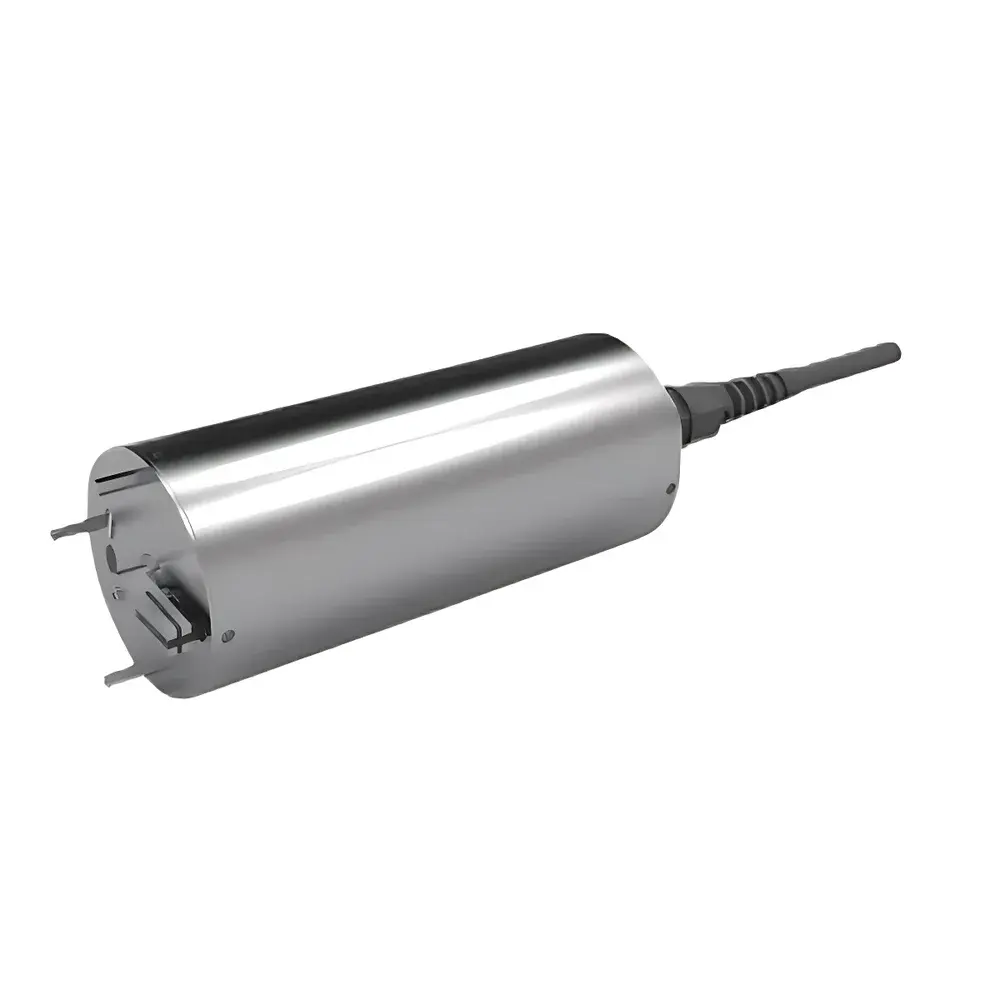
Zming Environmental HQ10-TUR-HT Online High-Range Turbidimeter
| Brand | Zming Environmental Technology Co., Ltd. |
|---|---|
| Origin | Shanghai, China |
| Model | HQ10-TUR-HT |
| Product Type | Online |
| Measurement Range | 0–3000 NTU |
| Resolution | 0.01 NTU |
| Operating Temperature | 5–40 °C |
| Accuracy | ≤5% |
| Enclosure Material | 316L Stainless Steel |
| IP Rating | IP68 |
| Output Interface | RS-485 (MODBUS RTU) & 4–20 mA |
| Power Supply | 12–24 VDC, 0.5 A |
| Submersion Depth | Up to 5 m |
| Cable Length | 5 m (standard) |
| Dimensions | Ø54 × 165 mm |
Overview
The Zming Environmental HQ10-TUR-HT Online High-Range Turbidimeter is an industrial-grade optical sensor engineered for continuous, real-time turbidity monitoring in demanding water and wastewater applications. It operates on the principle of nephelometry—specifically, 90° infrared light scattering—as defined by ISO 7027:2016. A near-infrared LED (typically 850 nm) emits collimated light into the sample stream; suspended particles scatter photons orthogonally, and a high-stability photodiode positioned at precisely 90° detects the scattered intensity. This geometry minimizes interference from sample coloration and absorbance, enabling robust performance in colored or highly variable matrices such as primary clarifier effluent, industrial process water, or reclaimed water distribution systems. The instrument’s extended 0–3000 NTU range supports both low-turbidity drinking water compliance verification and high-solids industrial discharge monitoring without range switching or manual intervention.
Key Features
- ISO 7027-compliant 90° infrared nephelometric detection with 850 nm LED source for minimized chromatic interference
- Dual-output analog and digital interfaces: isolated 4–20 mA current loop and RS-485 serial port supporting MODBUS RTU full-duplex protocol
- Galvanically isolated power supply and signal outputs—designed to meet IEC 61000-4 immunity requirements for industrial environments
- EMC-hardened circuitry including surge protection (IEC 61000-4-5 Level 3), ESD suppression (IEC 61000-4-2 ±8 kV contact), and RF field resilience (IEC 61000-4-3)
- IP68-rated 316L stainless steel housing with standard 3/4″ NPT threaded process connection—suitable for submersible or flow-cell mounting
- Integrated mechanical self-cleaning system featuring a motor-driven rotating scraper blade that periodically clears the optical window surface
- Onboard Pt1000 temperature sensor coupled with dynamic thermal compensation algorithms to correct for refractive index drift across 5–40 °C operating range
Sample Compatibility & Compliance
The HQ10-TUR-HT is validated for use with potable water, surface water, activated sludge mixed liquor, digester supernatant, and industrial cooling water—provided sample velocity remains within laminar-to-moderate turbulent flow conditions (Re < 5,000). Its optical design accommodates particulate distributions typical of municipal and industrial effluents, including clay, silt, algae, and bioflocs. The device complies with ISO 7027:2016 for measurement methodology and meets key regulatory reference points for EPA Method 180.1 and ASTM D6508–22 (Standard Practice for Online Turbidity Monitoring). While not intrinsically certified for hazardous locations, its isolation architecture supports integration into SIL2-capable safety instrumented systems when deployed with appropriate barrier modules. Calibration traceability follows NIST-traceable standards via factory-certified reference suspensions (Formazin or AMCO AEPA-1 equivalents).
Software & Data Management
The HQ10-TUR-HT operates as a standalone sensor but integrates natively into SCADA, DCS, and PLC platforms via MODBUS RTU register mapping—including real-time turbidity (holding register 40001), temperature (40002), status flags (40003), and diagnostic codes (40004–40007). Optional configuration software (Zming ConfigTool v3.x, Windows-based) enables local setup of damping time, zero/span calibration, alarm thresholds (high/low), and self-clean cycle frequency. All configuration changes are logged with timestamp and user ID; audit trails support GLP/GMP-aligned data integrity requirements. The 4–20 mA output is linearly scaled and optionally configurable for split-range operation (e.g., 4–12 mA = 0–1000 NTU; 12–20 mA = 1000–3000 NTU). No cloud connectivity or proprietary firmware updates are required—firmware resides in write-protected flash memory and retains settings through power loss.
Applications
- Continuous turbidity surveillance at drinking water treatment plant final filters and clearwells
- Real-time monitoring of sedimentation basin overflow and clarifier performance
- Effluent compliance tracking for municipal wastewater treatment plants under NPDES permit conditions
- Process control in membrane filtration systems—detecting breakthrough events before SDI escalation
- Industrial pretreatment monitoring for textile, food & beverage, and pharmaceutical facilities discharging to POTWs
- Sludge blanket level estimation in secondary clarifiers using calibrated high-range correlation models
FAQ
Does the HQ10-TUR-HT require periodic recalibration?
Yes—routine calibration is recommended every 30 days for critical compliance applications, or per site-specific QA/QC protocols. Zero calibration uses deionized water; span calibration employs certified Formazin or polymer-based standards traceable to NIST.
Can it be installed directly in open-channel flow?
No—this sensor requires either pressurized flow-cell installation or submerged mounting in a stilling well or bypass chamber. Direct open-channel deployment introduces uncontrolled flow dynamics and air entrainment that compromise scattering geometry.
Is the self-cleaning system programmable?
Yes—the cleaning interval (default: 2 hours) and duration (default: 15 seconds) are adjustable via MODBUS registers or Zming ConfigTool, allowing optimization for fouling-prone environments.
What is the maximum allowable pressure during flow-cell installation?
The sensor body is rated for continuous operation up to 6 bar (87 psi) at 25 °C; pressure derating applies above 30 °C per ASME B31.4 guidelines.
Does it support FDA 21 CFR Part 11 compliance?
The device itself does not implement electronic signatures or audit trail encryption—but when integrated into validated SCADA systems with Part 11–compliant historian layers (e.g., Ignition SCADA with Vault module), it contributes to compliant data acquisition workflows.




