
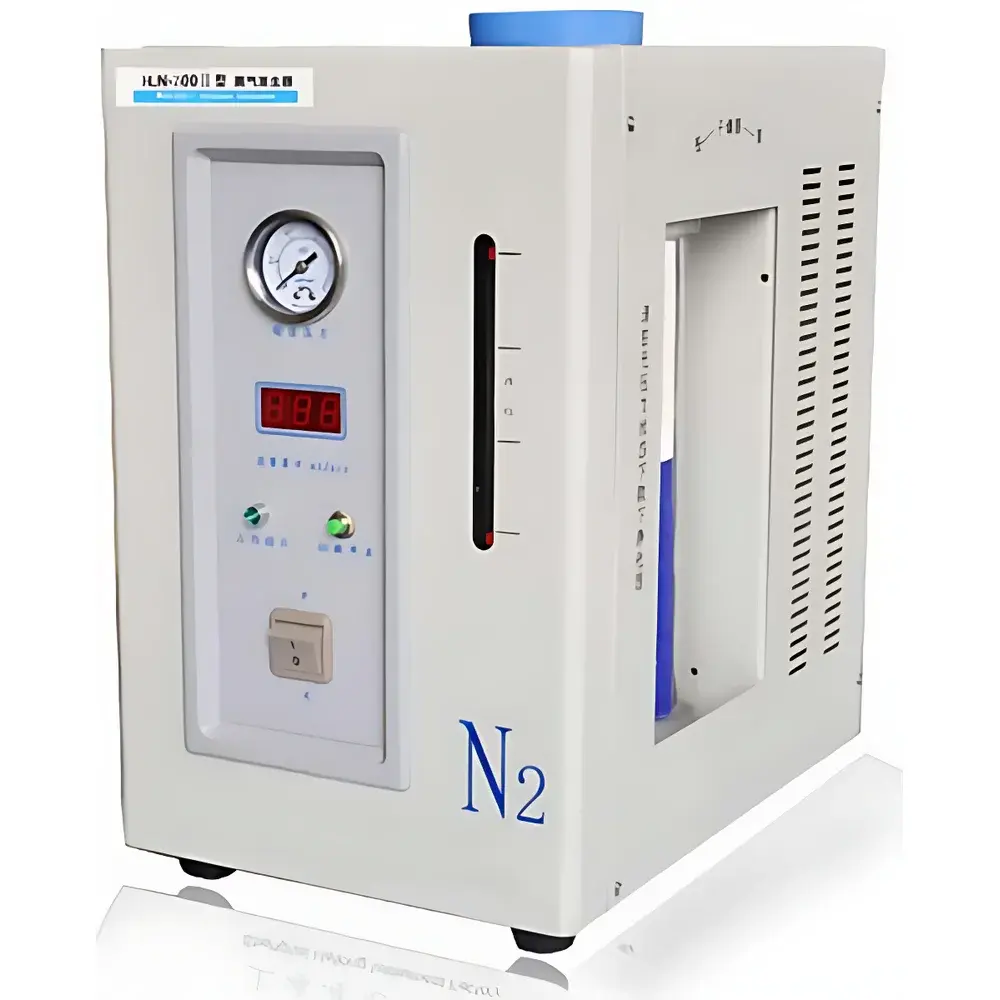
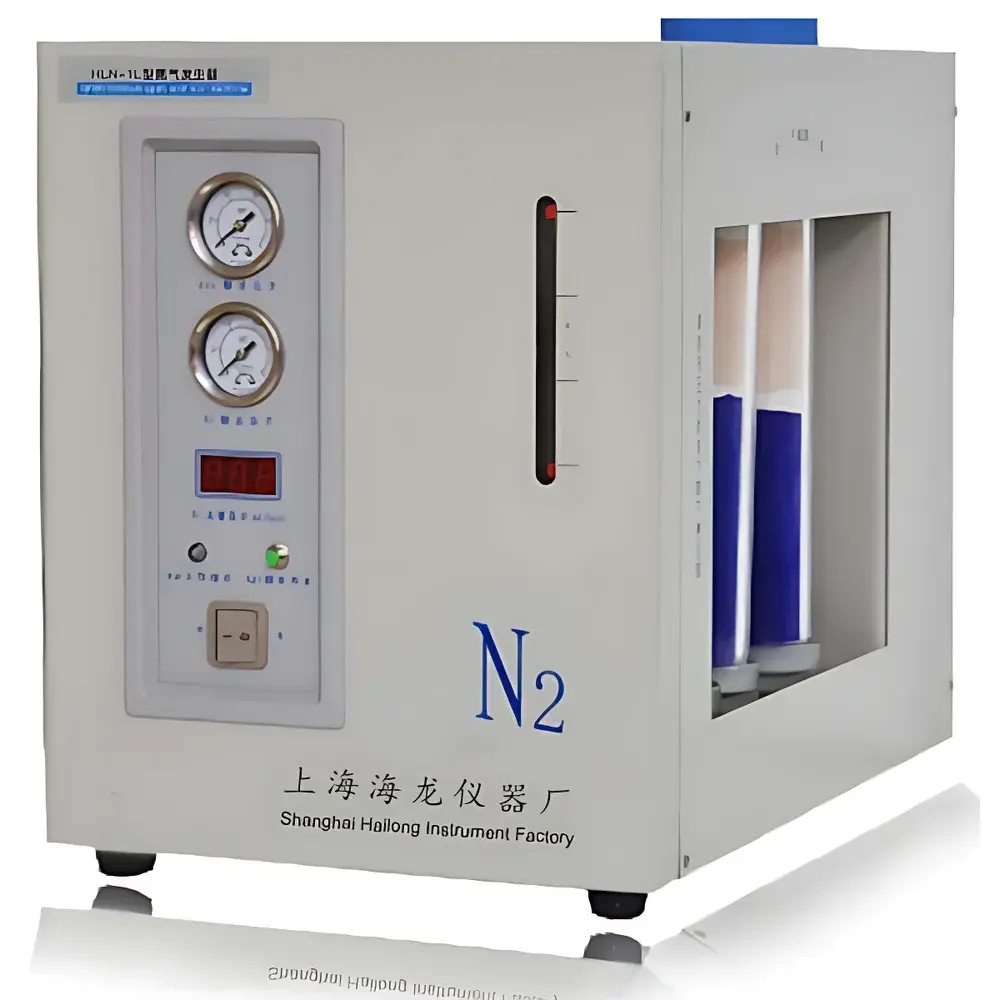
Haolong HLN-300II / HLN-500II / HLN-700II / HLN-1L Electrolytic Nitrogen Generator
| Brand | Haolong |
|---|---|
| Origin | Shanghai, China |
| Model | HLN-300II, HLN-500II, HLN-700II, HLN-1L |
| Nitrogen Generation Principle | Electrolysis of ultra-pure water |
| Output Flow Rate | 0–300 mL/min, 0–500 mL/min, 0–700 mL/min, 0–1 L/min |
| Output Pressure | 0–0.5 MPa (factory-set at 0.4 MPa) |
| Nitrogen Purity | ≥99.997% |
| Dew Point | –10 to –40 °C |
| Power Supply | 220 V ±10%, 50 Hz ±5% |
| Max. Power Consumption | 80 W (HLN-300II), 120 W (HLN-500II/700II), 185 W (HLN-1L) |
| Operating Ambient | 10–40 °C, RH ≤85%, non-corrosive, low-dust environment |
| Dimensions | 320 × 220 × 370 mm (HLN-300II/500II/700II), 490 × 300 × 380 mm (HLN-1L) |
| Weight | 15 kg (HLN-300II/500II/700II), 30 kg (HLN-1L) |
Overview
The Haolong HLN Series Electrolytic Nitrogen Generators are compact, on-demand laboratory-grade nitrogen sources engineered for precision analytical applications requiring high-purity, oil-free, and moisture-controlled N₂ gas. Unlike pressure swing adsorption (PSA) or membrane-based systems, the HLN series employs a proprietary dual-cathode stainless steel electrolytic cell to split ultra-pure water (≥18.2 MΩ·cm resistivity) into hydrogen and oxygen, with nitrogen selectively extracted from ambient air via a catalytic oxygen-removal stage — effectively delivering nitrogen with ≥99.997% purity (≤30 ppm O₂, ≤10 ppm H₂O) without compressed air feed or carbon molecular sieves. This electrolytic + catalytic hybrid architecture eliminates hydrocarbon contamination risk and ensures consistent gas quality across variable flow demands — critical for GC carrier gas, LC-MS purge gas, glovebox inerting, and sample preparation environments where trace oxygen or moisture compromises assay integrity.
Key Features
- Dual-cathode stainless steel electrolytic cell with enhanced surface area and optimized thermal management — maintains stable cell temperature (<45 °C) during continuous operation, minimizing electrolyte degradation and extending service life.
- Integrated anti-backflow liquid trap and check-valve assembly — prevents electrolyte migration into downstream lines under pressure transients or power interruption.
- Automatic gas-line shutoff circuit — de-energizes solenoid valves within 1.2 seconds of power loss or system instability, safeguarding connected instrumentation (e.g., GC inlets, mass spectrometer sources).
- High-efficiency switch-mode power supply — delivers precise current regulation to the electrolytic stack, improving energy conversion efficiency by >18% versus linear supplies and reducing thermal load on internal components.
- Modular design with standardized fittings (¼″ BSP male) — enables rapid integration into existing lab gas networks; compatible with standard CGA-675 or DIN 477-1 regulators and stainless steel tubing.
- Front-panel digital display with real-time monitoring of output pressure, flow rate (via calibrated rotameter), and system status indicators (ready, alarm, maintenance due).
Sample Compatibility & Compliance
The HLN series is designed for use with ultra-pure deionized water (resistivity ≥18.2 MΩ·cm, TOC <5 ppb) supplied via external reservoir or integrated recirculating deionizer (optional). It complies with ISO 8573-1:2010 Class 1.2.1 for compressed gases (particle, water, oil content) when operated within specified ambient conditions (10–40 °C, RH ≤85%). While not certified to FDA 21 CFR Part 11, its analog control architecture supports GLP/GMP workflows through manual logbook documentation; optional RS-232/USB interface (firmware v2.3+) enables timestamped data export for audit-ready records. The system meets IEC 61010-1 safety requirements for laboratory electrical equipment and carries CE marking for EMC and low-voltage directive compliance.
Software & Data Management
The base HLN models operate via embedded microcontroller logic without proprietary software dependencies. For laboratories requiring traceable gas delivery logs, the optional HLN-DataLink module (sold separately) provides serial communication (RS-232 or USB-CDC) to export time-stamped parameters — including cumulative runtime, total gas volume delivered, pressure deviation events, and maintenance alerts — into CSV or XML format. These logs align with ISO/IEC 17025 clause 7.7 (result reporting) and support internal calibration verification per ASTM D6364-22 Annex A1. No cloud connectivity or remote access is implemented — all data remains local to preserve network security and instrument autonomy.
Applications
- Gas chromatography (GC) carrier and detector make-up gas — especially for ECD, TCD, and FID systems requiring ultra-low oxygen and moisture.
- LC-MS and GC-MS solvent purge and nebulizer gas — preventing oxidation of sensitive analytes and reducing background chemical noise.
- Inert atmosphere generation for gloveboxes, reaction vessels, and sample storage cabinets — maintaining O₂ <10 ppm and dew point ≤–40 °C.
- Blank gas for FTIR, Raman, and XRD sample chambers — eliminating atmospheric interference in spectral baselines.
- Calibration gas dilution systems requiring stable, repeatable N₂ flow across multiple analytical platforms.
FAQ
What type of water must be used with the HLN generator?
Only Type I ultrapure water (ASTM D1193, resistivity ≥18.2 MΩ·cm at 25 °C, TOC <5 ppb) is acceptable. Tap, distilled, or RO water will cause rapid electrode fouling and irreversible cell damage.
Can the HLN series replace liquid nitrogen dewars in cryogenic applications?
No. The HLN delivers gaseous nitrogen at ambient temperature and ≤0.5 MPa pressure; it is not designed for cryogenic liquefaction or sub-zero cooling.
How often does the electrolytic cell require maintenance?
Under continuous operation with compliant water quality, the dual-cathode cell typically requires inspection every 12 months and replacement every 24–36 months. Visual electrolyte level checks should be performed weekly.
Is the nitrogen output suitable for USP or EP 2.5.27 testing?
Yes — the ≥99.997% purity, –40 °C dew point, and absence of hydrocarbons meet the specifications for “Nitrogen for Pharmaceutical Use” as defined in both monographs, provided water feed and ambient conditions remain within stated limits.
Does the HLN-1L model support simultaneous supply to multiple GC instruments?
Yes — with proper pressure regulation and flow splitting (e.g., using calibrated needle valves or mass flow controllers), the HLN-1L can serve up to three mid-range GC systems operating at ≤300 mL/min each, assuming total demand stays within 1 L/min and line pressure drop is compensated.
Related Products



