
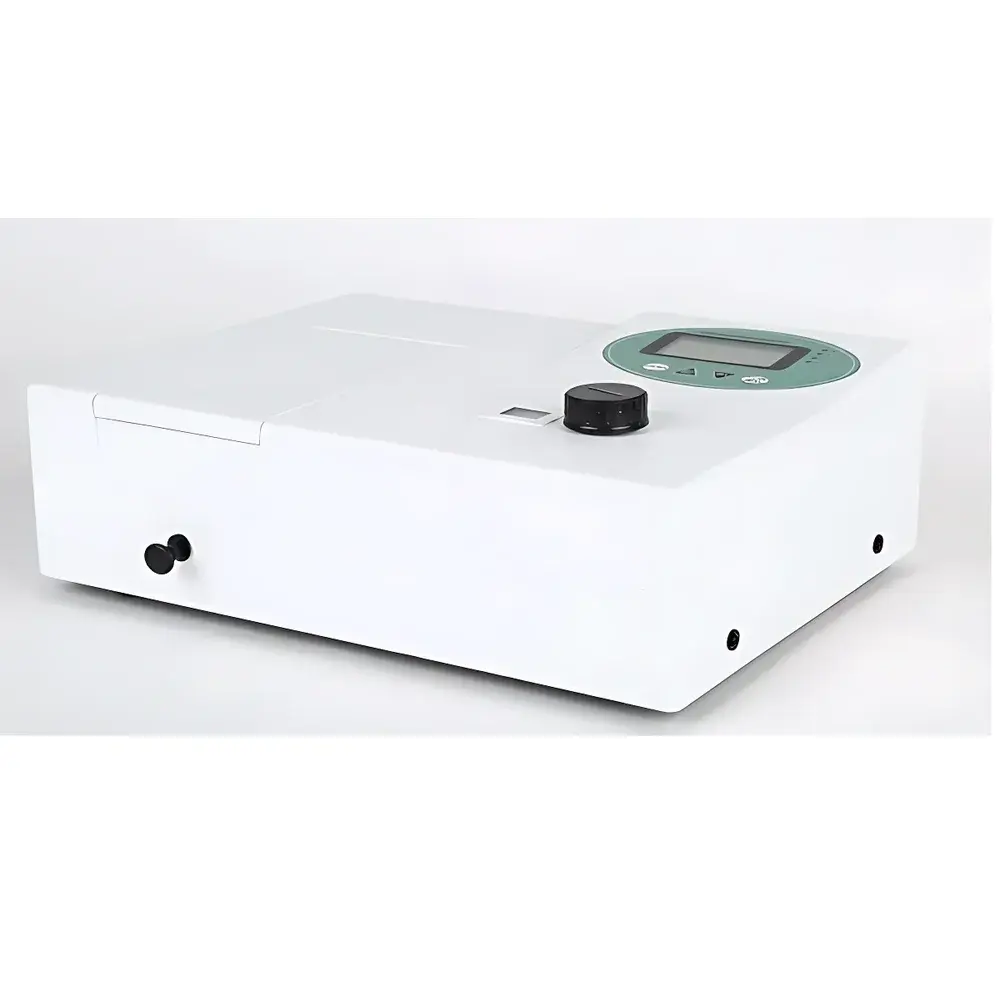
Hailong UV-Vis Spectrophotometer Series 721 / 721N / X1
| Brand | Hailong |
|---|---|
| Origin | Shanghai, China |
| Model | 721 / 721N / X1 |
| Wavelength Range | 325–1000 nm |
| Spectral Bandwidth | 4–5 nm |
| Wavelength Accuracy | ±2–±3 nm |
| Stray Light | ≤0.2% T @ 360 nm |
| Photometric Accuracy | ±0.5% T |
| Photometric Repeatability | ≤0.2% T |
| Stability | ±0.002 A/h @ 500 nm |
| Detector Type | Photomultiplier Tube (PMT) |
| Optical System | Self-collimating monochromator with 1200 lines/mm grating |
| Light Source | Imported tungsten-halogen lamp |
| Measurement Modes | Transmittance (T), Absorbance (A), Concentration (C), Factor (F) |
| Sample Chamber | Accommodates cuvettes from 5 mm to 50 mm pathlength |
| Dimensions | 400 × 310 × 160 mm |
| Weight | 6 kg |
Overview
The Hailong UV-Vis Spectrophotometer Series 721 / 721N / X1 is a benchtop double-beam-equivalent visible spectrophotometer engineered for routine quantitative and qualitative analysis in educational laboratories, quality control environments, and industrial R&D settings. Operating on the principle of Beer–Lambert law-based absorption spectroscopy, the instrument measures light attenuation across the visible and near-UV spectrum (325–1000 nm) to determine analyte concentration, purity, or reaction kinetics. Its self-collimating monochromator—equipped with a high-efficiency 1200 lines/mm diffraction grating—and thermally stabilized imported tungsten-halogen lamp deliver consistent spectral output and reliable baseline stability. Designed for robustness and operational simplicity, the series supports fixed-wavelength photometry, single-point calibration (C-mode), and linear calibration via slope-intercept equations (F-mode), making it suitable for standardized methods compliant with ISO 6425, ASTM E275, and USP for visible absorbance measurements.
Key Features
- High-fidelity optical architecture featuring a precision 1200 lines/mm grating and low-noise photomultiplier tube (PMT) detector for enhanced signal-to-noise ratio and photometric linearity.
- Automated zero-adjustment (0% T) and full-scale calibration (100% T) functions reduce operator dependency and improve inter-user reproducibility.
- Wide sample compartment accommodating standard rectangular cuvettes with optical path lengths from 5 mm to 50 mm—compatible with both microvolume and macro-volume applications.
- Microprocessor-controlled wavelength scanning and data acquisition enable intuitive navigation, real-time display of transmittance/absorbance values, and immediate mode switching between T, A, C, and F functions.
- Compact footprint (400 × 310 × 160 mm) and lightweight design (6 kg) facilitate relocation between teaching labs, production floors, and field-deployable testing stations without requiring recalibration.
- Thermally stable tungsten-halogen light source ensures minimal spectral drift over extended operation, supporting compliance with GLP documentation requirements for instrument performance verification.
Sample Compatibility & Compliance
The 721 / 721N / X1 series accepts standard quartz, glass, or plastic cuvettes meeting ISO 10917 specifications for dimensional tolerance and optical clarity. It is validated for use with aqueous, organic, and mildly corrosive solutions when paired with appropriate cell materials. The instrument meets essential performance criteria outlined in ISO 8575 (spectrophotometers — general requirements) and ASTM E380 (standard practice for use of the International System of Units). While not designed for regulatory-grade GMP environments requiring 21 CFR Part 11-compliant audit trails, its manual calibration logs, stable baseline performance (±0.002 A/h @ 500 nm), and traceable wavelength accuracy (±2–3 nm) support internal QA/QC workflows aligned with ISO/IEC 17025 clause 5.5.2 for equipment verification.
Software & Data Management
This analog-digital hybrid spectrophotometer operates via front-panel keypad interface without proprietary PC software. All measurement data—including absorbance, transmittance, concentration, and factor-derived results—are displayed in real time on a high-contrast LED screen. Users may manually record readings or integrate external digital loggers via RS-232 serial output (optional accessory). Though lacking built-in data storage or spectral scanning export, the device supports method documentation through standardized operating procedures (SOPs) that reference its fixed-wavelength repeatability (≤1 nm) and photometric consistency (≤0.2% T), facilitating alignment with laboratory information management systems (LIMS) during manual data entry workflows.
Applications
- Educational instruction in analytical chemistry: demonstration of Beer’s law, calibration curve construction, and spectrophotometric titration principles.
- Industrial QC for dye concentration monitoring, pharmaceutical excipient assay, and water quality parameters (e.g., nitrate, phosphate via colorimetric reagents).
- Food and beverage testing: determination of color indices (e.g., AOAC 971.22), antioxidant capacity (FRAP assay), and enzymatic reaction rates.
- Environmental analysis: quantification of heavy metals (e.g., Cr(VI) as diphenylcarbazide complex) and organic pollutants using standardized APHA or EPA-approved colorimetric protocols.
- Materials science: characterization of thin-film transmittance and pigment dispersion homogeneity in coatings and inks.
FAQ
What wavelength range does the Hailong 721 series cover?
The X1 model operates from 325 nm to 1000 nm; the 721 and 721N models cover 360–1000 nm and 325–1000 nm respectively.
Is this instrument compliant with FDA 21 CFR Part 11?
No—this is a standalone hardware-only spectrophotometer without electronic audit trail, user authentication, or secure data archiving capabilities required under Part 11.
Can I use plastic cuvettes with this instrument?
Yes, for wavelengths above 350 nm; however, quartz or high-quality optical glass cuvettes are recommended for measurements below 350 nm or for long-term precision work.
Does the device support kinetic or spectral scanning modes?
No—this series performs fixed-wavelength measurements only and does not offer continuous scanning or time-resolved acquisition.
How often should I verify wavelength accuracy?
We recommend quarterly verification using NIST-traceable holmium oxide or didymium filters, especially prior to critical calibration runs or after mechanical transport.
Related Products




