
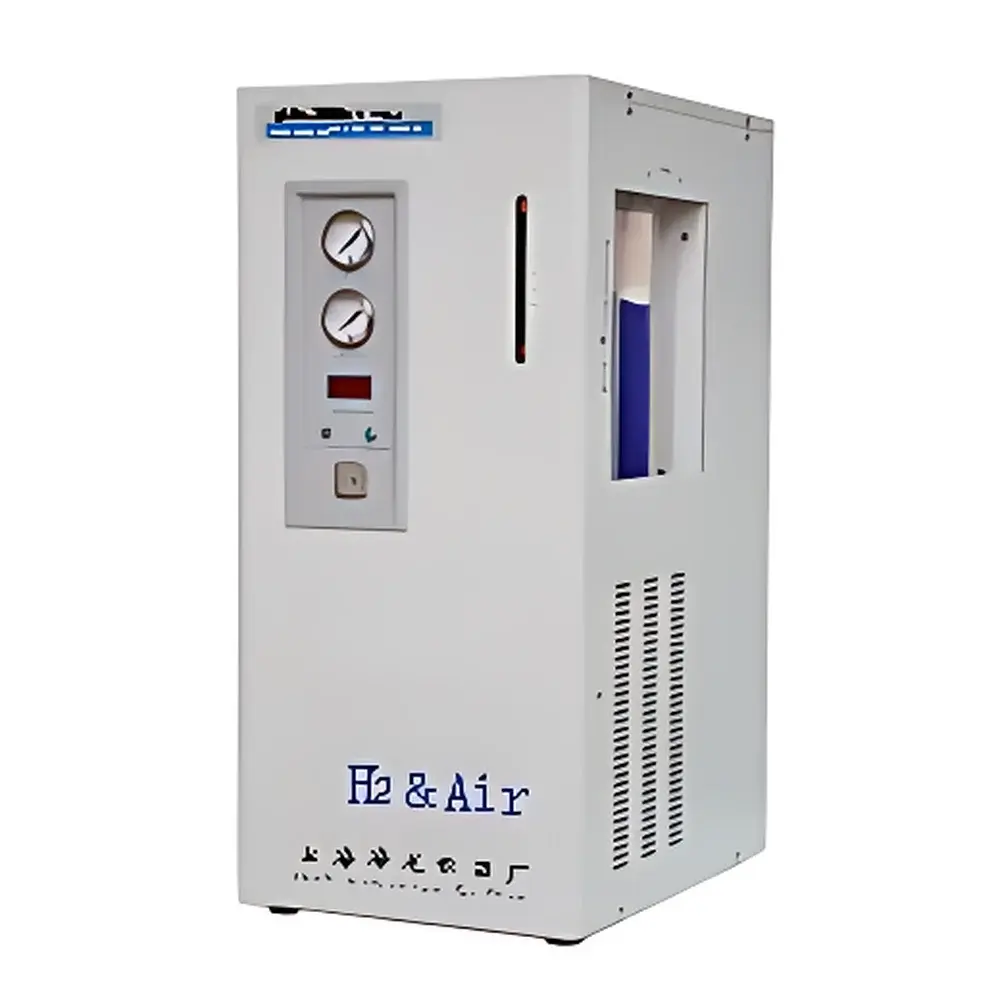
Hydrogen-Air Integrated Generator HLHA-300G (Oil-Free Compressor Type)
| Brand | Hailong |
|---|---|
| Origin | Shanghai, China |
| Model | HLHA-300G |
| Hydrogen Purity | 99.999% |
| H₂ Flow Rate | 0–300 mL/min |
| H₂ Output Pressure | 0–0.4 MPa (factory-set at 0.3 MPa) |
| Air Flow Rate | 0–2000 mL/min |
| Air Output Pressure | 0–0.5 MPa |
| Air Hydrocarbon Content (output) | <0.1 ppm |
| Max. Input Air Hydrocarbon Content | <100 ppm |
| Pressure Stability Accuracy | <0.0001 MPa |
| Max. Power Consumption | 300 W |
| Operating Temperature | 0–40 °C |
| Operating Humidity | <85% RH |
| Warranty | 1-year full unit, 3-year electrolyzer |
Overview
The Hailong HLHA-300G Hydrogen-Air Integrated Generator is an engineered solution for laboratories requiring concurrent, on-demand supply of high-purity hydrogen and instrument-grade compressed air—both generated in a single, compact footprint. Unlike traditional gas cylinder systems, this integrated generator employs membrane-separated alkaline electrolysis for hydrogen production and a dedicated oil-free diaphragm compressor with multi-stage pressure regulation and filtration for air generation. The system operates on the principle of water electrolysis (2H₂O → 2H₂ + O₂), with proprietary cylindrical electrolyzer architecture enabling stable, low-maintenance H₂ output. Simultaneously, the air path integrates dual-stage pressure stabilization and triple-stage filtration—including activated carbon, molecular sieve, and sub-micron particulate filters—to ensure hydrocarbon removal to <0.1 ppm, meeting stringent requirements for GC-FID, GC-TCD, and other detector applications where baseline stability and oxidation resistance are critical.
Key Features
- Cylindrical alkaline electrolyzer design with automatic anti-alkaline-backflow protection, eliminating risk of electrolyte migration into gas lines and extending service life beyond 5,000 operational hours.
- Dual independent gas conditioning paths: hydrogen stream features three-stage purification (particulate, moisture, trace metal scavenging); air stream incorporates two-stage pressure regulation and three-stage filtration (coalescing, activated carbon, and 0.01 µm final filter).
- Real-time pressure stability control with <0.0001 MPa deviation tolerance—engineered to maintain consistent backpressure for sensitive detectors and capillary columns.
- Oil-free, brushless diaphragm compressor ensures zero hydrocarbon contamination and eliminates lubricant degradation risks common in rotary vane or piston compressors.
- Integrated safety architecture includes over-pressure relief valves on both H₂ and air circuits, thermal cut-off at 65 °C, and automatic shutdown upon flow interruption or electrolyte level anomaly.
- Front-panel digital interface with LED indicators for H₂ pressure, air pressure, electrolyzer temperature, and system status—enabling rapid visual verification without software dependency.
Sample Compatibility & Compliance
The HLHA-300G is validated for continuous operation with gas chromatography systems requiring carrier gas (H₂) and detector support gas (air), including flame ionization (FID), thermal conductivity (TCD), and electron capture (ECD) detectors. Its hydrogen purity (99.999%) complies with ASTM D7165 and ISO 8573-1 Class 1 for gaseous impurities (total hydrocarbons ≤ 0.1 ppm, O₂ ≤ 1 ppm, H₂O ≤ 1 ppm dew point). Air output meets ISO 8573-1 Class 2 for particulates and Class 1 for hydrocarbons—suitable for GLP/GMP-regulated environments. While not certified to UL/CE for hazardous area installation, the unit conforms to IEC 61010-1 safety standards for laboratory electrical equipment and supports audit-ready documentation for FDA 21 CFR Part 11–aligned data integrity workflows when paired with optional logging modules.
Software & Data Management
The HLHA-300G operates as a standalone hardware platform with no mandatory software dependency. However, optional RS-232 or analog 0–5 V output interfaces enable integration with laboratory information management systems (LIMS) or building monitoring platforms for remote status telemetry (pressure, temperature, runtime). All operational parameters—including cumulative electrolyzer hours, total H₂ volume generated, and fault event logs—are stored in non-volatile memory and retrievable via serial command protocol. Audit trails comply with ALCOA+ principles when logged externally; internal memory retains ≥10,000 event records with timestamp resolution of ±1 second. No cloud connectivity or proprietary drivers are required—ensuring compatibility with legacy GC control systems and air-gas management networks.
Applications
- Carrier gas supply for capillary GC analysis using hydrogen—reducing analysis time by up to 40% versus helium while maintaining resolution in volatile organic compound (VOC) profiling.
- FID make-up and detector air source in environmental, petrochemical, and pharmaceutical QC labs—eliminating cylinder logistics and associated calibration drift from variable inlet pressure.
- On-site hydrogen generation for fuel cell research test benches requiring stable, low-carbon feedstock gas with trace-level impurity control.
- Replacement for high-pressure H₂ cylinders and oil-lubricated air compressors in regulated QA/QC labs seeking reduced operational risk, lower TCO, and improved space utilization (unit dimensions: 360 × 280 × 520 mm).
- Support gas for portable GC-MS field deployments where weight, footprint, and safety certification constraints preclude cylinder-based solutions.
FAQ
What maintenance intervals are recommended for the HLHA-300G?
The electrolyzer requires deionized water replenishment every 7–10 days under continuous operation; the air filter cartridge should be replaced every 6 months or after 2,000 operating hours—whichever occurs first. No scheduled electrolyte replacement is needed due to sealed, non-consumable electrolyte formulation.
Can the hydrogen and air outputs be used simultaneously at maximum flow rates?
Yes—the system is thermally and electrically rated for concurrent H₂ at 300 mL/min and air at 2000 mL/min without derating, provided ambient temperature remains ≤35 °C and ventilation exceeds 0.5 m³/min.
Is the unit compatible with GC systems requiring 0.5 MPa hydrogen pressure?
No—the maximum H₂ output pressure is 0.4 MPa; users requiring higher pressure must integrate an external booster or select a different model. The factory default setting of 0.3 MPa aligns with standard FID and packed-column GC configurations.
Does the generator meet ISO 8573-1 Class 0 for oil content?
Yes—being oil-free by design, it achieves Class 0 for oil aerosol and vapor (≤0.01 mg/m³), verified per ISO 8573-2:2019 testing protocols using online GC-FID hydrocarbon detection.
What documentation is provided for regulatory submissions?
Factory calibration certificates (traceable to NIST standards), CE Declaration of Conformity (IEC 61010-1), RoHS compliance statement, and detailed maintenance log templates are included. Optional IQ/OQ protocol packages are available upon request for GxP validation.



