
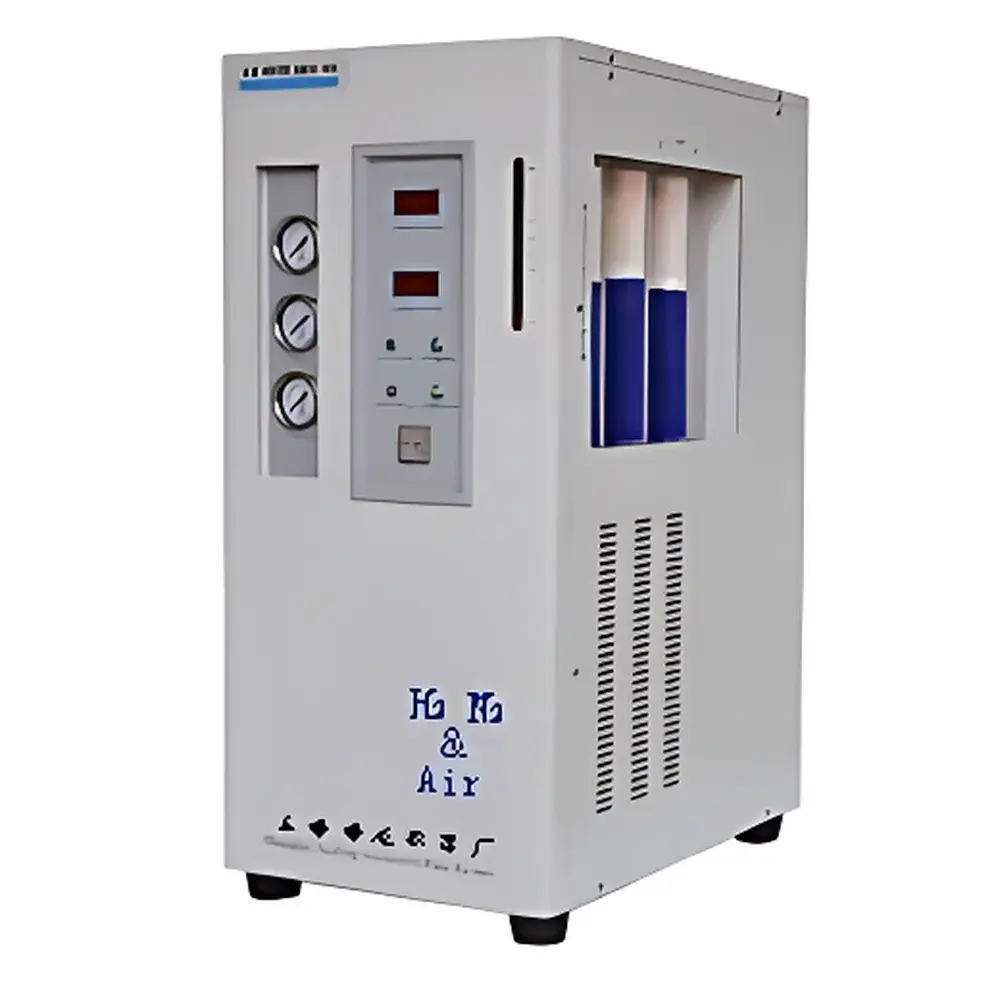
HLT-500G Integrated Nitrogen-Hydrogen-Air Gas Generator
| Brand | Hailong |
|---|---|
| Origin | Shanghai, China |
| Model | HLT-500G |
| Nitrogen Purity | >99.999% |
| Hydrogen Purity | >99.999% |
| Air Quality | Oil-free, Dry, Triple-Purified |
| N₂/H₂ Flow Range | 0–500 mL/min |
| Air Flow Range | 0–5000 mL/min |
| H₂ Output Pressure | 0–0.4 MPa (factory-set at 0.3 MPa) |
| N₂ Output Pressure | 0–0.5 MPa (factory-set at 0.4 MPa) |
| Air Output Pressure | 0–0.4 MPa |
| Power Supply | 220 V ±10%, 50 Hz ±5% |
| Max Power Consumption | 500 W |
| Operating Environment | 10–40 °C, RH ≤85%, non-corrosive, low-dust |
| Warranty | 1-year full unit, 3-year electrolyzer |
Overview
The HLT-500G Integrated Nitrogen-Hydrogen-Air Gas Generator is an engineered solution for laboratories requiring simultaneous, on-demand supply of high-purity nitrogen, hydrogen, and instrument-grade air—commonly used as carrier, fuel, and combustion gases in gas chromatography (GC), GC–mass spectrometry (GC–MS), and related analytical workflows. Unlike conventional cylinder-based systems, this generator employs membrane-based nitrogen separation, PEM (proton exchange membrane) electrolysis for hydrogen, and compressed-air filtration with desiccant and activated carbon stages for air generation—all housed within a single compact chassis. Its integrated architecture eliminates inter-unit piping, reduces footprint by up to 60% versus discrete generators, and ensures synchronized pressure and flow stability across all three gas streams. Designed for continuous unattended operation, the system meets ISO 8573-1 Class 1 (oil-free) and Class 2 (water content) specifications for compressed air, while nitrogen and hydrogen outputs comply with ASTM D6350 and ICH Q5C purity thresholds required for regulated pharmaceutical analysis.
Key Features
- Triple-gas integration in one enclosure: independent yet coordinated N₂, H₂, and air modules with shared control logic and unified status monitoring.
- Stainless-steel internal storage tanks (N₂ and H₂) rated to 1.0 MPa working pressure, certified per ASME BPVC Section VIII Division 1, enabling safe, low-pressure buffer storage without external cylinders.
- PEM electrolyzer stack with automatic anti-alkaline backflow protection—prevents KOH migration into gas lines during shutdown or pressure transients, extending membrane life and maintaining long-term H₂ purity.
- Membrane nitrogen generation using hollow-fiber polyimide membranes with real-time flow tracking; maintains constant outlet flow despite inlet pressure fluctuations via closed-loop mass flow control.
- Integrated air system featuring precision pressure regulation (±0.01 MPa), auto-drain condensate traps with level sensing, and triple-stage purification: coalescing filter → desiccant dryer → activated carbon adsorber.
- Comprehensive safety architecture: over-pressure relief valves on all gas paths, hydrogen leak detection (0–100% LEL), thermal cutoffs, electrolyzer temperature monitoring, and automatic shutdown on fault condition.
Sample Compatibility & Compliance
The HLT-500G is compatible with all major GC and GC–MS platforms requiring ultra-high-purity carrier and detector gases—including Agilent, Thermo Fisher Scientific, Shimadzu, and PerkinElmer instruments. Nitrogen output (>99.999% purity, <1 ppm O₂, <0.1 ppm H₂O) satisfies USP , EP 2.2.43, and ASTM D6350 Class 1 requirements for GC carrier gas. Hydrogen output (>99.999% purity, <0.5 ppm moisture, <10 ppb total hydrocarbons) meets ASTM D7165 specifications for FID fuel gas. Instrument air conforms to ISO 8573-1:2010 Class 1.2.1 (solid particles: ≤0.1 µm, water dew point: −40 °C, oil content: <0.01 mg/m³). The unit supports GLP/GMP environments with optional audit-trail-enabled firmware (compliant with FDA 21 CFR Part 11 when paired with validated software).
Software & Data Management
The generator includes an embedded 4.3-inch TFT LCD touchscreen interface with real-time display of all operational parameters: individual gas flow rates, outlet pressures, electrolyzer voltage/current, dew point readings, filter service intervals, and active alarms. Logged data (timestamped pressure, flow, temperature, and error codes) is stored internally for ≥30 days and exportable via USB 2.0 to CSV format. Optional Ethernet or RS-485 Modbus RTU connectivity enables integration into centralized lab infrastructure management systems (LIMS or SCADA). Remote diagnostics and firmware updates are supported through secure HTTPS-based portal access—no proprietary software installation required.
Applications
- Gas chromatography: nitrogen as carrier gas for capillary columns; hydrogen as fuel gas for flame ionization detectors (FID); dry, oil-free air as oxidant for FID and nitrogen phosphorus detectors (NPD).
- GC–MS systems requiring stable, low-oil nitrogen for collision gas (CID) and high-purity hydrogen for chemical ionization (CI) sources.
- Residual solvent analysis (ICH Q2(R2)) where consistent gas quality directly impacts method reproducibility and LOQ performance.
- Environmental testing labs performing EPA Method 8260/8270, where uninterrupted gas supply and documented purity compliance are mandatory for accreditation (e.g., ISO/IEC 17025).
- Academic and industrial research labs seeking reduced operational risk, elimination of cylinder logistics, and improved traceability of gas source history.
FAQ
What maintenance intervals are recommended for the HLT-500G?
Filter cartridges (air pre-filter, coalescing filter, desiccant, carbon) require replacement every 6–12 months depending on ambient conditions; electrolyzer stack lifetime exceeds 5,000 operating hours under normal load.
Can the generator be installed in a fume hood or enclosed cabinet?
No—it must be placed in a well-ventilated area with ≥50 cm clearance on all sides; hydrogen venting and heat dissipation requirements preclude confined-space installation.
Is the nitrogen output suitable for LC–MS nitrogen drying gas applications?
Yes, provided optional heated nitrogen module (HLT-NH-HEAT) is added to achieve dew point <−70 °C and particle filtration to 0.01 µm; standard output meets GC-grade requirements only.
Does the system support remote monitoring via network protocols?
Yes—Modbus RTU over RS-485 and TCP/IP Ethernet are available; configuration requires commissioning by certified field engineer.
How does the auto-flow tracking function maintain consistent output under variable demand?
Each gas module uses digital mass flow controllers (MFCs) with PID-regulated feedback loops that adjust upstream valve positions in real time based on downstream pressure and setpoint deviation—achieving ±1% flow accuracy across full range.



