
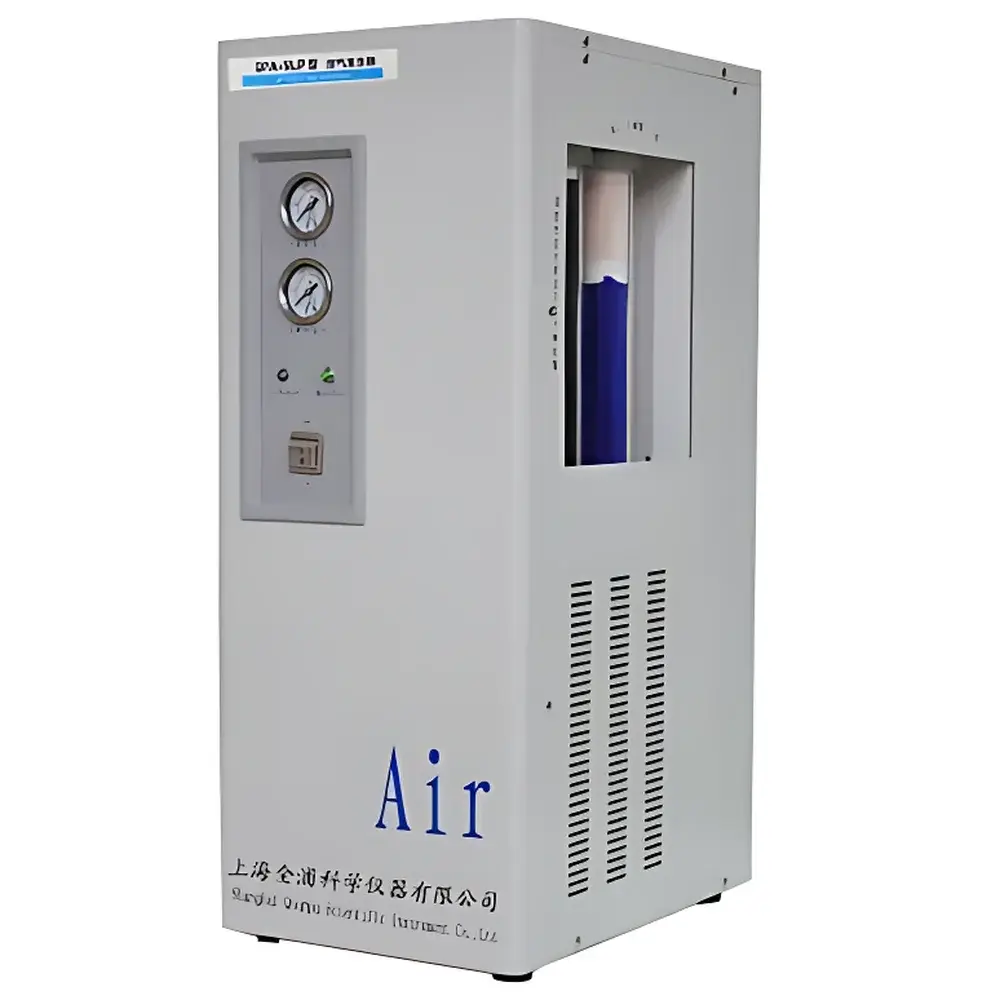
Helon HLA-2LG & HLA-5LG Air Generators with Auto-Regenerating Purification System
| Brand | Helon |
|---|---|
| Model | HLA-2LG / HLA-5LG |
| Origin | Shanghai, China |
| Output Flow | 0–2000 mL/min (HLA-2LG) / 0–5000 mL/min (HLA-5LG) |
| Output Pressure | 0–0.5 MPa (factory-set at 0.4 MPa) |
| Hydrocarbon Content | <0.1 ppm (v/v) in output air |
| Dew Point | 0–40 °C |
| Inlet Hydrocarbon Tolerance | ≤100 ppm (v/v) |
| Power Consumption | ≤600 W |
| Dimensions (W×D×H) | 260 × 360 × 670 mm |
| Weight | 29 kg |
| Operating Ambient | 0–40 °C, <85% RH |
| Construction | Electropolished stainless steel tubing, auto-draining stainless steel storage tank, oil-free compressor |
| Purification Technology | HL-A catalytic adsorption system with fully automatic regeneration cycle |
Overview
The Helon HLA-2LG and HLA-5LG Air Generators are engineered for continuous, on-demand supply of high-purity compressed air in analytical laboratories, chromatography suites, and instrument calibration environments. These units operate on a closed-loop purification architecture integrating an oil-free scroll compressor, electropolished stainless steel gas pathways, and the proprietary HL-A catalytic adsorption module — a multi-stage system designed to remove hydrocarbons (including aliphatic/aromatic hydrocarbons, esters, and trace lubricant vapors), particulates, moisture, and oil aerosols from ambient intake air. Unlike conventional activated carbon or molecular sieve systems requiring periodic cartridge replacement, the HL-A module executes fully automated thermal regeneration cycles — triggered by real-time hydrocarbon sensor feedback — ensuring consistent <0.1 ppm(v/v) total hydrocarbon content in the output stream without manual intervention or consumable depletion. The generators meet ISO 8573-1 Class 1:2:1 (solid particles, water, oil) specifications for instrument-grade air and are compatible with GC-FID, FTIR, particle counters, and other sensitive detection platforms demanding ultra-low background interference.
Key Features
- Oil-free scroll compressor with low-pressure startup sequence — extends service life and reduces mechanical wear under frequent cycling.
- Electropolished 316L stainless steel gas circuitry, ultrasonically cleaned prior to assembly — eliminates leachable metals and organic residues.
- Auto-draining stainless steel storage tank with integrated condensate separator — prevents rust formation and eliminates risk of iron oxide contamination in downstream applications.
- Dual-stage filtration and dual-stage pressure regulation — delivers stable output pressure (±0.01 MPa repeatability) across variable flow conditions.
- Compact footprint (260 × 360 × 670 mm) and acoustic enclosure design — achieves <55 dB(A) operating noise level, suitable for benchtop placement in shared lab spaces.
- Intelligent regeneration control logic — monitors inlet hydrocarbon load and initiates thermal desorption of the HL-A catalyst bed only when saturation thresholds are approached, minimizing energy use and thermal stress.
Sample Compatibility & Compliance
These generators produce air compliant with ASTM D6216 (Standard Specification for Compressed Air Used in Gas Chromatography), ISO 8573-1:2010 Class 1:2:1, and USP requirements for instrument air used in analytical instrumentation. The <0.1 ppm(v/v) hydrocarbon limit satisfies GC-FID baseline stability criteria per ICH Q2(R2) and supports GLP/GMP audit readiness when paired with optional data logging modules. Units operate within ambient conditions of 0–40 °C and <85% RH; no external cooling or dehumidification is required. The stainless steel wetted path ensures compatibility with reactive gases and eliminates catalytic decomposition risks associated with aluminum or brass components.
Software & Data Management
While the base models operate via front-panel controls with LED status indicators (flow, pressure, regeneration phase, fault codes), optional RS-485 Modbus RTU or Ethernet TCP/IP interfaces enable integration into centralized lab infrastructure monitoring systems. Logged parameters include cumulative runtime, number of regeneration cycles, inlet/outlet hydrocarbon sensor readings (via analog 4–20 mA output), and compressor duty cycle — all timestamped and exportable for 21 CFR Part 11-compliant audit trails when deployed with validated third-party SCADA or LIMS software. Firmware updates are performed via secure USB interface with cryptographic signature verification.
Applications
- Carrier and fuel gas supply for flame ionization detectors (FID) in gas chromatography systems.
- Bias gas for FTIR spectrometers and laser-based particle sizers requiring hydrocarbon-free purge streams.
- Actuation and control air for automated sample introduction valves and pneumatic actuators in regulated QC labs.
- Cleanroom environmental monitoring stations where background VOC interference must be minimized.
- Calibration gas blending systems requiring stable, low-hydrocarbon diluent air.
FAQ
How does the HL-A auto-regeneration system extend maintenance intervals?
The HL-A module uses temperature-programmed desorption to thermally release trapped hydrocarbons from the catalyst surface back into the exhaust stream, restoring adsorption capacity without physical replacement. Regeneration occurs only when sensor-derived loading metrics exceed preset thresholds — typically every 3–6 months under continuous operation.
Can the generator be installed in an unventilated cabinet?
No. While noise is low, the unit dissipates up to 600 W of heat during regeneration cycles. Minimum clearance of 15 cm on all sides and passive airflow are required to maintain internal component temperatures within specification.
Is the output air suitable for mass spectrometry applications?
The <0.1 ppm hydrocarbon specification meets typical requirements for LC-MS nitrogen generator support air and GC-MS detector gas, but users performing ultra-trace analysis (<1 pg/mL) should verify compatibility with their specific MS ion source configuration and conduct blank testing.
What safety protections are built into the system?
Over-temperature cutoff, over-pressure relief valve (0.6 MPa setpoint), compressor thermal overload protection, and automatic shutdown upon loss of airflow or sensor fault — all conforming to IEC 61000-6-2/6-4 EMC and EN 61010-1 safety standards.



