
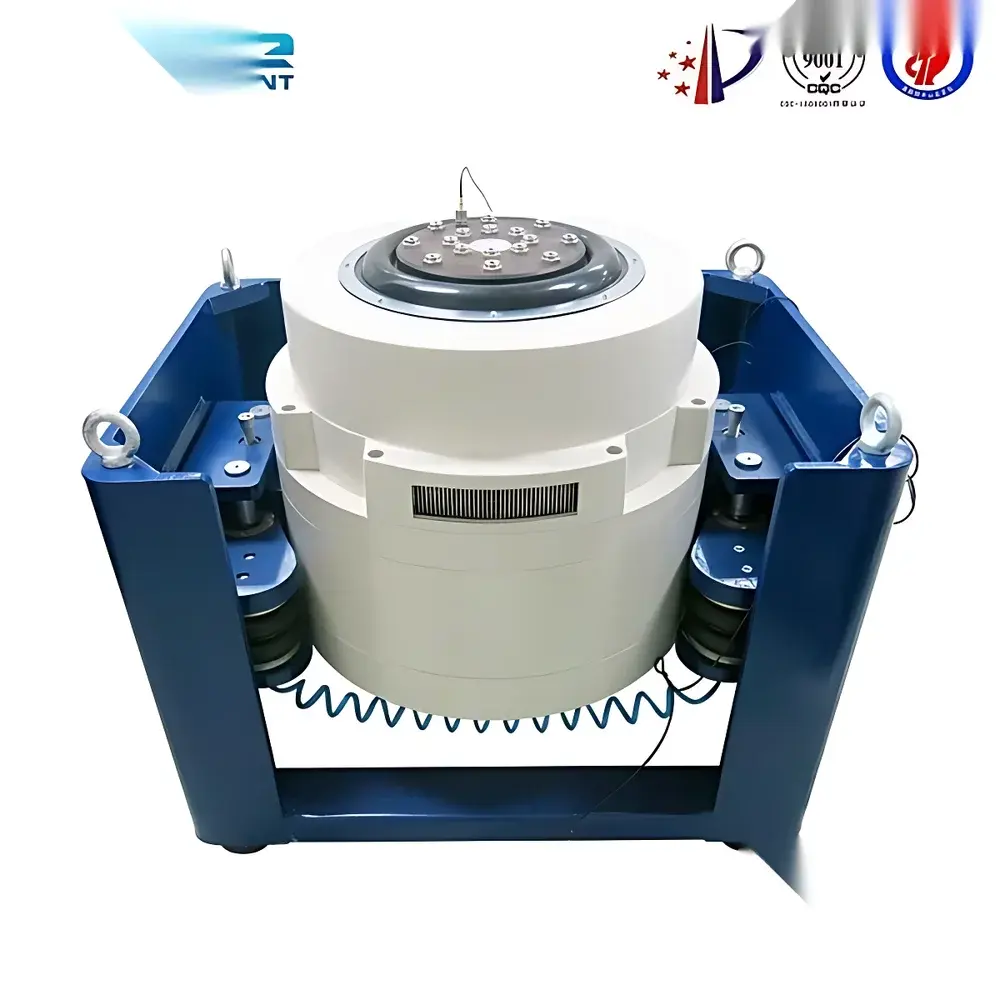
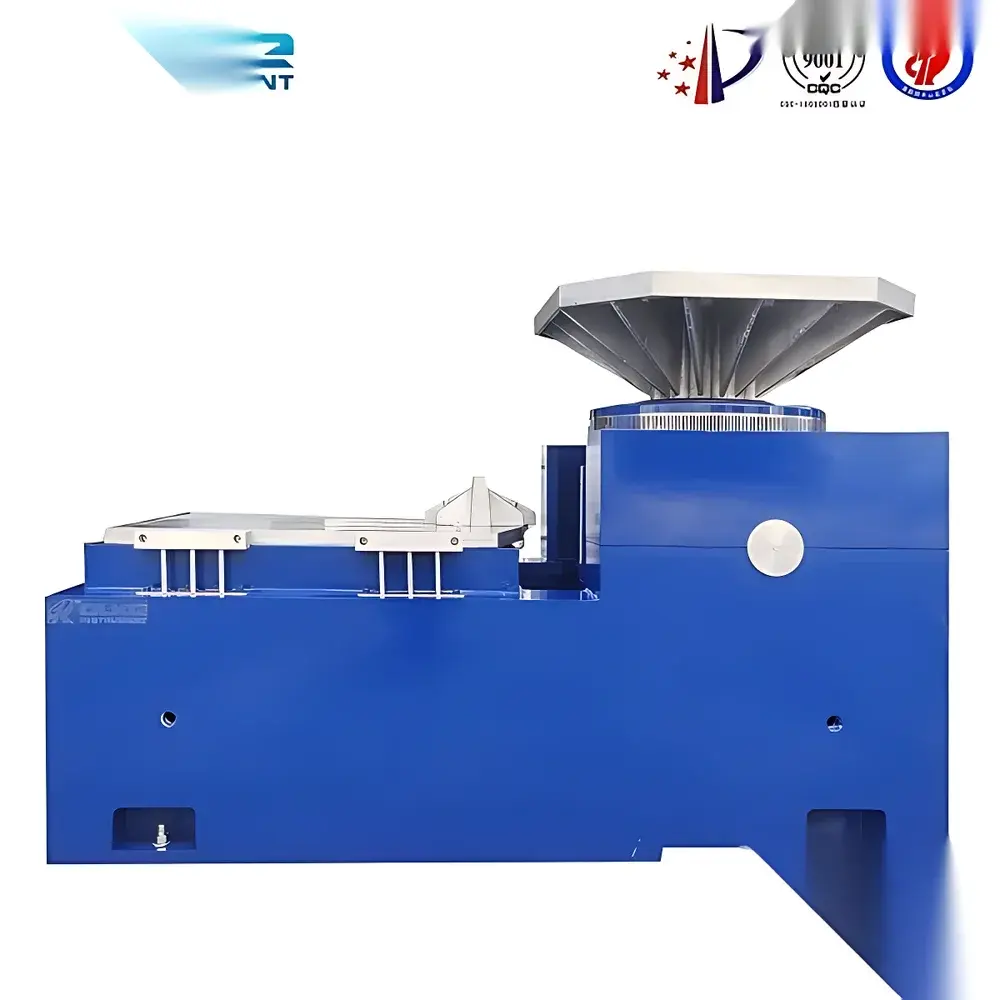
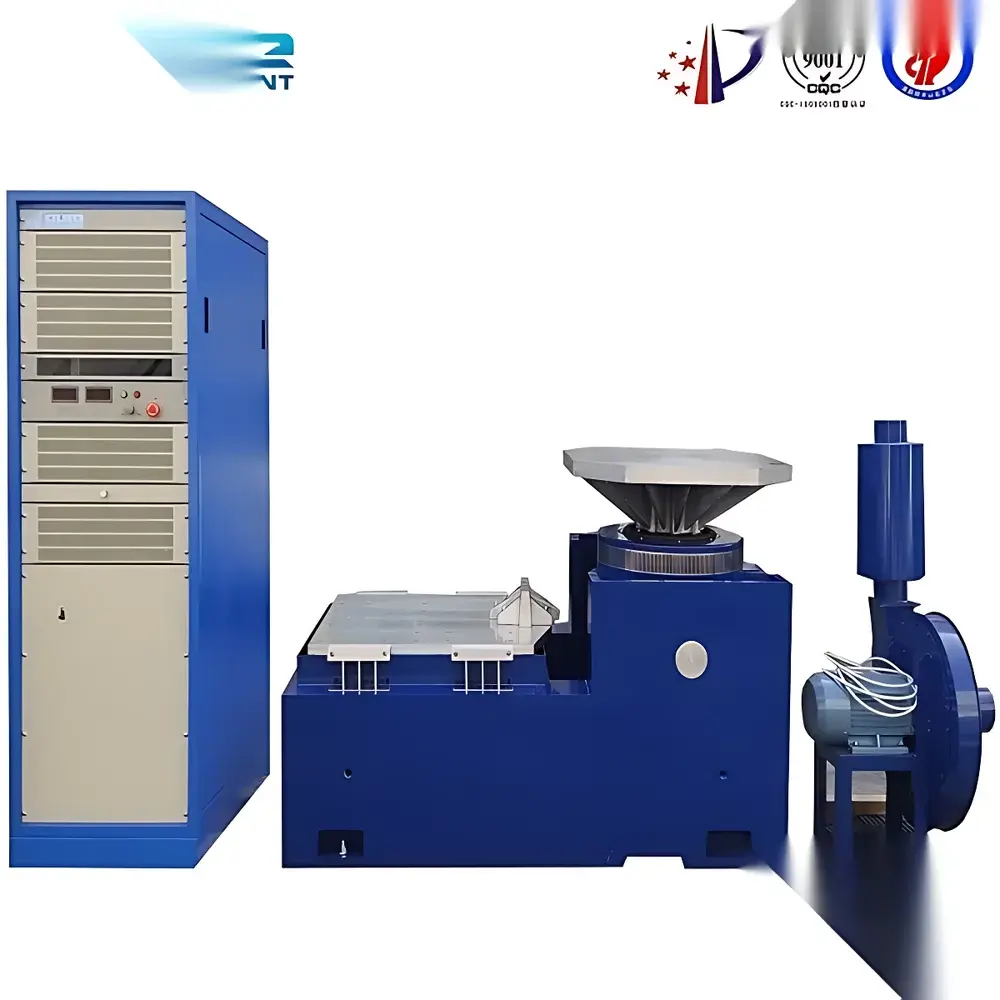
Low-Frequency Transport Simulation Vibration Shaker – Generic Industrial Model
| Brand | Other Brands |
|---|---|
| Origin | Imported |
| Manufacturer Type | Authorized Distributor |
| Frequency Range | 100–300 rpm |
| Amplitude (p-p) | 25.4 mm |
| Timer Range | 0–99 h 99 min |
| Frequency Display Resolution | 0.1 rpm |
| Vibration Mode | Rotary (eccentric cam-driven) |
| Max Load Capacity | 100 kg |
| Effective Table Size | 1000 × 1000 mm |
| Motor Power | 1 HP (0.75 kW) |
| Dimensions (W×D×H) | 1100 × 1300 × 650 mm |
| Weight | ~300 kg |
| Max Acceleration Limit | 20 g (calculated per ISO 10816-1 & ASTM D999) |
| Max Amplitude Constraint | 5 mm (frequency-dependent, per EN 1010-1 derived envelope) |
| Compliance | ISTA 2A/3A, ASTM D999, ANSI X3.31, UL 60950-1, EN 61000-6-2 |
Overview
The Low-Frequency Transport Simulation Vibration Shaker is a mechanically driven rotary vibration system engineered to replicate the dominant low-frequency excitations encountered during road, rail, and maritime freight transport. Unlike electrodynamic shakers optimized for high-frequency spectral fidelity, this unit employs a robust eccentric cam mechanism coupled with a DC motor and precision-tuned belt drive to generate controlled, repeatable sinusoidal displacement profiles in the 1.67–5.0 Hz range (100–300 rpm). Its design adheres to the physical basis of transport vibration—characterized by dominant energy below 10 Hz, large-displacement excitation, and amplitude-limited acceleration envelopes—as codified in ISTA Procedure 2A and ASTM D999. The system does not perform true random vibration synthesis; rather, it delivers deterministic, adjustable rotational motion that emulates the cumulative mechanical stress induced by vehicle suspension systems, cargo shifting, and road surface irregularities. This makes it particularly suitable for durability screening of packaged goods, assembled electronics, and consumer products prior to distribution.
Key Features
- Rotary vibration mechanism with eccentric cam shaft and low-backlash timing belt transmission—ensures high mechanical reproducibility and minimal phase drift over extended test durations.
- Digital frequency display with ±0.1 rpm resolution, enabling precise replication of standardized transport profiles defined in ISTA 3A (e.g., 150 rpm for simulated truck transit).
- Heavy-duty structural base fabricated from reinforced C-channel steel with integrated elastomeric isolation pads—eliminates requirement for anchored floor mounting while maintaining <±0.5 mm lateral table runout under full 100 kg load.
- Linear guide-mounted sample fixture interface—facilitates rapid, tool-free loading/unloading and ensures consistent center-of-gravity alignment across test cycles.
- DC motor speed control architecture—provides smooth torque delivery across the full operational range, sustaining rated output even at low-speed, high-load conditions without thermal derating.
- Noise-optimized synchronous belt drive—operates at <65 dB(A) at 1 m distance, meeting laboratory ambient noise requirements per ISO 7779 and enabling integration into shared QC lab environments.
Sample Compatibility & Compliance
This shaker accommodates rigid and semi-rigid packaged units up to 100 kg, including corrugated shipping containers, molded plastic trays, wooden crates, and palletized loads. The 1000 × 1000 mm active table surface supports standard RSC (Regular Slotted Container) configurations and permits dual-sample placement for comparative testing. All operational parameters—including maximum acceleration (20 g) and peak-to-peak amplitude (5 mm)—are constrained in accordance with the empirical limits derived from real-world transport telemetry data and referenced in EN 1010-1 Annex B and ASTM D4169 Appendix X1. The system meets functional equivalence requirements for ISTA 2 Series (2A, 2B), ASTM D999 Method A (Sinusoidal), and ANSI X3.31-1977 for packaging vibration resistance validation. It is routinely deployed in GLP-compliant quality assurance workflows where traceable, auditable test execution is required per FDA 21 CFR Part 11 (when paired with validated external data logging).
Software & Data Management
While the base configuration operates via standalone analog controls and digital panel instrumentation, optional integration modules support RS-232 or Modbus RTU communication for external SCADA or LIMS linkage. Time-stamped test logs—including start/stop timestamps, actual frequency setpoint, elapsed duration, and operator ID—can be exported as CSV files for audit trail generation. When used with third-party acquisition hardware (e.g., IEPE accelerometers + USB DAQ), raw vibration data may be post-processed using MATLAB or Python-based spectral analysis tools to verify compliance with acceleration spectral density (ASD) envelopes defined in MIL-STD-810H Method 514.7, though such analysis falls outside the native capability of the shaker’s embedded controller.
Applications
This vibration shaker serves as a primary qualification tool in packaging engineering labs, manufacturing QA departments, and third-party testing facilities. Typical use cases include: validating corrugated box compression strength retention after simulated shipment; assessing solder joint integrity in PCB assemblies subjected to resonant low-frequency forcing; evaluating latch reliability in consumer appliance enclosures; verifying structural adhesion performance in laminated displays; and benchmarking cushioning material efficacy under repetitive impact-like displacement cycles. It is widely applied across industries regulated by UL, CE, and FCC—particularly for products requiring ISTA-certified packaging documentation prior to retail distribution in North America and the EU.
FAQ
Can this shaker perform random vibration testing?
No. It is a fixed-frequency sinusoidal (rotary) shaker. Random vibration requires electrodynamic actuation and real-time closed-loop control—capabilities not present in this mechanical design.
Is calibration certification included?
Factory calibration verification is provided upon shipment; NIST-traceable calibration certificates are available as an add-on service with annual recalibration options.
What safety interlocks are built in?
The unit features a hardware-enforced emergency stop circuit, door-open detection on the front access panel, and overload current cutoff on the motor driver—compliant with EN 60204-1 Category 3 safety architecture.
Does it meet FDA or ISO 13485 requirements for medical device packaging validation?
Yes—when operated within documented, validated test protocols and supported by equipment qualification (IQ/OQ) documentation, it satisfies clause 7.5.2.1 of ISO 13485:2016 for simulated distribution testing of sterile barrier systems.
Can the table be customized for non-standard fixtures?
Yes. The M6 threaded mounting grid across the entire table surface allows secure attachment of custom aluminum tooling plates, vacuum chucks, or pneumatic clamping fixtures—subject to static load distribution analysis.



