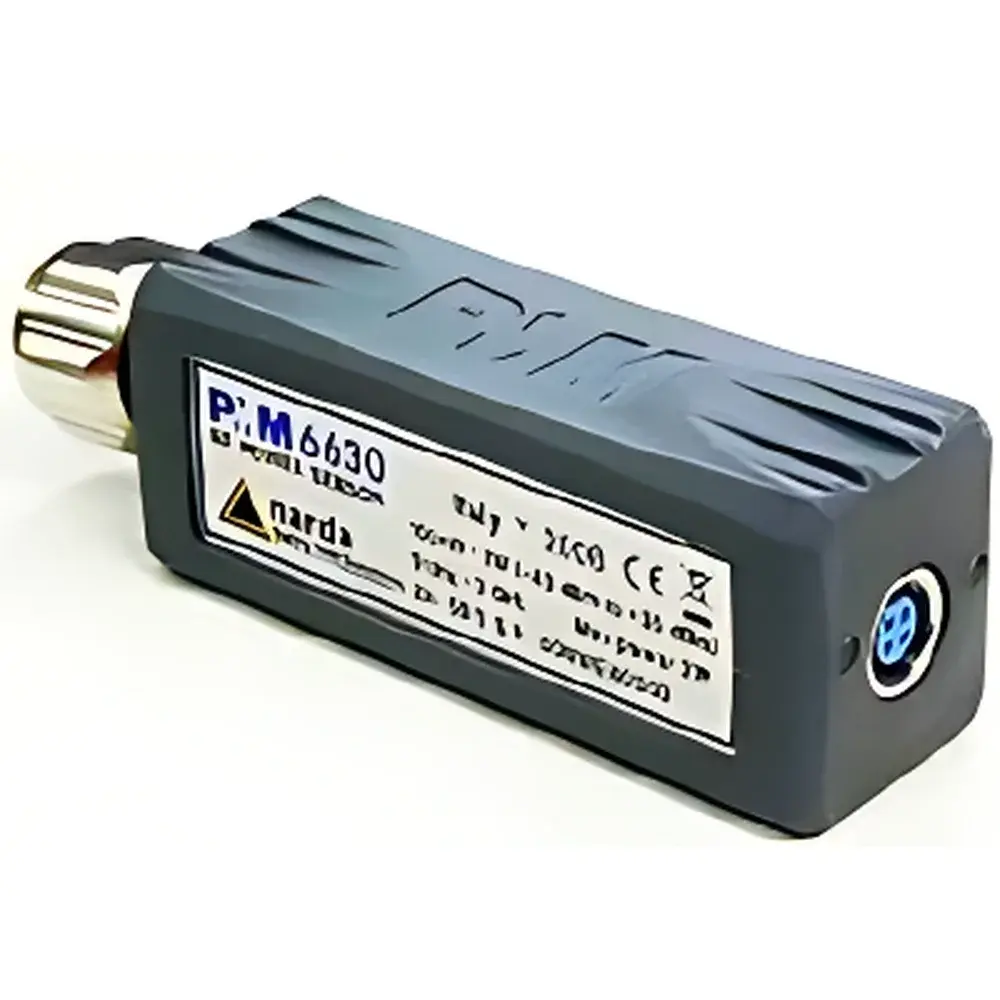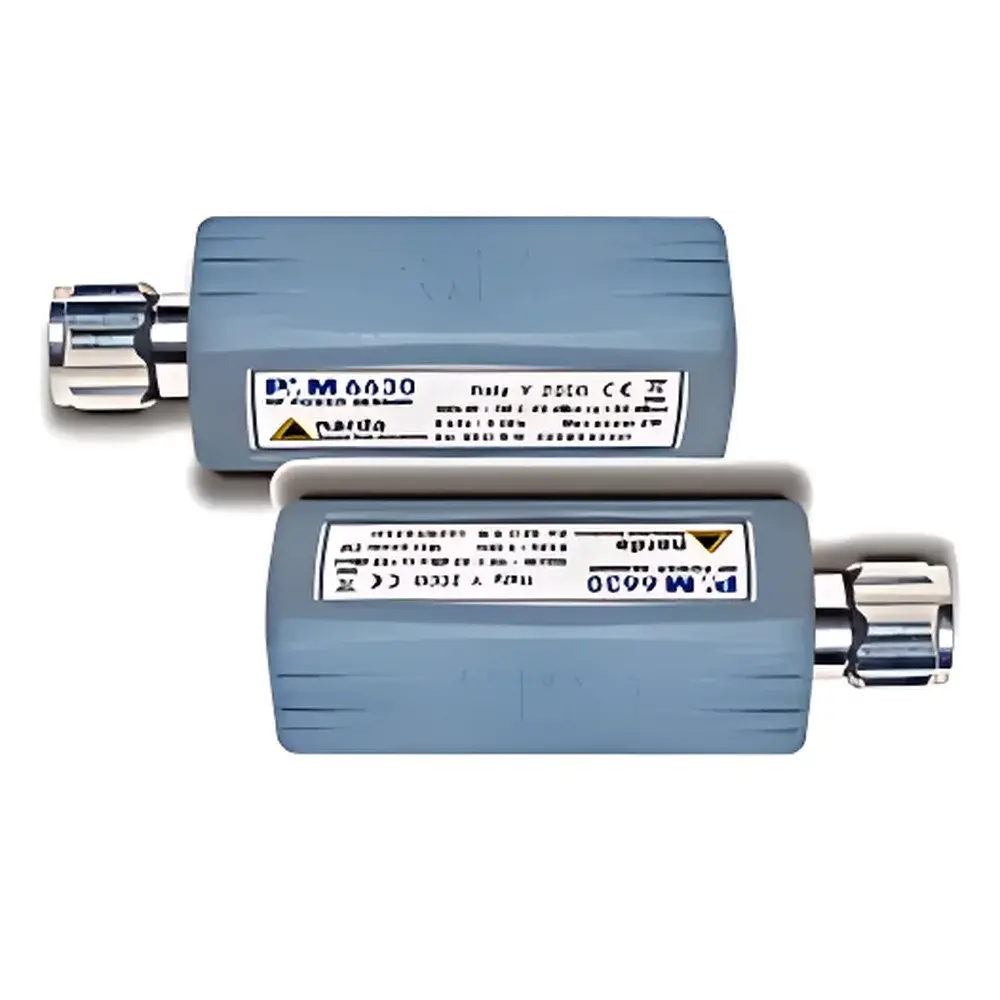
PMM 6600 Series Compact RF Power Meter
| Key | Frequency Range: 9 kHz–3 GHz (6600/6600D: up to 1 GHz) |
|---|---|
| Input Power Range | 100 nW–1 W (−40 dBm to +30 dBm) |
| Linearity | ±0.2 dB (typ.) |
| Measurement Modes | Forward & Reverse Power |
| Detection | True RMS, >70 dB dynamic range |
| Interface | USB 1.0/1.1/2.0 (6600/6600D: proprietary 486-style interface) |
| Units | dBm, W, Vrms |
| Compliance | CE, RoHS |
Overview
The PMM 6600 Series Compact RF Power Meter is an integrated, self-contained metrology-grade instrument engineered for precise, traceable RF power measurement across laboratory, production, and field service environments. Unlike traditional benchtop power meters requiring external sensors and calibration references, the 6600 Series embeds a calibrated thermistor- or diode-based power detection element directly within the meter housing—eliminating interconnect uncertainty and enabling true plug-and-play operation. Its core measurement principle relies on broadband thermal conversion (for CW and modulated signals) combined with high-stability analog-to-digital conversion and real-time digital signal processing. This architecture ensures stable, repeatable readings over temperature and time without reliance on periodic reference source recalibration—a critical advantage in ISO/IEC 17025-accredited labs where measurement traceability must be demonstrable through internal validation protocols rather than external dependency.
Key Features
- Integrated sensor/meter architecture: No external probe cables, connectors, or bias tees required—reducing insertion loss, mismatch error, and mechanical drift.
- True RMS detection across 70+ dB dynamic range: Validated for continuous wave, pulsed, OFDM, CDMA, LTE, and 5G NR waveforms with peak-to-average power ratio (PAPR) up to 12 dB.
- Wideband frequency coverage: Standard models operate from 9 kHz to 3 GHz; the 6600 and 6600D variants are optimized for 75 MHz–1.5 GHz with enhanced linearity below 1 GHz.
- High linearity performance: ±0.2 dB typical deviation across full scale—meeting requirements for RF amplifier characterization, transmitter output verification, and antenna system testing per IEC 62047-17 and MIL-STD-461G CS114.
- Direct USB 2.0 interface: Enables seamless integration into automated test systems (ATE) using SCPI command sets; supports data streaming at up to 100 readings/sec with timestamping and trigger synchronization.
- Multi-unit display and conversion: Simultaneous readout in dBm, watts, and Vrms—facilitating cross-domain analysis in RF design, EMC pre-compliance, and signal integrity validation.
Sample Compatibility & Compliance
The PMM 6600 Series is compatible with standard 50 Ω RF interfaces (SMA female input) and accepts direct connection to signal generators, spectrum analyzers, power amplifiers, and antenna feed lines without attenuators or couplers in most low-to-mid power applications. It complies with EN 61326-1:2013 (EMC for electrical equipment) and EN 61000-3-2:2019 (harmonic current emissions). Calibration certificates issued by PMM’s accredited Italian metrology lab (ISO/IEC 17025:2017 certified) include full uncertainty budgets referenced to NIST-traceable standards. The device supports GLP/GMP audit trails when used with optional PMM ControlSuite software—logging operator ID, calibration status, environmental conditions, and measurement timestamps in accordance with FDA 21 CFR Part 11 requirements.
Software & Data Management
PMM ControlSuite (Windows 10/11, 64-bit) provides comprehensive instrument control, real-time waveform visualization, statistical analysis (min/max/avg/std dev), and export to CSV, MATLAB (.mat), or XML formats. The software implements secure user authentication, role-based access control, and electronic signature workflows compliant with ALCOA+ data integrity principles. All measurement sessions generate immutable log files containing firmware version, serial number, sensor health diagnostics, and ambient temperature/humidity metadata—enabling full forensic reconstruction during regulatory audits. Remote operation via TCP/IP (optional Ethernet module) supports integration into LabVIEW, Python (PyVISA), or Keysight PathWave environments.
Applications
- RF component validation: Characterizing insertion loss, return loss, and gain flatness of filters, isolators, and circulators.
- Wireless transmitter compliance: Verifying output power, ACLR, and EVM pre-scan prior to formal EMC/ETSI/FCC testing.
- Education and training: Teaching RF fundamentals—including impedance matching, standing wave ratio, and power transfer efficiency—in university electronics labs.
- Maintenance and field service: Troubleshooting broadcast transmitters, cellular base stations, and satellite uplink systems with portable, battery-operable units (optional).
- Quality assurance in RF manufacturing: In-line monitoring of PA modules, front-end ICs, and IoT antenna assemblies under production floor environmental conditions.
FAQ
Does the PMM 6600 require annual recalibration?
Yes—recommended recalibration interval is 12 months, aligned with ISO/IEC 17025 Clause 7.8.2; however, built-in self-test routines and drift compensation algorithms extend stability between calibrations.
Can it measure burst-mode or TDMA signals?
Yes—true RMS detection and ≥100 kS/s sampling rate support accurate peak, average, and duty-cycle-corrected power measurement for GSM, Bluetooth LE, and NB-IoT frame structures.
Is USB isolation provided for EMI-sensitive environments?
The USB interface includes galvanic isolation (2.5 kVRMS) and ferrite-filtered data lines, meeting CISPR 11 Group 1 Class B immunity requirements.
What is the maximum input VSWR the meter can tolerate without damage?
Input VSWR is ≤1.25:1 up to 1 GHz and ≤1.5:1 up to 3 GHz; internal protection circuitry limits damage risk to inputs exceeding +33 dBm for <10 ms pulses.
Are calibration factors stored internally or only in software?
Full multi-point calibration coefficients are embedded in non-volatile memory on the sensor die and automatically loaded at power-up—ensuring accuracy even when used standalone without PC connectivity.