
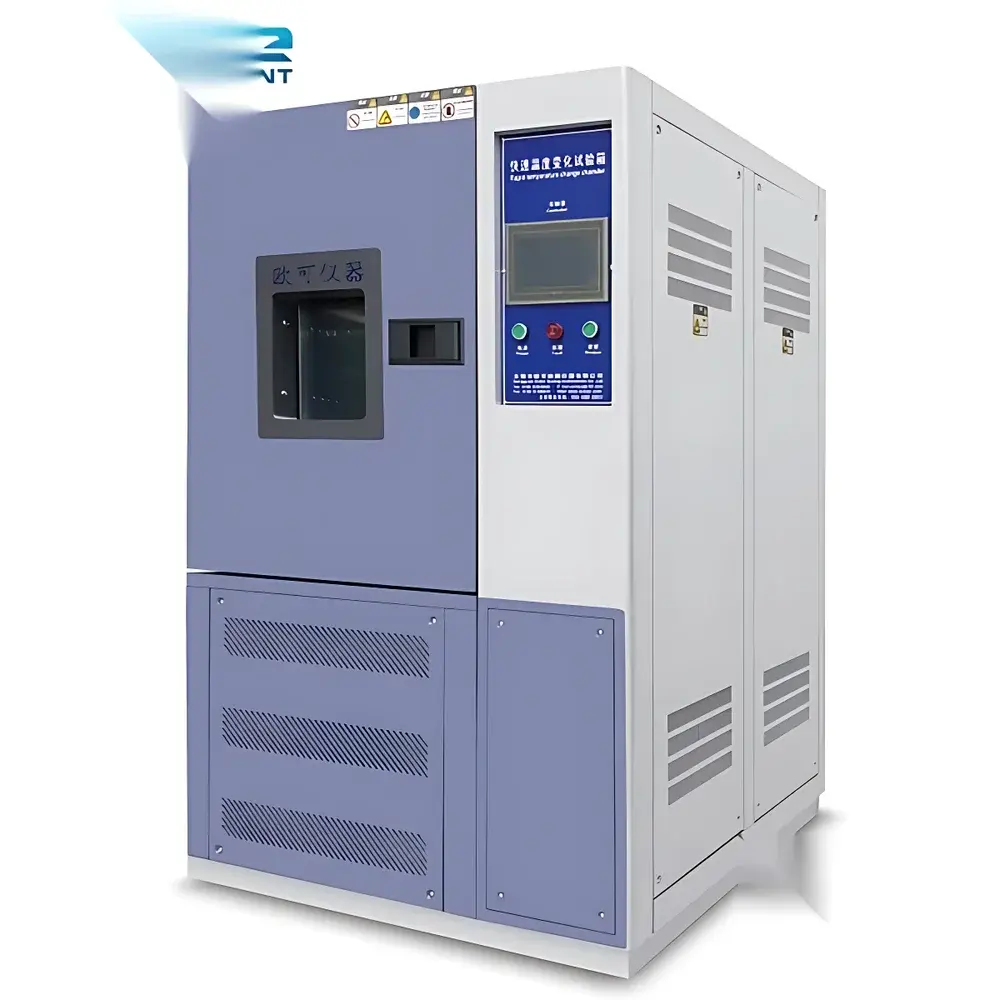
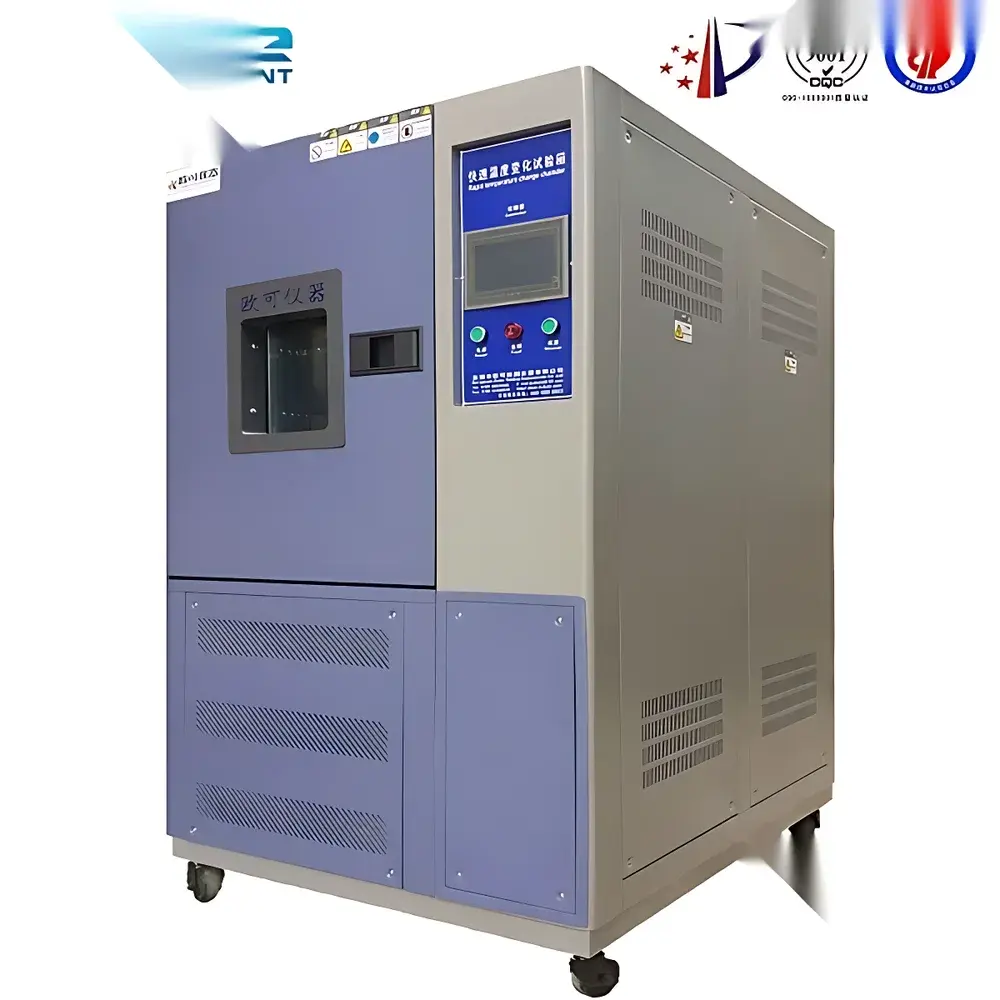
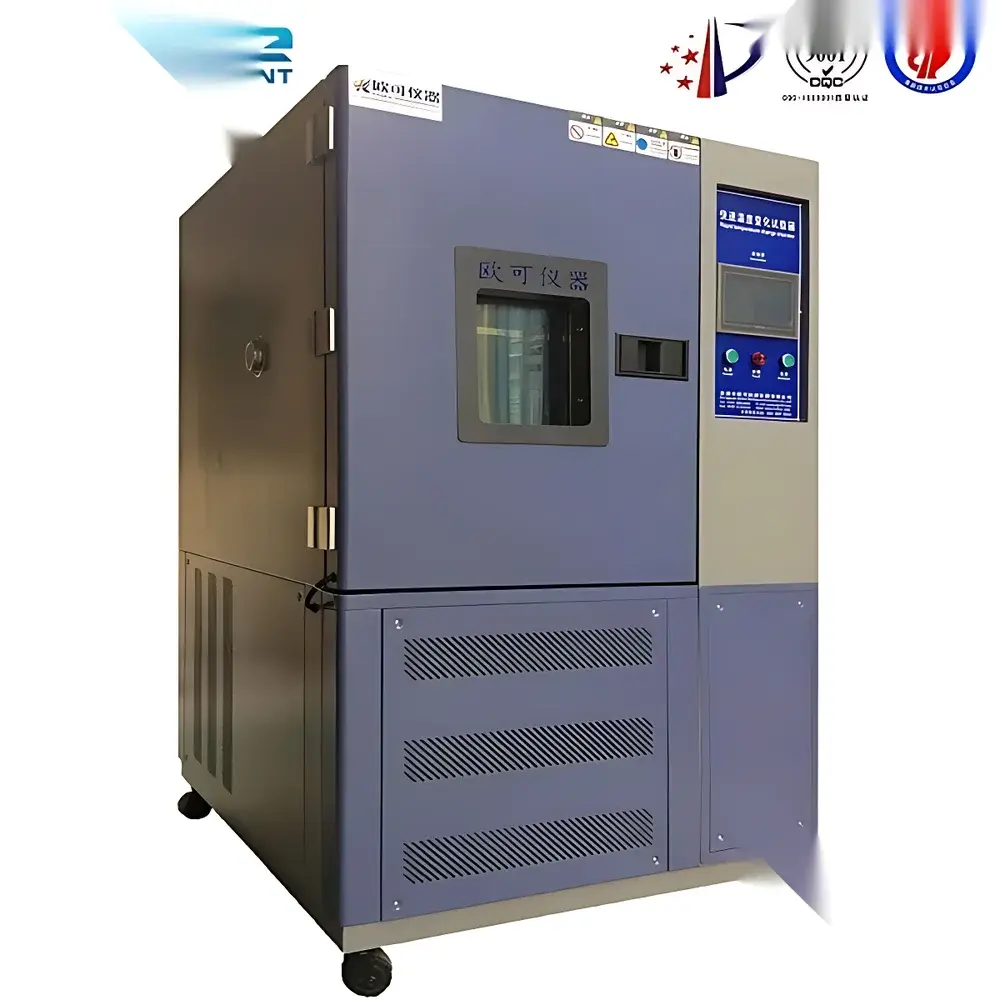
Generic Brand Rapid Temperature Change Chamber (RTCC) – Industrial Environmental Test System
| Brand | Other Brands |
|---|---|
| Origin | Imported |
| Manufacturer Type | Authorized Distributor |
| Price | USD 2,650 (FOB) |
| Display | 7-inch TFT LCD, 800×480 resolution, true-color touchscreen interface |
| Programming Capacity | 1,000 programmable test profiles |
| Temperature Resolution | 0.1 °C |
| Time Resolution | 0.1 min |
| Sensor | PT100 platinum resistance thermometer |
| Communication | Standard 10/100 Mbps Ethernet port with embedded Web Server (supports up to 255 units on same network) |
| Data Logging | Adjustable sampling interval from 1 s to 60 s |
| Refrigeration | Dual-stage mechanical compression system with imported compressors |
| Refrigerants | R404A / R23 |
| Cooling Method | Air-cooled or water-cooled (optional) |
| Heating | Nickel-chromium alloy wire heaters |
| Safety Protections | Over-temperature cutoff, earth leakage protection, fan overload protection, compressor high-pressure/overload/overheat protection, over-current protection, phase sequence monitoring, fuse protection, water pressure monitoring (water-cooled models only) |
| Standard Accessories | One Φ50 mm cable port, two adjustable sample shelves, LED interior lighting, elapsed time meter, four swivel casters, 6-meter power cord, two USB 2.0 ports |
Overview
The Rapid Temperature Change Chamber (RTCC) is an industrial-grade environmental stress screening (ESS) system engineered for precise, repeatable, and accelerated thermal cycling across extreme temperature ranges. Based on dual-stage mechanical compression refrigeration and resistive heating, the chamber delivers controlled ramp rates—typically ranging from 5 °C/min to 15 °C/min depending on configuration and load—to simulate real-world thermal shock conditions encountered during product development, qualification, and reliability validation. Designed for compliance with key international testing standards—including IEC 60068-2-14 (change of temperature), MIL-STD-810H Method 503.5 (temperature shock), and JESD22-A104 (temperature cycling)—this RTCC supports both single-point conditioning and multi-step programmed profiles. Its architecture integrates robust thermal insulation, uniform air distribution via forced convection, and closed-loop PID control with real-time feedback from calibrated PT100 sensors, ensuring spatial temperature uniformity within ±2.0 °C and stability within ±0.5 °C under steady-state conditions.
Key Features
- 7-inch true-color touchscreen HMI with intuitive Chinese/English bilingual menu navigation and drag-and-drop programming interface
- High-capacity controller supporting 1,000 stored test programs, each with up to 100 definable steps and 999 repeat cycles—enabling complex multi-phase thermal profiles (e.g., dwell-ramp-dwell sequences)
- Embedded Web Server functionality via standard Ethernet interface, allowing remote monitoring, parameter adjustment, and real-time data visualization through any modern web browser without proprietary software
- Dual-stage refrigeration system using R404A/R23 mixed refrigerants for extended low-temperature capability (typically –70 °C to +180 °C), with optional air- or water-cooling configurations to suit facility infrastructure constraints
- Comprehensive safety architecture including redundant over-temperature cutoffs, compressor protection logic, electrical isolation monitoring, and (for water-cooled variants) automatic shutdown upon loss of cooling water pressure
- Configurable data logging with user-selectable sampling intervals (1–60 seconds); onboard memory retains up to 600 days of timestamped temperature/time records at maximum interval, compliant with internal audit requirements
Sample Compatibility & Compliance
The chamber accommodates a broad range of sample types—from printed circuit boards (PCBs) and automotive ECUs to aerospace components and medical device assemblies—via two adjustable stainless-steel sample shelves and a standard Φ50 mm cable port for external signal routing. Optional accessories include custom-sized test ports, reinforced shelves for heavy loads, and integrated humidity control modules (not included). The system adheres to electromagnetic compatibility (EMC) requirements per EN 61326-1 and electrical safety standards per IEC 61010-1. While not certified to UL or CSA out-of-the-box, it is designed to support third-party certification pathways for end-user facilities operating under ISO/IEC 17025, A2LA, or FDA-regulated environments requiring documented traceability and calibration management.
Software & Data Management
No dedicated PC software is required: all operational functions—including program creation, execution, pause/resume, and data export—are accessible via the built-in web interface. Logged data can be downloaded in CSV format directly through HTTP GET requests or via USB mass-storage mode using the dual USB 2.0 ports. For laboratories implementing 21 CFR Part 11-compliant workflows, the controller supports user-level access control (three-tier privilege model), electronic signature prompts for critical actions, and immutable audit trails recording operator ID, timestamp, and parameter changes—provided the firmware version is v3.2 or higher. Firmware updates are delivered via USB or network push, ensuring long-term maintainability and regulatory alignment.
Applications
This RTCC serves as a core tool in reliability engineering labs for thermal shock testing per JEDEC JESD22-A106, solder joint fatigue assessment, cold-start validation of automotive electronics, and accelerated life testing of polymer-based enclosures. It is routinely deployed in QC/QA departments for incoming inspection of electro-mechanical subassemblies and in R&D settings for failure mode identification during design verification. Its programmability and data integrity features also support GLP/GMP-aligned validation protocols, including IQ/OQ documentation packages for regulated industries such as medical devices (ISO 13485) and pharmaceutical manufacturing equipment.
FAQ
What is the typical temperature range and ramp rate achievable with this chamber?
Standard configuration covers –70 °C to +180 °C; ramp rates depend on setpoint delta and load mass but typically achieve 5–10 °C/min between –40 °C and +85 °C with no internal load.
Is calibration certificate included with shipment?
A factory calibration report (traceable to NIST-equivalent national standards) is provided; full ISO/IEC 17025-certified calibration requires separate arrangement with an accredited lab.
Can the chamber be integrated into a centralized test management system?
Yes—via Modbus TCP or HTTP RESTful API (available in firmware v3.4+), enabling integration with LabVantage, TrackWise, or custom MES platforms.
What maintenance is required for long-term reliability?
Quarterly condenser coil cleaning (air-cooled) or cooling tower water quality monitoring (water-cooled), annual refrigerant leak check, and biannual verification of PT100 sensor accuracy using a reference thermometer.
Are spare parts and technical support available globally?
Yes—authorized distributors maintain regional spares inventory, and firmware updates, troubleshooting guides, and remote diagnostics support are provided through the manufacturer’s global service portal.



