
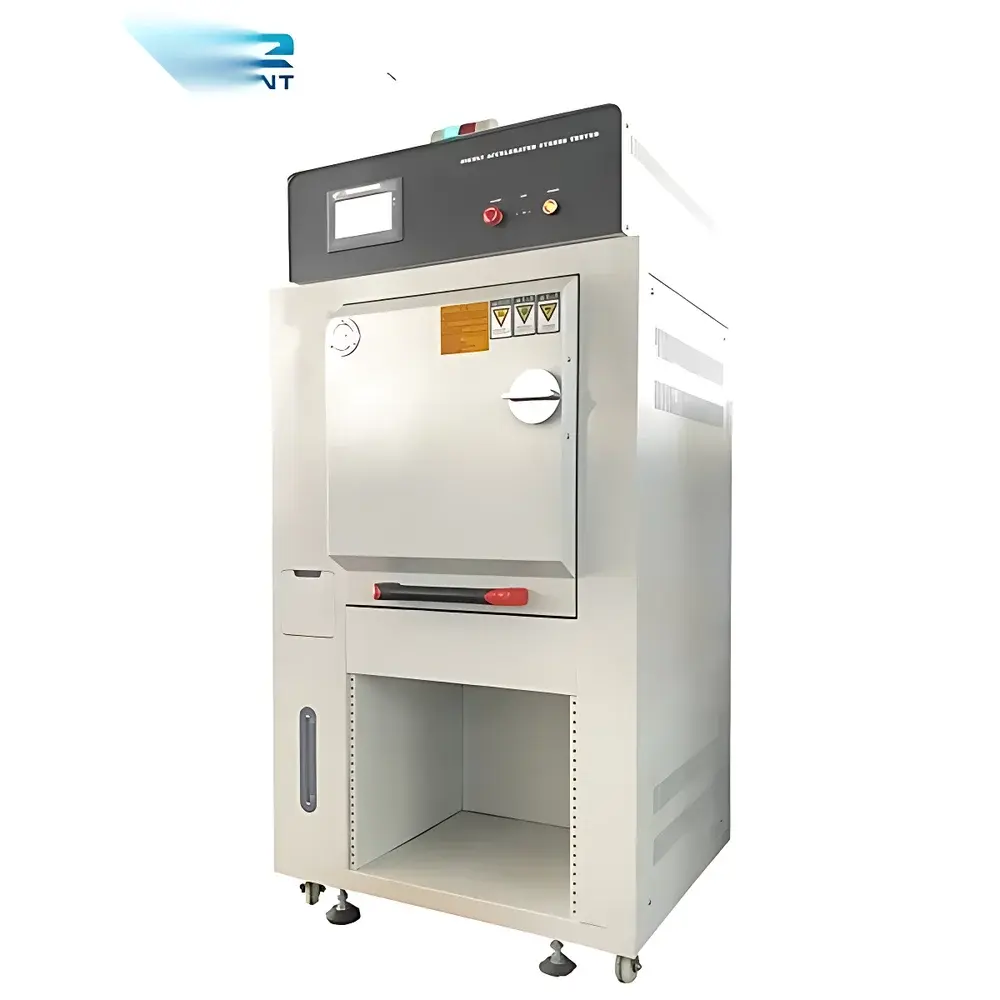
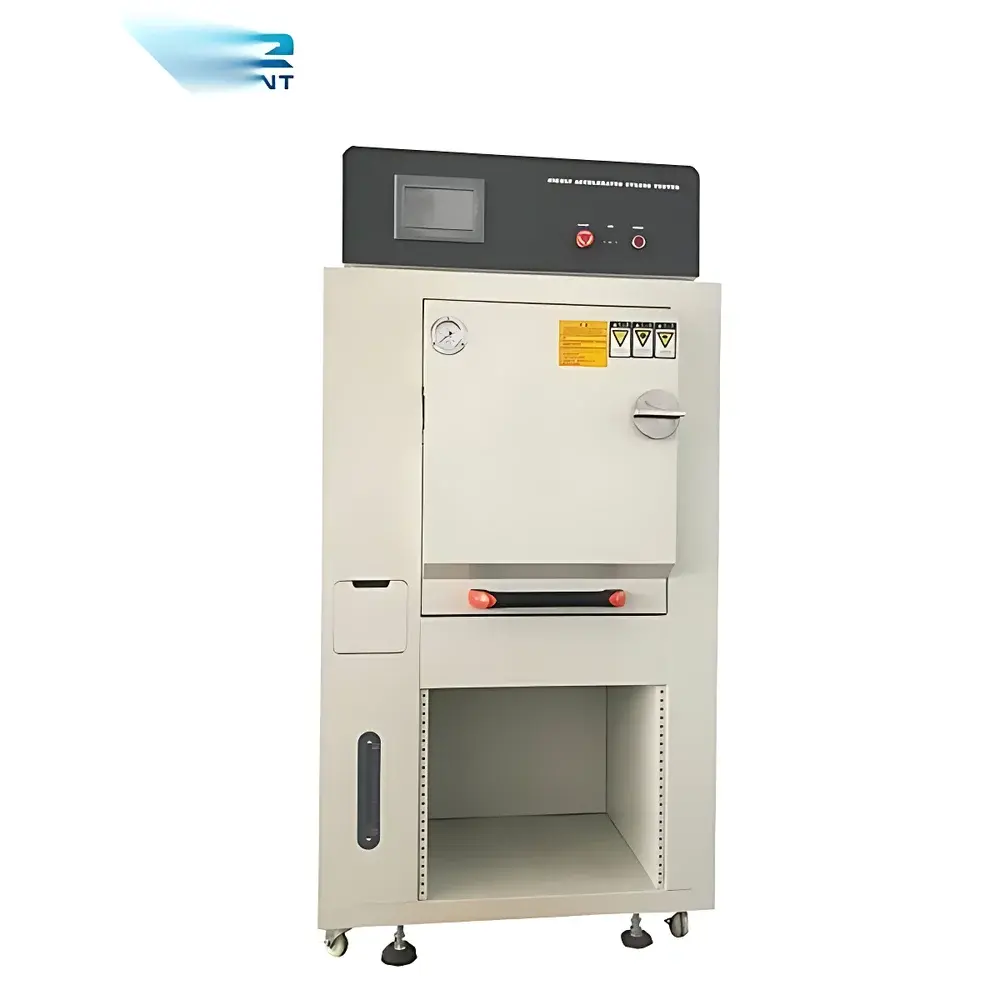
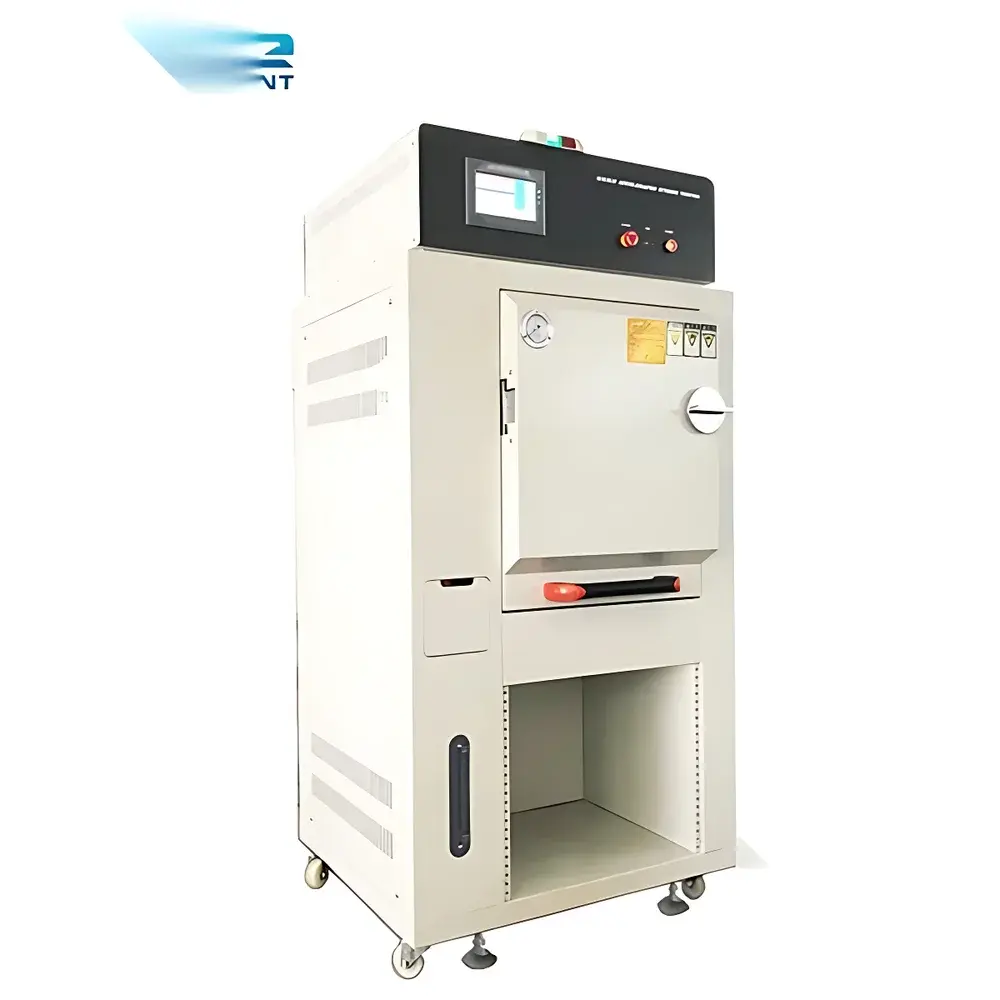
HAST Accelerated Aging Test Chamber – Industrial-Grade High-Pressure Steam Environment Simulator
| Brand | OEM / Custom Brand Available |
|---|---|
| Origin | Imported |
| Supplier Type | Authorized Distributor |
| Price | USD 13,500 (FOB) |
| Internal Chamber Dimensions | Ø350 × 500 mm (cylindrical) |
| Internal Material | SUS304 stainless steel |
| External Material | Powder-coated steel |
| Temperature Range | RT+10°C to 132°C (saturated steam) |
| Humidity Range | 75–100% RH (saturation-controlled) |
| Pressure Range | 0.00–2.90 kg/cm² gauge (max vessel rating: 3.5 kg/cm²) |
| Test Duration | 0–999 hours (programmable) |
| Temperature Uniformity | ±1.0°C |
| Ramp-up Time (RT→132°C) | ≤60 min |
| Pressurization Time (0→2.0 kg/cm²) | ≤50 min |
| Vacuum Preconditioning | Integrated particulate-filtered air purge (<1 µm filtration) |
| Water Autonomy | Up to 200 h per fill (optional fully automated补水 system available) |
Overview
The HAST Accelerated Aging Test Chamber is an engineered environmental stress screening system designed for high-fidelity simulation of high-temperature, high-humidity, and elevated-pressure conditions—specifically replicating saturated steam environments encountered in real-world operational lifecycles of hermetically sealed electronic components, multilayer PCBs, IC packages, LED modules, and automotive sensors. Unlike conventional THB (Temperature-Humidity-Bias) testing, this chamber operates under pressurized saturated steam (typically 100–132°C at 1.5–2.5 kg/cm² gauge), accelerating moisture diffusion through encapsulants and dielectric interfaces by orders of magnitude—enabling failure mode identification within days rather than weeks or months. Its cylindrical pressure vessel architecture complies with ASME BPVC Section VIII Div. 1 design principles for low-pressure steam service, ensuring structural integrity, thermal stability, and long-term repeatability under cyclic thermal-mechanical loading.
Key Features
- Cylindrical internal chamber (Ø350 × 500 mm) fabricated from electropolished SUS304 stainless steel—optimized for uniform steam distribution, condensate management, and corrosion resistance in aggressive humid environments.
- Radially symmetric inner liner geometry minimizes localized superheating and prevents direct impingement of latent heat on test specimens—critical for preserving thermal gradient fidelity across sensitive microelectronic assemblies.
- Self-sealing gasket system utilizing differential pressure-assisted compression: as internal pressure increases, the elastomeric packing deforms radially inward, enhancing sealing force without mechanical over-torque—extending gasket service life beyond 5,000 cycles.
- Interlocked door mechanism with dual-sensor validation (temperature + pressure) ensures physical access is prohibited until both parameters fall below safe thresholds—meeting IEC 61000-4-27 and ISO 13857 safety clearance requirements.
- Integrated vacuum preconditioning cycle evacuates ambient air and replaces it with HEPA-filtered (≤1 µm particle retention), low-oxygen, low-particulate atmosphere—reducing oxidation risk and improving test reproducibility for moisture-sensitive substrates.
- Automated pressure relief, vacuum break, and water replenishment sequences are programmable via embedded controller—supporting unattended operation for up to 200 hours per fill; optional closed-loop auto-refill with level monitoring and conductivity-based purity verification.
Sample Compatibility & Compliance
This chamber accommodates standard JEDEC trays (JEDEC JESD22-A110), 200 mm wafers (with custom carriers), SMT component reels, and molded plastic housings up to Ø300 mm diameter. It supports sample weights up to 15 kg distributed evenly across the horizontal cylindrical floor. All operational protocols align with internationally recognized accelerated reliability standards—including ASTM F1876 (HAST for plastic-encapsulated microcircuits), IEC 60068-2-66 (damp heat, accelerated, high pressure), JIS C 60068-2-66, MIL-STD-883 Method 1008.3, and AEC-Q200 qualification requirements for passive components. The system’s pressure control accuracy (±0.05 kg/cm²) and temperature stability (±0.3°C steady-state) meet GLP audit criteria for data traceability and method validation.
Software & Data Management
Equipped with a 7-inch industrial touchscreen HMI running embedded Linux, the chamber provides real-time logging of temperature, pressure, humidity, vacuum status, and elapsed time at user-defined intervals (1–60 s). All data are timestamped with NTP-synchronized UTC and stored locally on encrypted SD card (16 GB) with optional Ethernet/RS-485 Modbus TCP export. Audit trails include operator ID, parameter changes, alarm events, and calibration logs—all compliant with FDA 21 CFR Part 11 requirements when paired with optional PKI-based digital signature module. Export formats include CSV, PDF test reports, and XML metadata compatible with LIMS integration (e.g., LabWare, Thermo Fisher SampleManager).
Applications
Primary use cases include: accelerated moisture sensitivity level (MSL) grading per J-STD-020; qualification of conformal coatings and underfill materials; evaluation of solder joint intermetallic growth kinetics under combined thermo-hygro-mechanical stress; validation of MEMS package hermeticity; screening for electrochemical migration (ECM) and conductive anodic filament (CAF) formation in HDI PCBs; and reliability assessment of power semiconductor modules subjected to repeated thermal cycling under humid bias. The chamber is routinely deployed in R&D labs, wafer fabs, automotive Tier-1 supplier QC departments, and third-party certification bodies performing UL 746E, IEC 60747-19, and ISO/TS 16949-compliant testing.
FAQ
What is the maximum allowable test duration without manual intervention?
Standard configuration supports continuous operation for up to 200 hours per water fill; optional automated refill system enables indefinite runtime with remote monitoring.
Does the chamber support vacuum desiccation prior to steam exposure?
Yes—integrated vacuum pump and HEPA-filtered air reintroduction sequence is fully programmable and validated to achieve ≤10 Pa residual pressure with particulate-free atmosphere.
Is pressure calibration traceable to national standards?
All pressure transducers are factory-calibrated against NIST-traceable deadweight testers; annual recalibration certificate included with purchase.
Can the system be integrated into a central lab automation network?
Yes—Modbus TCP, OPC UA, and RESTful API interfaces are available for SCADA and MES integration; full protocol documentation provided upon request.
What safety certifications does the unit carry?
CE marked per Machinery Directive 2006/42/EC and EMC Directive 2014/30/EU; conforms to EN 61010-1:2010 for electrical safety in laboratory equipment.



