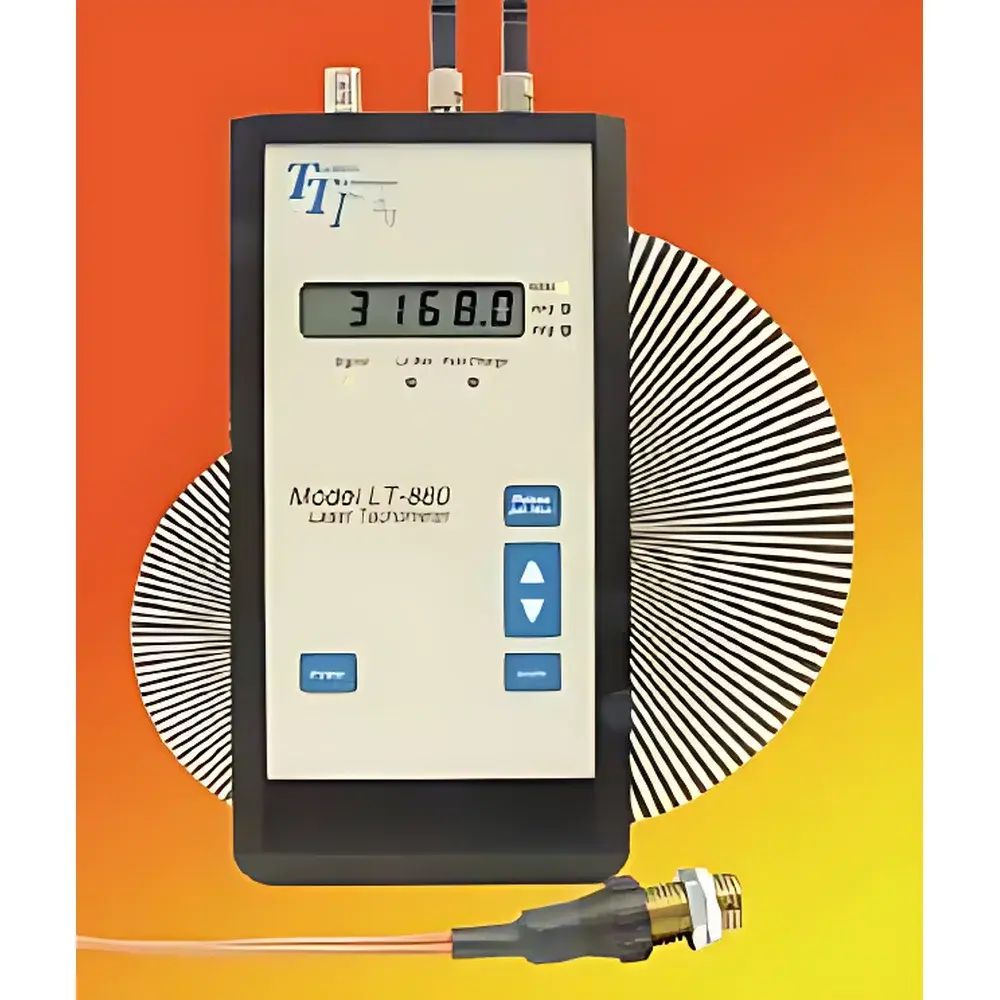
TTI LT880 Fiber Optic Laser Tachometer
| Origin | USA |
|---|---|
| Manufacturer Type | Authorized Distributor |
| Origin Category | Imported |
| Model | LT880 |
| Pricing | Available Upon Request |
Overview
The TTI LT880 Fiber Optic Laser Tachometer is a high-resolution, non-contact rotational and linear speed measurement instrument engineered for precision metrology in industrial, R&D, and quality assurance environments. It operates on the principle of optical reflectance modulation: a collimated laser beam emitted through a flexible 5-meter fiber-optic probe illuminates a rotating or translating surface marked with alternating high- and low-reflectivity segments (e.g., printed black-and-white patterns). Each transition between reflective and non-reflective zones generates a discrete TTL/CMOS-compatible digital pulse. The instrument’s photodetector captures intensity variations in the backscattered light, enabling real-time conversion of spatial periodicity into temporal frequency data. Unlike conventional photoelectric tachometers requiring standardized calibration tapes, the LT880 accepts user-generated reference patterns—eliminating consumables and reducing setup time. Its core architecture supports both RPM (revolutions per minute), RPS (revolutions per second), and PPS (pulses per second) output modes, with a maximum sampling rate of 40,000 PPS—sufficient to resolve sub-millisecond timing events in high-speed rotating machinery, turbine blades, motor armatures, or reciprocating components.
Key Features
- Fiber-optic coupling enables safe, remote operation in hazardous, high-temperature, electrically noisy, or physically inaccessible locations—including inside enclosures, near high-voltage equipment, or within vacuum chambers.
- 6-digit LCD display with selectable units: RPM, RPS, or PPS—configured via front-panel controls without software dependency.
- Native TTL/CMOS output compatible with oscilloscopes, spectrum analyzers, data acquisition systems (DAQ), programmable logic controllers (PLCs), and frequency counters for downstream spectral analysis of rotational harmonics, angular vibration, or velocity ripple.
- Self-contained battery-powered design ensures portability and operational independence from AC mains—ideal for field service, maintenance audits, and mobile lab applications.
- No mechanical contact or physical attachment required; eliminates loading effects, wear, and signal distortion associated with eddy-current or magnetic pickup sensors.
- Reflectance-agnostic detection: functions reliably with both retroreflective tape and matte-surface contrast patterns (e.g., inkjet-printed barcodes), supporting rapid ad-hoc target preparation.
Sample Compatibility & Compliance
The LT880 accommodates diverse sample geometries and surface conditions—including metallic shafts, polymer belts, composite rotors, ceramic rollers, and coated substrates—provided a minimum reflectance differential of ≥30% between adjacent pattern segments exists. It complies with IEC 61326-1:2013 for electromagnetic compatibility (EMC) in industrial environments and meets laser safety Class 2 requirements per IEC 60825-1:2014 (visible wavelength ≤1 mW output). While not certified to ISO/IEC 17025 for accredited calibration, its measurement traceability aligns with NIST-traceable standards when used with validated reference patterns. For regulated industries (e.g., aerospace MRO, pharmaceutical manufacturing), raw pulse outputs support integration into GLP/GMP-compliant data logging workflows when paired with 21 CFR Part 11–compliant acquisition software.
Software & Data Management
The LT880 operates as a standalone sensor with no embedded firmware or proprietary software dependency. All configuration and readout occur locally via the integrated display and tactile interface. However, its TTL/CMOS square-wave output facilitates seamless integration with third-party platforms—including MATLAB® Signal Processing Toolbox, LabVIEW™ DAQ modules, Python-based SciPy acquisition scripts, or commercial FFT analyzers—for time-domain waveform capture, frequency spectrum generation, and phase-resolved vibration diagnostics. Pulse timestamps can be logged with microsecond resolution using external high-speed counters, enabling post-acquisition calculation of instantaneous angular acceleration, jerk, or slip ratio in variable-speed drives.
Applications
- Dynamic balancing verification of centrifuges, fans, and spindles under operational load.
- Vibration mode identification in rotating assemblies via synchronous averaging of speed-correlated harmonics.
- Validation of encoder resolution and linearity in servo motor feedback loops.
- Line speed monitoring of web-handling systems (paper, film, foil) without mechanical slippage errors.
- RPM trending during thermal soak tests of electric motors and gearboxes.
- Non-intrusive validation of turbine engine rotational stability during ground testing.
- Academic research in tribology, fluid-structure interaction, and rotational dynamics where minimal sensor mass loading is critical.
FAQ
Does the LT880 require factory calibration before use?
No—its optical pulse generation mechanism is inherently stable and does not drift with ambient temperature or battery voltage. Users may verify performance using a known-speed reference (e.g., calibrated motor or strobe tachometer) prior to critical measurements.
Can the LT880 measure angular vibration directly?
Not autonomously—but its high-frequency PPS output provides the fundamental time-series data required for angular displacement reconstruction when processed with spectral analysis tools (e.g., order tracking, envelope demodulation).
Is the 5-meter fiber optic cable replaceable or extendable?
Yes—the standard SMA-terminated fiber is field-replaceable; custom lengths up to 15 meters are available with attenuation compensation. Extension beyond 5 meters may reduce signal-to-noise ratio depending on ambient lighting conditions.
What is the minimum detectable mark width?
At nominal operating distance (100–300 mm), the laser spot size is ~1.2 mm; therefore, minimum resolvable feature width is approximately 0.6 mm for reliable edge detection at full 40 kPPS capability.
Does the device store historical measurements internally?
No—it lacks onboard memory or USB connectivity. All data must be captured externally via its digital output interface.