
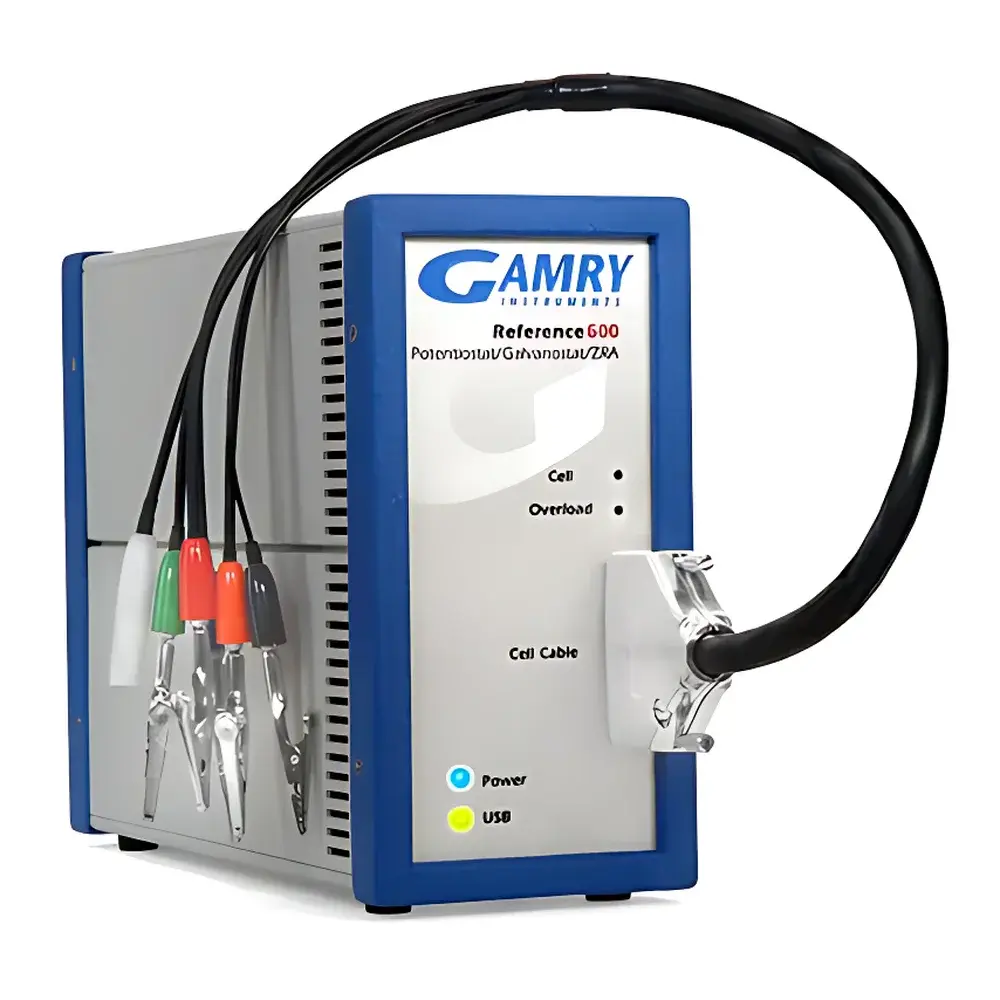
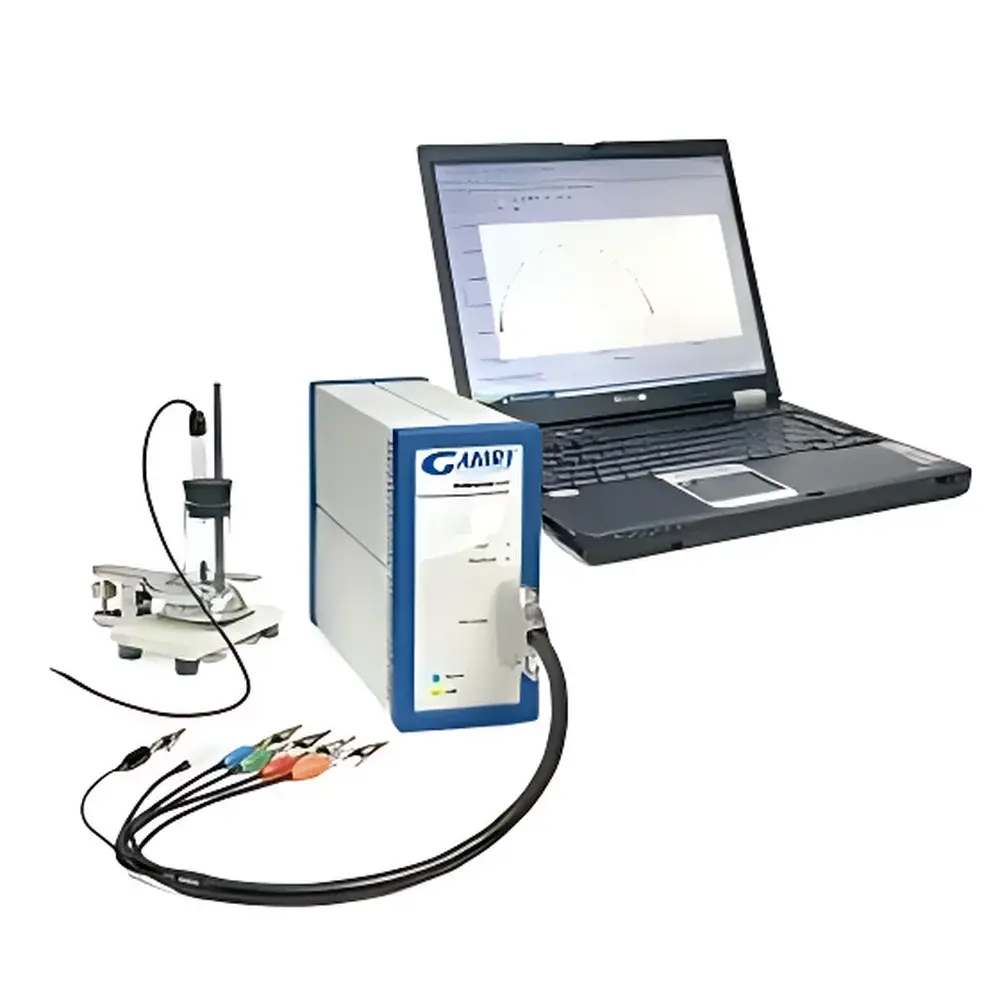
Gamry Reference 600 Electrochemical Workstation
| Brand | Gamry |
|---|---|
| Origin | USA |
| Model | Reference 600 |
| Instrument Type | Electrochemical Workstation |
| Current Range | 600 fA – 600 mA |
| Current Accuracy | ±10 pA or ±0.3% of reading |
| Potential Accuracy | ±1 mV or ±0.2% of range |
| Potentiostatic Range | ±22 V |
| AC Impedance Frequency Range | 10 µHz – 1 MHz |
| Potential Resolution | 1 µV |
| Current Resolution | 20 aA |
| Input Bias Current | <5 pA (typ. <2 pA) |
| Maximum Output Current | ±600 mA |
| Cell Voltage Compliance | ±22 V |
| Applied Voltage Range | ±11 V |
| Sampling Rate | 300 kS/s |
| Floating Ground Architecture | Yes |
| EIS Excitation | Direct Digital Synthesis (DDS) with sub-harmonic sampling |
Overview
The Gamry Reference 600 Electrochemical Workstation is a high-precision, floating-ground potentiostat/galvanostat engineered for demanding electrochemical research and industrial applications requiring exceptional current resolution, wide dynamic range, and robust noise immunity. It operates on the fundamental principles of controlled-potential and controlled-current electrochemistry, enabling quantitative measurement of interfacial charge transfer, double-layer capacitance, diffusion-controlled kinetics, and impedance response across electrochemical systems—from ultra-low-conductivity coatings to highly resistive corrosion interfaces. Its architecture integrates dual-processor signal conditioning (PowerPC for analog front-end control and USB-connected microcontroller for digital interface), ensuring galvanic isolation between the electrochemical cell and host computer. This design eliminates ground loops and enables true in-situ measurements on grounded or electrically noisy platforms—such as autoclaves, fatigue test frames, buried pipelines, or TEM-compatible electrochemical cells—without external isolation accessories or empirical correction.
Key Features
- Floating-ground topology with fully isolated analog circuitry and shielded DC power supply, eliminating common-mode interference in high-impedance measurements.
- 11 standard current ranges (600 mA to 60 pA), plus two extended low-current ranges (6 pA and 600 fA), delivering sub-attoampere resolution (20 aA) and calibrated accuracy down to ±3 pA ±0.12% of range.
- Potentiostatic control with ±22 V compliance, ±11 V maximum applied voltage, and 1 µV potential resolution—optimized for high-voltage coating breakdown studies and aggressive electrolyte environments.
- Integrated EIS capability using Direct Digital Synthesis (DDS) waveform generation and sub-harmonic sampling, supporting impedance spectroscopy from 10 µHz to 1 MHz with phase accuracy <0.1° and magnitude error <0.1% over 10−2–1012 Ω.
- 300 kS/s real-time sampling rate with hardware-triggered acquisition, enabling ultrafast cyclic voltammetry (up to 106 V/s) and transient analysis of rapid electrode processes.
- Modular expansion support for multi-channel operation via synchronized auxiliary potentiostats, facilitating parallel corrosion monitoring or multi-electrode sensor arrays.
Sample Compatibility & Compliance
The Reference 600 is routinely deployed in ASTM G5/G59/G102-compliant corrosion testing (e.g., polarization resistance, electrochemical noise, critical pitting temperature determination), ISO 16773-2 coating impedance evaluation, and USP electrochemical sensor validation workflows. Its floating-ground architecture satisfies IEC 61000-4-6 immunity requirements for conducted RF disturbances, while its analog isolation meets GLP/GMP environmental monitoring prerequisites for trace-level redox sensing. The system supports electrode configurations including three-electrode cells, rotating disk electrodes (RDE), ultramicroelectrodes (UME), and custom multi-terminal setups—ideal for studying heterogeneous catalysis, battery interphases, bioelectrochemical interfaces, and conductive polymer films. All hardware and firmware comply with FCC Part 15 Class B and CE electromagnetic compatibility directives.
Software & Data Management
Controlled by Gamry’s Framework™ software suite, the Reference 600 provides an Office-style GUI with context-sensitive menus, drag-and-drop experiment sequencing, and open-source scripting (via Python and .NET APIs). Preconfigured application packages—including DC105 (corrosion & coatings), EIS300 (impedance), EXPLAIN (noise analysis), and CPT (critical pitting temperature)—are validated per ASTM F2129 and ISO 10993-15. Data files adhere to HDF5-based binary format with embedded metadata (timestamp, calibration coefficients, instrument settings), ensuring auditability under FDA 21 CFR Part 11 when configured with electronic signatures and audit-trail logging. Offline analysis modules permit post-acquisition processing—including Kramers–Kronig validation, distribution of relaxation times (DRT), and equivalent circuit fitting—on standalone workstations without interrupting live experiments.
Applications
- Long-term corrosion monitoring of reinforced concrete, offshore platforms, and nuclear waste containment materials under simulated service conditions.
- High-resistivity coating integrity assessment (e.g., epoxy, polyurethane, sol-gel layers) via low-frequency EIS and pore resistance modeling.
- In-situ electrochemical characterization during mechanical loading (tribocorrosion), thermal cycling, or hydrothermal aging in autoclave-coupled cells.
- Ultra-low-current detection in biosensor development, single-molecule electron transfer studies, and nanoelectrode array mapping.
- Electrochemical noise analysis (ENA) for localized corrosion initiation prediction and stochastic process quantification.
- Development and validation of reference electrodes, pH sensors, and solid-state ion-conducting membranes.
FAQ
Is the Reference 600 compatible with third-party electrochemical cells and accessories?
Yes—it supports standard BNC, banana, and SMA connectors and is fully interoperable with commercial electrochemical cells, Faraday cages, temperature controllers, and flow cells.
Does the system meet regulatory requirements for pharmaceutical or medical device testing?
When deployed with Framework’s Part 11-compliant configuration (audit trail, user authentication, electronic signatures), it satisfies data integrity requirements for USP, EP, and ISO 13485-aligned electrochemical validation protocols.
Can EIS data be acquired simultaneously with DC techniques like potentiodynamic polarization?
Yes—multi-technique sequences (e.g., EIS superimposed on OCP decay or after potentiostatic hold) are natively supported through scriptable experiment trees.
What is the warranty and service coverage for international users?
Gamry provides a 24-month limited hardware warranty; global technical support is available via remote diagnostics, and authorized service centers operate in North America, Europe, and Asia-Pacific regions.
How does the floating-ground design improve measurement fidelity in high-impedance systems?
By decoupling the instrument’s analog ground from earth reference, it eliminates stray capacitive coupling and leakage currents that dominate errors in systems exceeding 109 Ω—critical for accurate coating defect detection and passive film characterization.





