
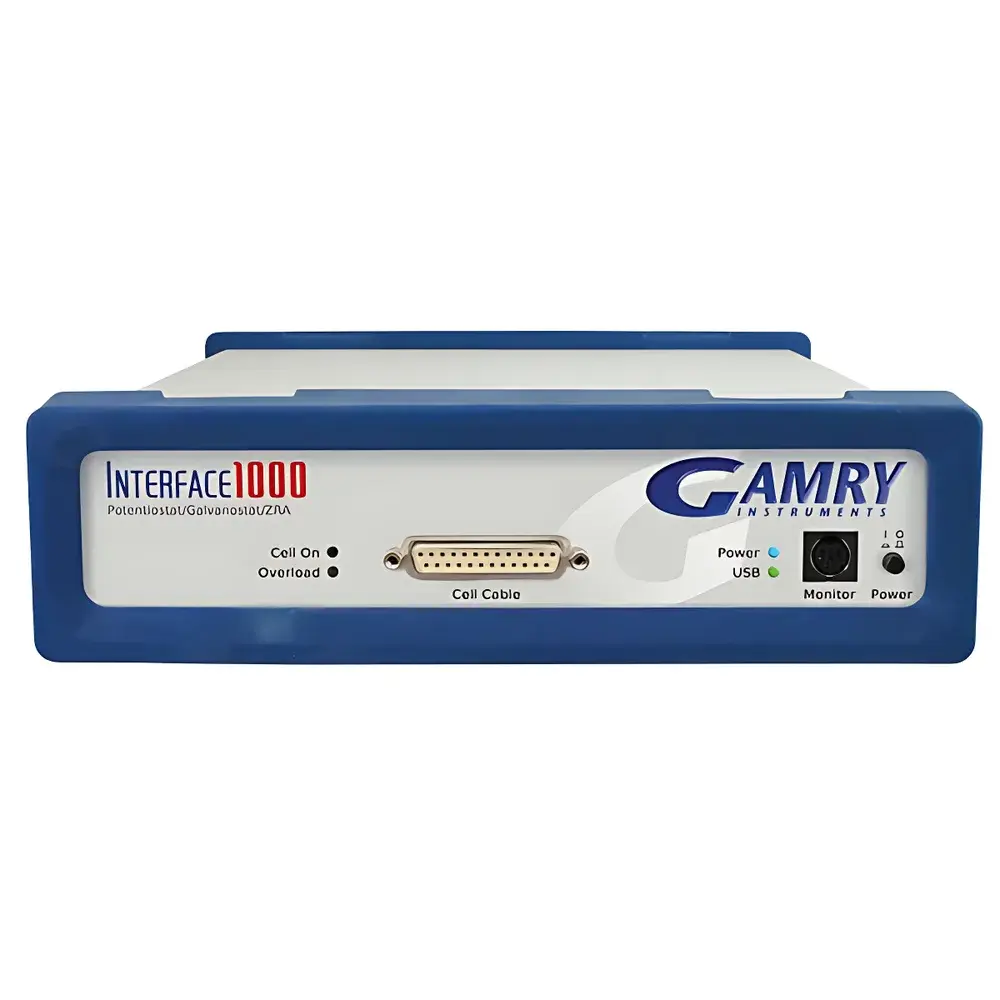
Gamry Interface 1000 Electrochemical Workstation
| Brand | Gamry |
|---|---|
| Origin | USA |
| Model | Interface 1000 |
| Current Range | 100 pA – 1 A |
| Current Accuracy | ±0.2% of reading |
| Potential Accuracy | ±0.2% of full scale |
| Potentiostatic Range | ±12 V |
| EIS Frequency Range | 10 µHz – 1 MHz |
| Potentiostat Architecture | Floating (True Ground-Independent) |
| Voltage Compliance | ±22 V |
| Potential Resolution | 1 µV |
| Current Resolution | 3.3 fA |
| Built-in FRA | Yes, integrated up to 1 MHz |
Overview
The Gamry Interface 1000 is a high-performance, floating electrochemical workstation engineered for precision potentiostatic, galvanostatic, and electrochemical impedance spectroscopy (EIS) measurements in research and industrial laboratories. Based on Gamry’s proven bipotentiostat architecture and low-noise analog front-end design, the Interface 1000 operates on the principle of three-electrode potentiostatic control—maintaining precise potential between working and reference electrodes while measuring current at the working electrode relative to the counter electrode. Its true floating design enables reliable operation with grounded working electrodes, multi-electrode cells sharing a common electrolyte, or non-aqueous systems requiring electrical isolation. With a wide compliance voltage (±22 V), high current output (±1 A), and ultra-low current detection capability (down to 100 pA, extendable to 10 pA via software gain), the system supports demanding applications including battery cycling, corrosion under realistic environmental conditions, fuel cell catalyst evaluation, and thin-film sensor characterization.
Key Features
- Floating Potentiostat Architecture: Enables measurement of grounded or electrically isolated working electrodes—critical for corrosion studies in conductive media (e.g., seawater, soil, concrete), high-temperature/pressure autoclave integration, and TEM-electrochemical cell coupling.
- Integrated Frequency Response Analyzer (FRA): Full EIS capability from 10 µHz to 1 MHz without external modules; supports multi-sine, single-sine, and stabilized EIS modes compliant with ASTM G106 and ISO 16773 standards.
- Ultra-Low Noise Performance: Input-referred noise < 20 µV RMS (typical), ensuring high signal-to-noise ratio for microelectrode and low-current kinetic studies (e.g., electron transfer rate determination).
- High-Resolution Control & Measurement: 1 µV potential resolution and 3.3 fA current resolution (at highest gain setting); current accuracy specified as ±0.2% of reading plus ±5 pA offset.
- Modular Multi-Channel Scalability: Supports up to eight independent channels via optional expansion; each channel maintains full specification—enabling synchronized EIS + CV on separate cells (e.g., glovebox vs. ambient benchtop vs. reactor vessel).
- Open-Source Software Framework (Framework™): Python- and .NET-accessible API allows custom protocol development, real-time data streaming, and integration with LabVIEW or MATLAB environments—fully compatible with GLP/GMP audit-trail requirements when configured with electronic signature and 21 CFR Part 11 extensions.
Sample Compatibility & Compliance
The Interface 1000 accommodates standard three-electrode cells (e.g., Pt/C/Ag|AgCl), rotating disk electrodes (RDE), microelectrodes, coated metal substrates, solid-state batteries (with appropriate test fixtures), and multi-electrode arrays. It meets IEC 61000-4-3 (EMC immunity), UL 61010-1 (safety), and RoHS directives. For regulated environments, optional software modules provide FDA 21 CFR Part 11-compliant user authentication, electronic signatures, and immutable audit trails. All electrochemical methods—including cyclic voltammetry (ASTM D7918), linear sweep voltammetry (ASTM G5), polarization resistance (ASTM G59), and EIS (ASTM G106)—are implemented per published standard definitions with traceable calibration protocols.
Software & Data Management
Framework™ software provides an intuitive, Office-style ribbon interface with context-sensitive menus and drag-and-drop method sequencing—reducing operator training time without sacrificing analytical depth. Raw data are stored in open HDF5 format, supporting metadata embedding (timestamp, instrument ID, user, method parameters). Offline analysis tools include Kramers–Kronig validation, equivalent circuit fitting (ZView®-compatible), Tafel slope extraction, and diffusion-controlled peak deconvolution. Batch processing scripts can be exported and reused across instruments. Data export options include CSV, Excel (.xlsx), and MPT-compatible formats for third-party modeling platforms (e.g., COMSOL, DigiElch).
Applications
- Battery R&D: Galvanostatic intermittent titration technique (GITT), differential capacity analysis (dQ/dV), SEI growth monitoring via low-frequency EIS.
- Corrosion Science: Zero-resistance ammeter (ZRA) mode for galvanic couple studies; electrochemical noise analysis (ENA) per ASTM G199.
- Fuel Cells & Electrolysers: Catalyst activity mapping via CO stripping, hydrogen underpotential deposition (HUPD), and membrane resistance tracking.
- Sensor Development: Amperometric detection limits, interference rejection assessment, and stability profiling over >1000 cycles.
- Physical Electrochemistry: Electron transfer kinetics (Butler–Volmer analysis), double-layer capacitance quantification, and mass transport modeling.
- Coatings & Inhibitors: Pore resistance evolution, delamination onset detection, and inhibitor efficiency calculation per ASTM D1141.
FAQ
Is the Interface 1000 suitable for grounded working electrode configurations?
Yes—the floating architecture eliminates ground loops and enables direct measurement of electrodes connected to earth-referenced systems such as pipelines, reinforced concrete, or high-pressure reactors.
Can EIS and DC techniques run simultaneously on different channels?
Yes—multi-channel synchronization allows concurrent EIS on one cell and potentiodynamic polarization on another, with time-aligned data acquisition and shared reference timing.
Does the system support low-current measurements below 1 nA?
Yes—using internal gain switching and hardware filtering, the Interface 1000 achieves stable 100 pA full-scale resolution; sub-picoampere currents are resolvable with averaging and optimized shielding.
How is calibration traceability maintained?
Gamry provides NIST-traceable calibration certificates for voltage, current, and impedance; annual recalibration services include full functional verification against ISO/IEC 17025-accredited procedures.
What safety protections are built into the hardware?
Overvoltage, overcurrent, and thermal shutdown circuits are embedded in each channel; programmable compliance limits prevent damage during unexpected short circuits or electrolyte drying.





