
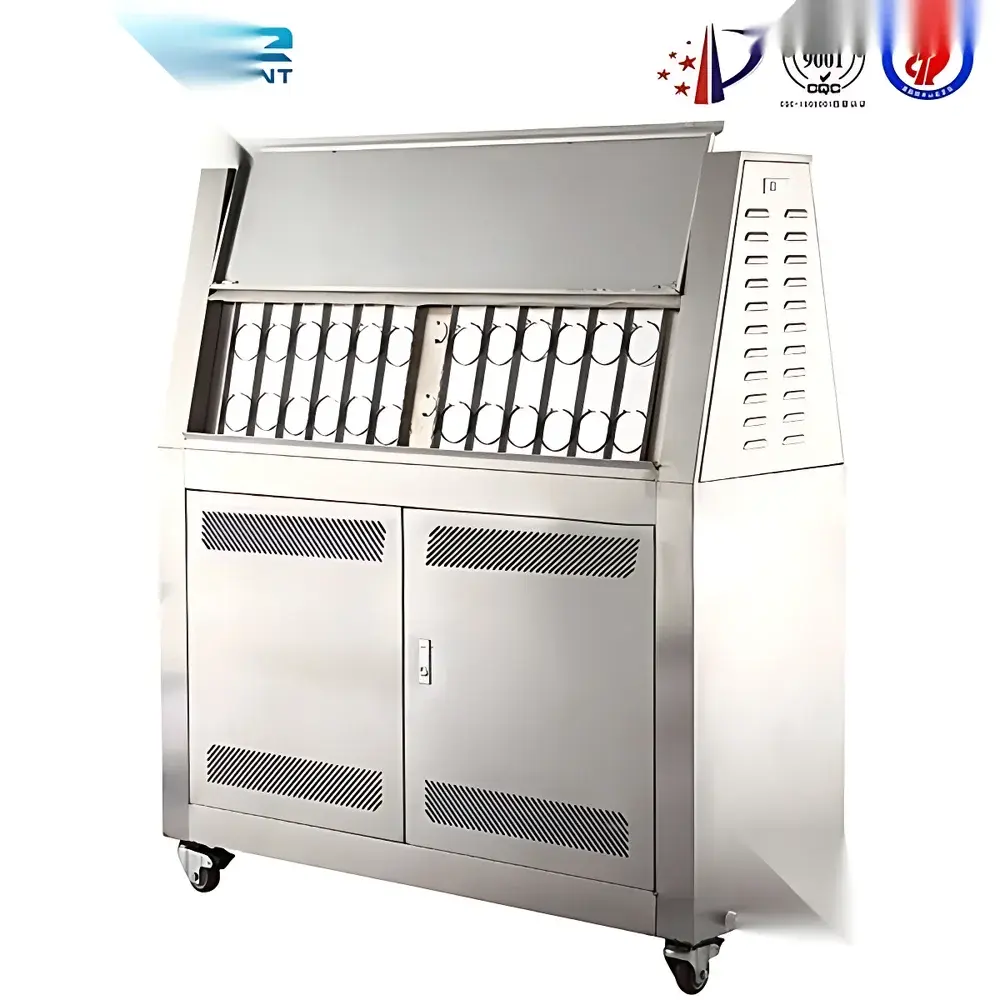
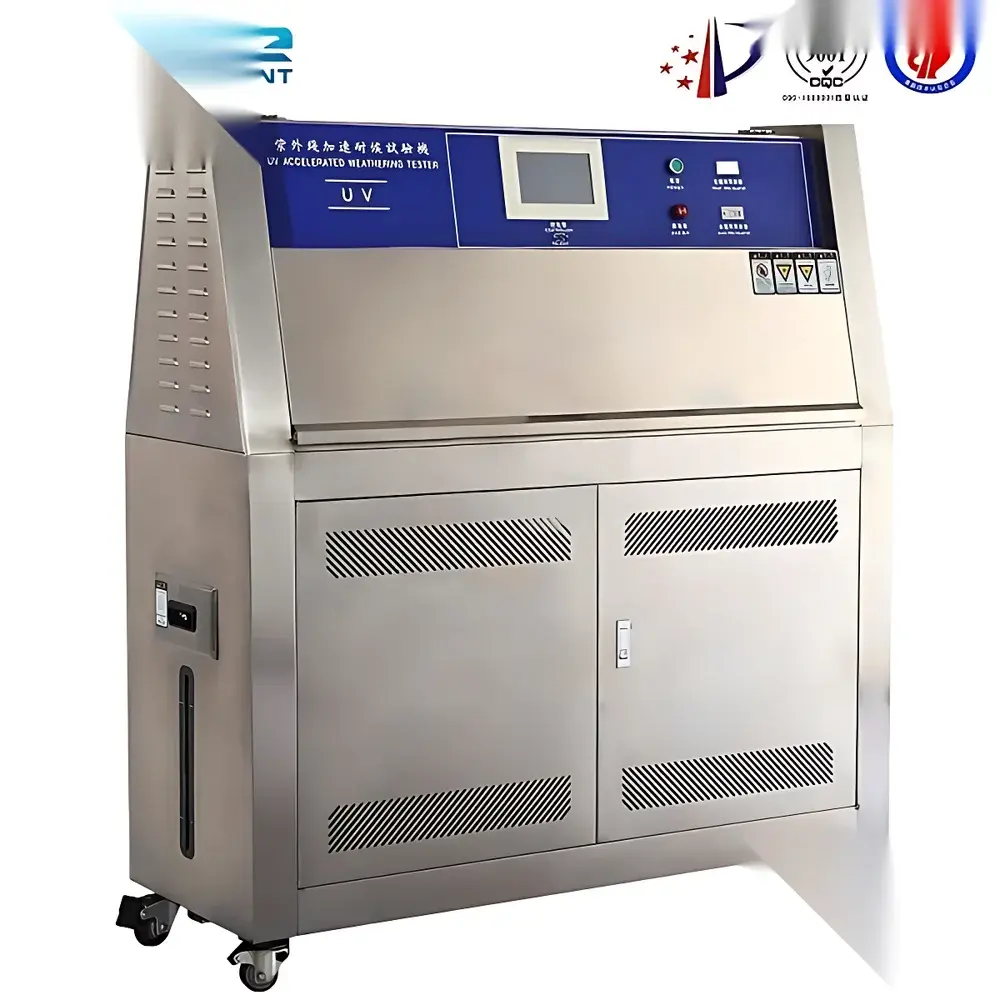
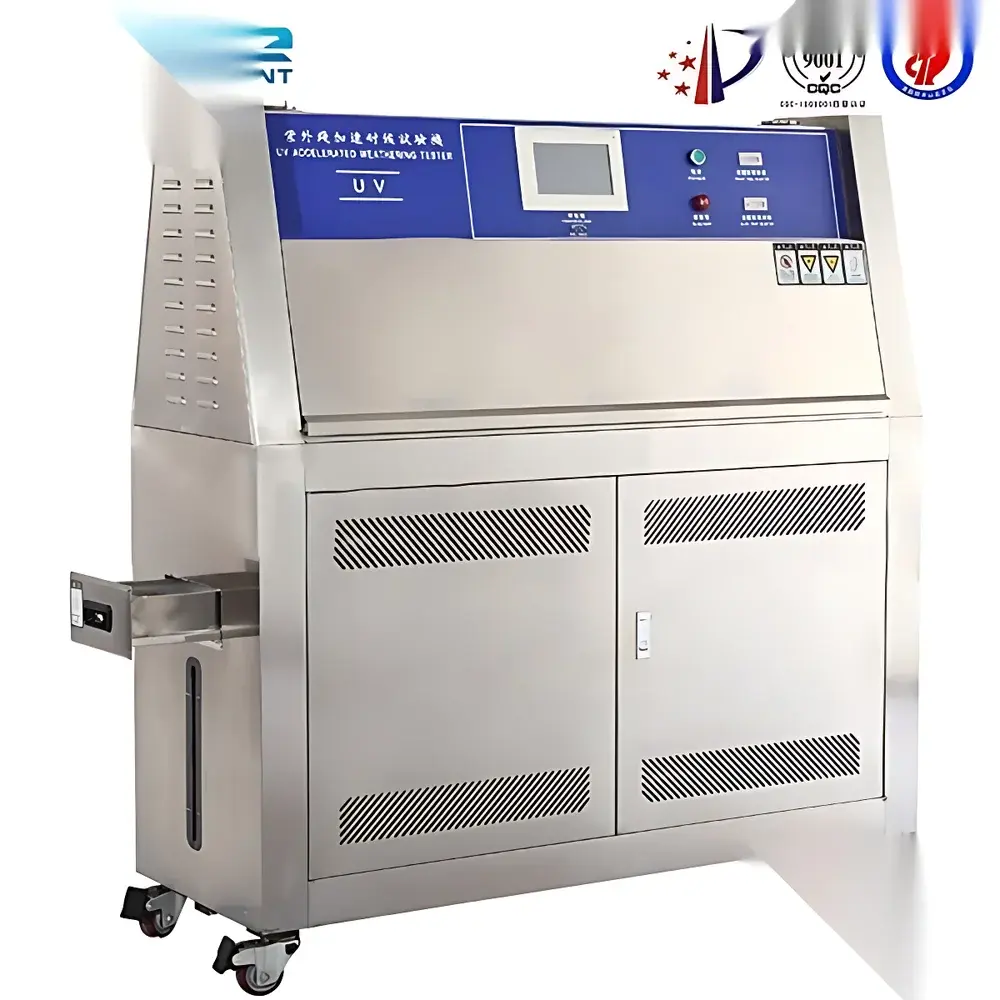
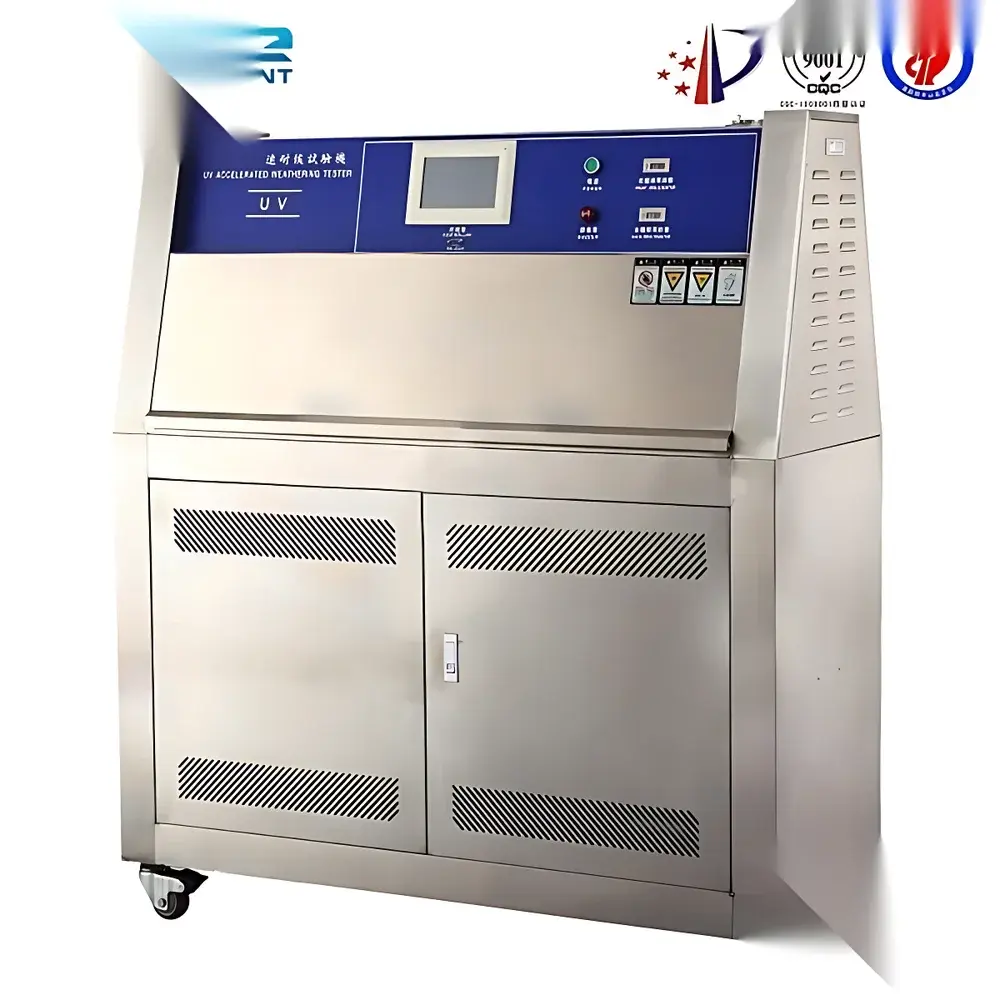
UV Aging Test Chamber – Fluorescent UV Accelerated Weathering Tester
| Brand | OEM / Generic |
|---|---|
| Origin | Imported |
| Manufacturer Type | Authorized Distributor |
| Price Reference | USD 2,600 (excl. tax & freight) |
Overview
The UV Aging Test Chamber is an engineered environmental test system designed to simulate and accelerate the photochemical degradation effects of natural sunlight—specifically ultraviolet (UV) radiation—and moisture exposure on polymeric, coating, automotive, textile, and packaging materials. Based on the ASTM G154 and ISO 4892-3 standards, it employs fluorescent UV lamps (UVA-340 or UVB-313) to replicate the spectral distribution of terrestrial solar UV irradiance below 400 nm. Concurrent condensation cycles—generated via controlled temperature-induced water vapor saturation on specimen surfaces—mimic nocturnal dew formation. This dual-stress methodology enables rapid assessment of material durability under cyclic UV irradiation and humidity, compressing years of outdoor exposure into days or weeks in a reproducible, laboratory-controlled setting.
Key Features
- Fluorescent UV lamp array with selectable spectral output (UVA-340 for daylight simulation; UVB-313 for aggressive, accelerated testing)
- Programmable irradiance control (typically 0.35–1.55 W/m² @ 340 nm) with real-time feedback via calibrated UV sensor
- Condensation cycle generation through bottom-mounted water reservoir and precise chamber wall temperature control (typically 40–60 °C black panel temperature)
- Integrated water spray function for thermal shock and surface erosion simulation (optional per configuration)
- Digital touch-screen controller with multi-step cycling capability (e.g., 4-hr UV + 4-hr condensation; customizable ramp profiles)
- Stainless steel 316L inner chamber with corrosion-resistant hardware and sealed gasketed door
- Over-temperature, over-irradiance, and low-water-level safety interlocks compliant with IEC 61000-6-2/6-4 EMC requirements
Sample Compatibility & Compliance
The chamber accommodates flat specimens up to 75 mm × 150 mm (standard rack capacity: 48 positions), with optional fixtures for 3D parts, coated panels, or film substrates. It supports standardized test protocols including ASTM D4329 (plastics), ASTM D4587 (coatings), ISO 11507 (paints and varnishes), and SAE J2020 (automotive exterior materials). All operational parameters—including irradiance uniformity (±15% across sample plane), temperature stability (±2 °C), and condensation duration—are traceable to NIST-calibrated instrumentation. The system architecture meets GLP documentation requirements for audit-ready test records when paired with compliant data logging software.
Software & Data Management
Equipped with embedded firmware supporting USB export of time-stamped test logs (irradiance, chamber temperature, condensation status, cycle count). Optional PC-based software provides full remote monitoring, automated report generation (PDF/CSV), and compliance with FDA 21 CFR Part 11 via electronic signature, audit trail, and user role management. Data integrity safeguards include write-protected storage, cyclic redundancy check (CRC) validation, and automatic backup to external drives. Historical calibration certificates and lamp usage hours are stored within device memory and retrievable via diagnostic menu.
Applications
- Evaluation of UV stabilizers, HALS additives, and pigment dispersion efficacy in thermoplastics and elastomers
- Qualification of automotive clearcoats and interior trim materials against ISO 16322-2 and GMW14124
- Validation of photovoltaic encapsulant yellowing resistance per IEC 61215-2 MQT10
- Accelerated aging of medical device packaging films (e.g., Tyvek®) per ISO 11607-1 Annex B
- Correlation studies between lab-based UV/condensation exposure and real-world field performance in tropical or desert climates
- QC release testing for batch-to-batch consistency of architectural coatings and roofing membranes
FAQ
What UV lamp types are supported, and how do they differ?
The chamber accepts UVA-340 lamps (peak emission at 340 nm), closely matching solar UV below 360 nm, and UVB-313 lamps (peak at 313 nm), delivering higher-energy photons for extreme stress screening. Lamp selection must align with the applicable standard (e.g., ASTM G154 Cycle 1 specifies UVA-340).
Is condensation mandatory in every test cycle?
No—condensation is programmable and may be omitted or replaced with dark soak periods depending on material failure mode. However, inclusion of condensation is required for standards assessing hydrolytic degradation (e.g., ISO 4892-3 Method A).
How often must UV lamps be replaced?
Fluorescent UV lamps degrade spectrally and radiometrically; replacement is recommended after 1,600–2,000 hours of operation or per manufacturer’s calibration schedule—whichever occurs first—to maintain irradiance accuracy within ±10%.
Can this chamber be integrated into a LIMS or MES environment?
Yes—via Modbus TCP or RS-485 serial interface, the controller supports bidirectional communication for recipe upload, status polling, and alarm forwarding to enterprise systems.
What safety measures protect operators from UV exposure?
The chamber features interlocked door switches that instantly de-energize UV lamps upon opening, plus a visible “UV ON” indicator. Operators must wear ANSI Z87.1-compliant UV-blocking eyewear and limit direct exposure during sample loading/unloading (as per OSHA 1910.133 guidance).
Related Products



