
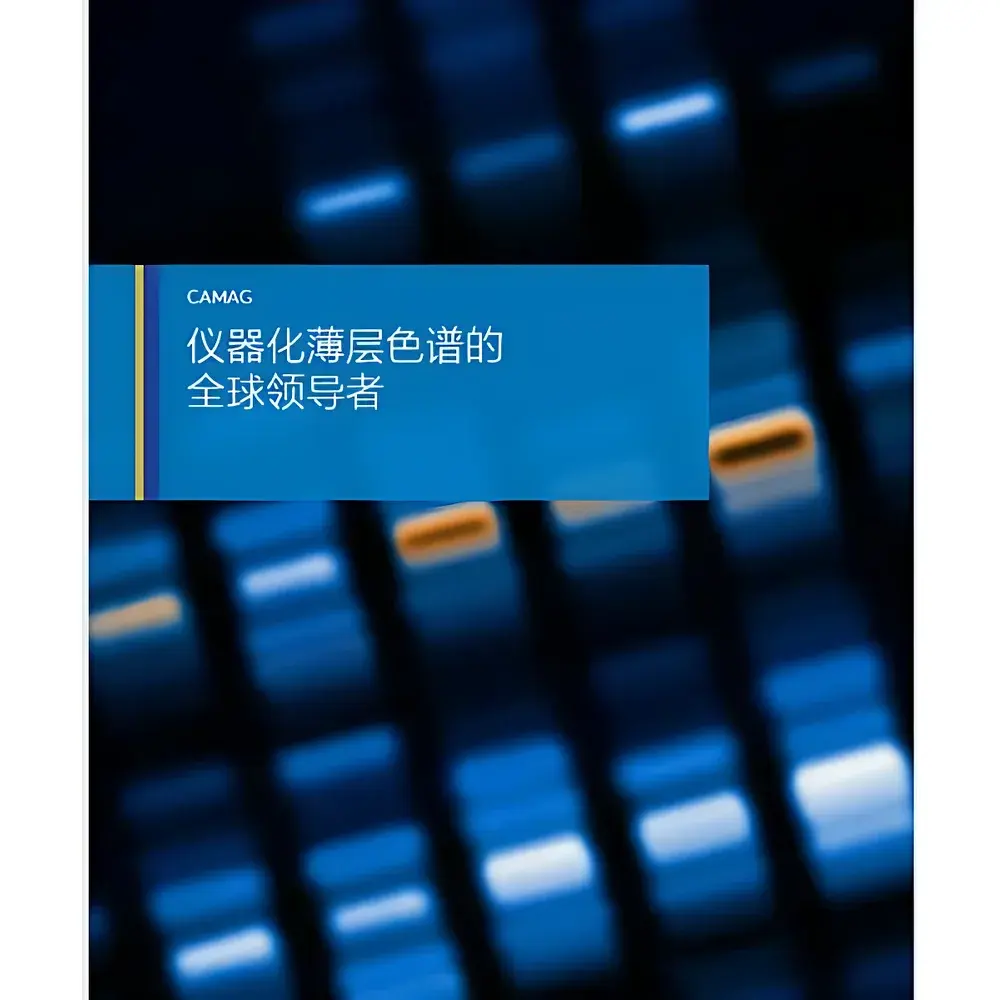
CAMAG Instrumented Thin-Layer Chromatography (TLC) System
| Brand | CAMAG (distributed by JHT / Yichenghengda) |
|---|---|
| Origin | Beijing, China |
| Manufacturer Type | Authorized Distributor |
| Country of Origin | PRC |
| Model | CAMAG TLC Systems (e.g., ATS 4, Linomat 5, Nanomat 4, ADC 2, AMD 2, TLC Visualizer 2, TLC Scanner 4, TLC-MS Interface 2, visionCATS 5) |
| Pricing | Upon Request |
Overview
Instrumented thin-layer chromatography (TLC) is a planar, solid-phase separation technique grounded in capillary-driven migration of analytes across a stationary phase—typically silica gel, alumina, or cellulose—coated on a rigid support (glass, aluminum, or plastic plate). Unlike conventional manual TLC, instrumented TLC integrates automated sample application, controlled development, derivatization, digital imaging, and quantitative densitometric scanning under standardized environmental conditions. The CAMAG platform implements this methodology with precision engineering for reproducible Rf values, linear dynamic range quantification, and seamless integration into regulated laboratory workflows. Its modular architecture supports both qualitative screening and validated quantitative analysis in compliance with ICH Q2(R2), USP , and EP 2.2.27 guidelines. The system operates on the principle of differential partitioning between mobile and stationary phases, enabling rapid method development, stability-indicating assays, and preparative fraction collection—all without requiring high-pressure instrumentation or complex solvent delivery systems.
Key Features
- Automated sample application via ATS 4 (full-automation), Linomat 5 (semi-automated linear/serial spotting), or Nanomat 4 (manual precision spotting) — ensuring consistent spot volume (0.1–2 µL), positional accuracy (<±0.2 mm), and minimal lateral diffusion.
- Controlled chromatographic development using AMD 2 (Automatic Multiple Development) or horizontal development tanks — enabling gradient elution, multi-step solvent programming, and reproducible migration distances (Rf CV <1.5%).
- Programmable derivatization modules including immersion (TLC Immersion Device), spraying (TLC Sprayer 2), heating (TLC Plate Heater), and vapor-phase reagent exposure — compatible with common reagents (e.g., anisaldehyde/H2SO4, ninhydrin, KMnO4).
- Digital evaluation via TLC Visualizer 2 (RGB + UV 254/366 nm imaging) and TLC Scanner 4 (densitometric scanning at 10–100 µm resolution, wavelength range 190–800 nm, reflectance/transmission modes).
- Direct hyphenation to mass spectrometry via TLC-MS Interface 2 — enabling online elution, post-chromatographic on-probe extraction, and atmospheric pressure ionization (API) coupling with LC-MS systems.
- Full audit trail, electronic signatures, and role-based access control compliant with FDA 21 CFR Part 11, EU Annex 11, and ISO/IEC 17025 requirements.
Sample Compatibility & Compliance
The CAMAG instrumented TLC system accommodates diverse sample matrices—including pharmaceutical actives, natural product extracts, polymers, lipids, peptides, and degradation products—without matrix-specific hardware modification. Pre-coated plates (standard, RP-18, NH2, F254/F366) are single-use and certified for batch traceability. All instruments meet CE marking requirements and conform to electromagnetic compatibility (EMC) Directive 2014/30/EU and Low Voltage Directive 2014/35/EU. Method validation documentation supports GLP and cGMP environments, with full traceability from raw data acquisition (TIFF, PDF, XML) through report generation. Plate handling complies with ISO 8573-1 (compressed air purity) where pneumatic components are employed.
Software & Data Management
visionCATS 5 serves as the unified software platform for instrument control, image acquisition, densitometric calibration, peak integration, and reporting. It supports multi-wavelength scanning, background subtraction algorithms, and calibration curves (linear, quadratic, log-log) per ICH Q2(R2) linearity criteria. Electronic records include timestamped metadata (operator ID, instrument ID, plate lot, ambient T/RH), raw scan files, and processed results—each cryptographically hashed and stored in a tamper-evident database. The software provides configurable user roles (Administrator, Analyst, Reviewer), electronic signature workflows, and automated backup to network-attached storage (NAS) or LIMS interfaces via ASTM E1467-compliant APIs. Audit trail review functions satisfy FDA inspection readiness requirements for data integrity (ALCOA+ principles).
Applications
Instrumented TLC is routinely applied in pharmaceutical quality control (assay, related substances, residual solvents), herbal fingerprinting (EP monographs), forensic toxicology (drug metabolite profiling), food adulterant screening (melamine, Sudan dyes), and polymer additive analysis (antioxidants, UV stabilizers). In R&D, it enables rapid scouting of mobile phase compositions prior to HPLC method transfer. The AMD 2 module facilitates forced degradation studies by sequential solvent fronts, while TLC-MS coupling permits structural elucidation of unknown bands directly from the plate—eliminating scraping, extraction, and solvent exchange steps. Regulatory submissions (e.g., ANDA, MAA) routinely include instrumented TLC data when justified by specificity, robustness, and comparability to reference methods.
FAQ
What regulatory standards does the CAMAG system support?
The system fully complies with FDA 21 CFR Part 11, EU GMP Annex 11, ISO/IEC 17025, and ICH Q2(R2) for analytical procedure validation.
Can visionCATS 5 integrate with existing LIMS or ERP systems?
Yes — via standardized ASTM E1467 or HL7 interfaces; custom API connectors are available upon request.
Is plate activation or pre-washing required before development?
Pre-activation (e.g., 10 min at 110 °C for silica plates) is recommended for reproducible Rf values; pre-washing is optional and method-dependent.
How is detection sensitivity quantified in instrumented TLC?
Limit of detection (LOD) is method-specific but typically ranges from 1–10 ng/spot for UV-active compounds and 10–100 ng/spot for derivatized analytes, verified per ICH Q2(R2) signal-to-noise criteria.
Are CAMAG plates compatible with third-party scanners or imaging systems?
CAMAG pre-coated plates are dimensionally standardized (e.g., 20 × 20 cm, 10 × 10 cm) and compatible with most commercial densitometers; however, optimal performance requires CAMAG-calibrated optics and firmware.




