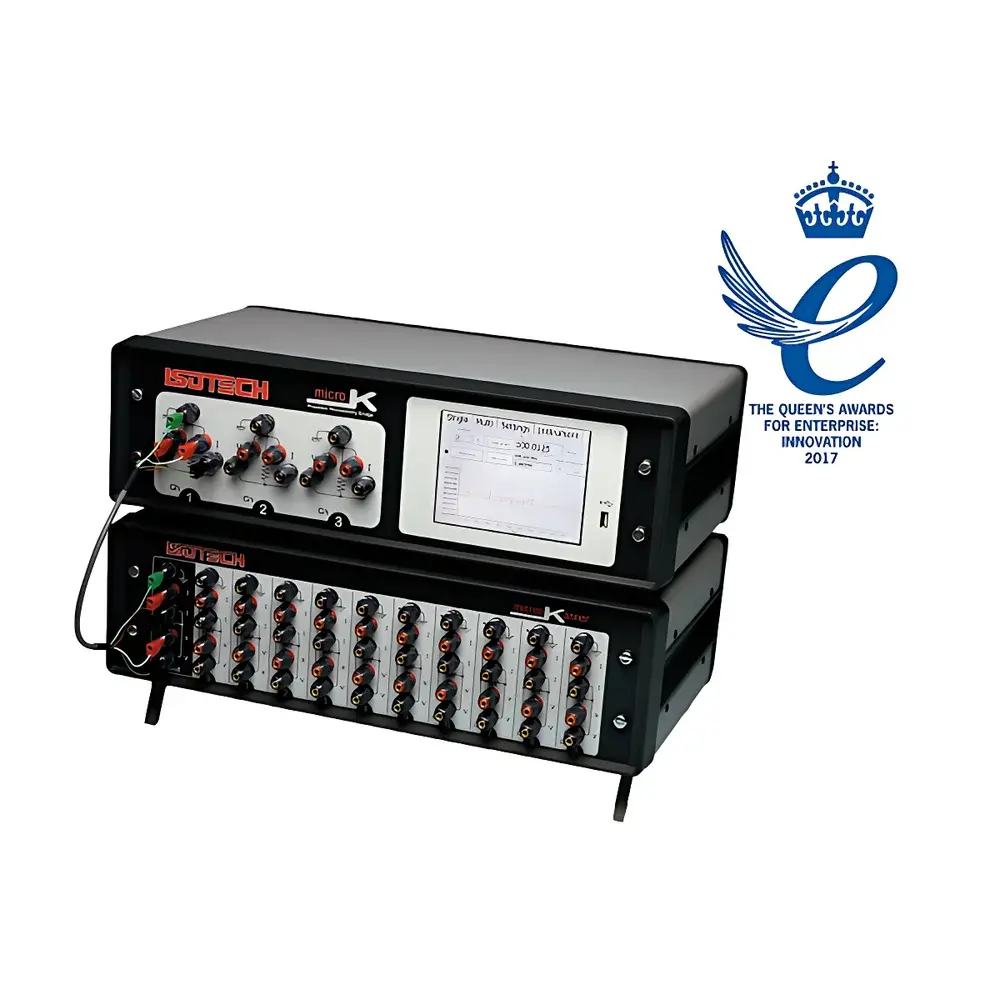
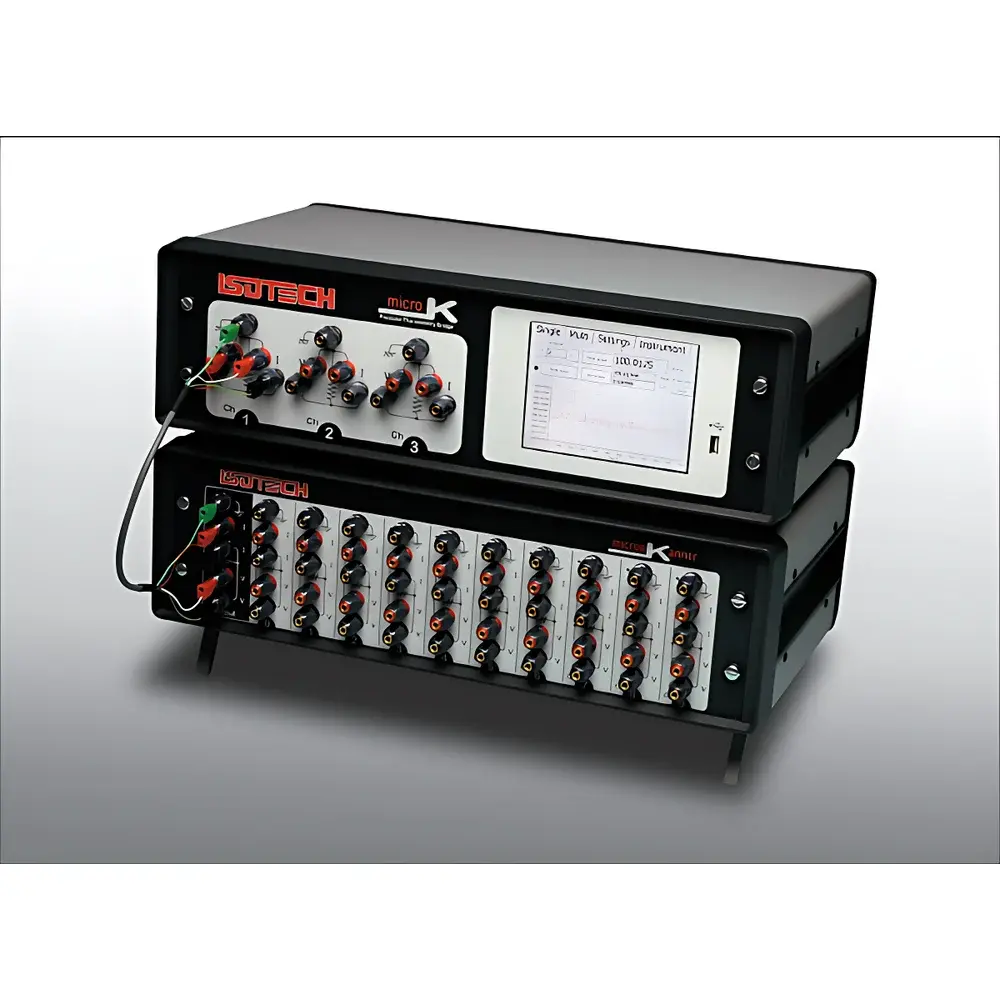
ISOTECH microK Precision Temperature Bridge
| Brand | ISOTECH |
|---|---|
| Origin | United Kingdom |
| Model | microK |
| Measurement Principle | Four-Terminal Resistance Ratio Metrology with Alpha-Delta ADC Architecture |
| Primary Application | Primary and Secondary Thermometry Calibration (SPRT, PRT, Thermistors, Thermocouples) |
| Channel Capacity | 3 Parallel Input Channels (Expandable to 90 via External Multiplexers) |
| Display | 6.4" TFT Color Touchscreen Running Windows CE |
| Data Export | Native Excel (.xls) Format via USB Storage |
| Terminal Interface | Gold-Plated Tellurium-Copper CablePod™ Sockets Accepting 4 mm Banana, Flat Blade, and Bare Wire |
| Thermal EMF Performance | < 0.1 µV Typical Contact EMF |
| Stability | < 3 ppm/year Voltage Drift |
| Compliance | Designed for ISO/IEC 17025 Accredited Laboratories |
Overview
The ISOTECH microK Precision Temperature Bridge is a metrology-grade resistance ratio instrument engineered for primary and secondary thermometry calibration in national metrology institutes (NMIs), accredited calibration laboratories, and high-precision industrial R&D environments. It operates on the fundamental principle of four-terminal, current-reversal resistance ratio measurement — a technique traceable to the International Temperature Scale of 1990 (ITS-90) and aligned with the recommendations of the CIPM Guide to the Expression of Uncertainty in Measurement (GUM). Unlike conventional digital multimeters or switching-based bridges, the microK employs a proprietary alpha-delta analog-to-digital converter architecture combined with inherent substitution methodology to eliminate zero drift in resistance measurements and suppress long-term voltage reference instability. Its design enables direct, simultaneous acquisition from three independent sensor inputs — eliminating mechanical relay switching, reducing thermal EMF contributions, and delivering sub-ppm-level repeatability across its full operational range (−200 °C to 962 °C for SPRTs with R₀ ≥ 2.5 Ω).
Key Features
- Three-channel parallel acquisition with real-time display of all channels — no manual switching required
- Alpha-delta ADC architecture enabling <0.07 ppm full-scale accuracy (microK70 model) and <0.017 ppm ratio accuracy in the 0.95–1.05 range
- Zero-drift resistance measurement via built-in substitution technique; voltage reference stability <3 ppm/year
- Integrated 6.4″ color touchscreen running Windows CE OS — fully self-contained operation without external PC
- USB host interface supporting keyboard, mouse, and mass storage devices for direct Excel (.xls) data export
- CablePod™ terminal system with gold-plated tellurium-copper contacts ensuring thermal EMF <0.1 µV and optimal contact reproducibility
- Constant excitation current control with “keep-warm” mode to maintain PRT thermal equilibrium during idle periods, minimizing self-heating uncertainty
- Solid-state architecture — no electromechanical relays — enhancing reliability, longevity, and maintenance-free operation
Sample Compatibility & Compliance
The microK supports a broad spectrum of temperature sensing elements under a single platform: Standard Platinum Resistance Thermometers (SPRTs), Industrial Platinum Resistance Thermometers (PRTs), thermistors (0–500 K), and thermocouples (with optional reference junction compensation). Its hardware and firmware architecture comply with the functional requirements of ISO/IEC 17025:2017 for calibration laboratories, including documented measurement uncertainty budgets, traceability chains to NMIs (e.g., NPL, NIST, PTB, NIM), and configurable audit logging. When paired with ISOTECH’s certified software suite, the system supports electronic signature, user access control, and data integrity features aligned with FDA 21 CFR Part 11 for regulated environments. The device has been validated for use in climate-controlled metrology labs, aerospace environmental test facilities, nuclear instrumentation qualification, and oceanographic sensor certification programs.
Software & Data Management
The embedded Windows CE operating system provides an intuitive, menu-driven interface optimized for metrological workflows. All configuration parameters — excitation current, integration time, channel mapping, and unit conversion — are adjustable directly on the touchscreen. Measurement data are stored internally and exported in native Microsoft Excel format via USB flash drive, preserving column headers, timestamps, and metadata (e.g., channel ID, sensor type, calibration date). Optional PC-based software extends functionality with automated ITS-90 interpolation, uncertainty propagation modeling, certificate generation (per ISO 17025 Annex A.3), and batch reporting. Audit trail records include operator ID, parameter changes, calibration events, and data export actions — configurable to meet GLP and GMP documentation standards.
Applications
- Primary thermometer calibration at NMIs and regional metrology institutes (e.g., NPL, NIST, PTB, NIM)
- Industrial PRT and thermistor calibration in ISO/IEC 17025-accredited laboratories
- Thermal validation of environmental chambers, autoclaves, and pharmaceutical manufacturing equipment
- Reference-grade temperature monitoring in aerospace ground-test facilities and satellite thermal vacuum chambers
- Research-grade cryogenic and high-temperature sensor characterization (e.g., superconducting transition studies, furnace uniformity mapping)
- Field-deployable metrology support for offshore oil & gas platforms and marine observatories
FAQ
What is the difference between full-scale accuracy and ratio accuracy in the microK specification?
Full-scale accuracy refers to absolute resistance measurement uncertainty over the entire bridge range (e.g., 0.07 ppm of 1 Ω). Ratio accuracy applies specifically to comparisons between two resistors (e.g., unknown vs. reference SPRT) and defines the uncertainty in their quotient — critical for ITS-90 interpolation where only resistance ratios matter.
Can the microK operate without a connected PC?
Yes. All core functions — setup, acquisition, display, and Excel export — are fully supported via the integrated touchscreen and onboard OS. A PC is only required for advanced analysis or certificate generation using optional software.
Does the microK support thermocouple measurements natively?
It does not measure thermocouple voltage directly. However, when used with a certified ice-point reference junction block and appropriate cold-junction compensation settings, it can serve as the resistance-measurement engine within a complete thermocouple calibration system.
How is traceability maintained during field deployment?
Each microK unit ships with a UKAS-accredited calibration certificate. Internal reference standards are periodically verified against traveling standards traceable to NPL. Firmware version, calibration date, and sensor-specific correction tables are digitally embedded and exportable with every dataset.
What maintenance is required for long-term stability?
No routine recalibration is needed within the specified 12-month interval. The solid-state design eliminates relay wear. Users should verify thermal EMF performance annually using short-circuit null tests and confirm excitation current stability via external DMM cross-check.
Related Products