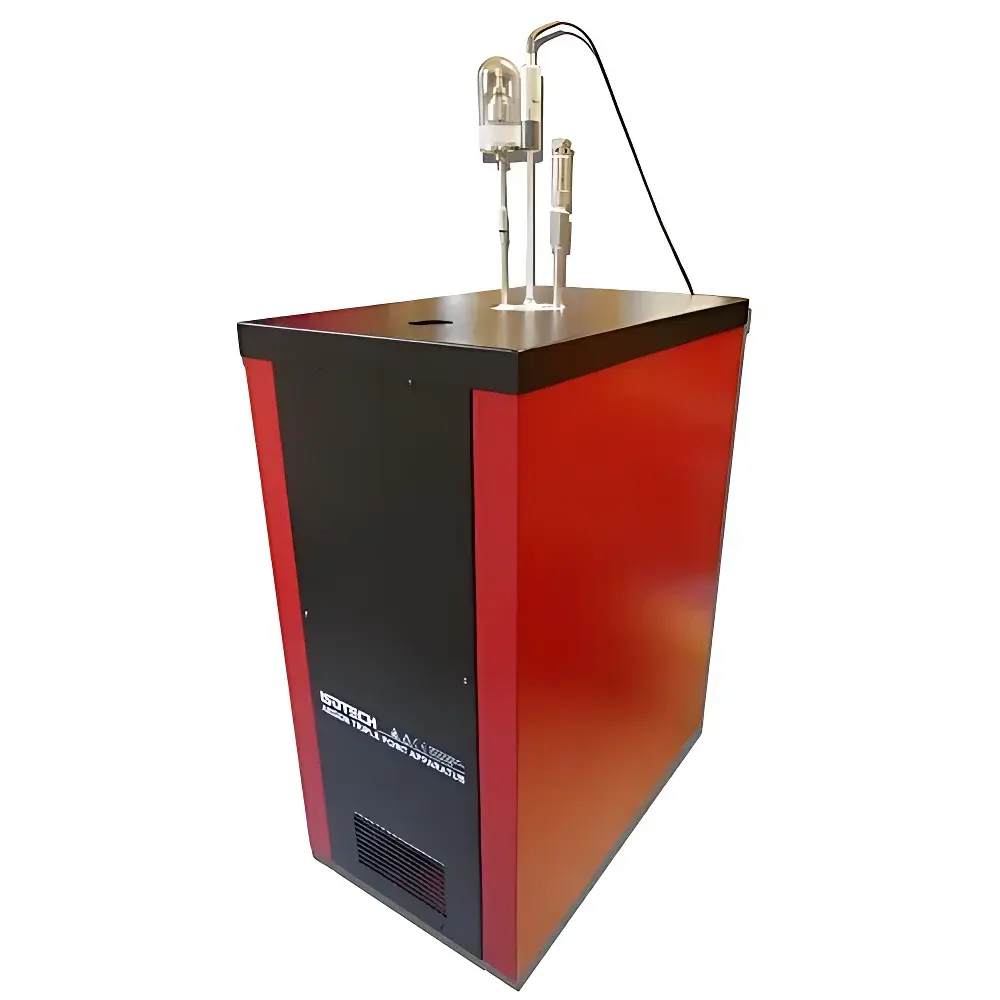
ISOTECH Model 471 Argon Triple Point Cell Apparatus
| Brand | ISOTECH |
|---|---|
| Origin | United Kingdom |
| Model | 471 |
| Temperature Fixed Point | Argon Triple Point (−189.3442 °C) |
| Uncertainty (k=2) | 1.844 mK |
| Plateau Duration | ≥4 h |
| Accuracy | ±1 mK |
| Dimensions (H×W×D) | 1250 × 380 × 615 mm (Apparatus Height: 900 mm) |
Overview
The ISOTECH Model 471 Argon Triple Point Apparatus is a precision temperature fixed-point realization system engineered for high-accuracy calibration of Standard Platinum Resistance Thermometers (SPRTs) and other primary thermometry standards in accordance with the International Temperature Scale of 1990 (ITS-90). Unlike liquid nitrogen boiling point comparators—commonly deployed for convenience and low operational cost—the argon triple point (−189.3442 °C) is an officially defined ITS-90 fixed point, providing metrologically traceable reference conditions essential for national metrology institutes (NMIs), accredited calibration laboratories, and high-end industrial temperature calibration facilities. The apparatus operates on the principle of phase equilibrium between solid, liquid, and vapor phases of ultra-high-purity argon (≥99.9999 %), stabilized within a sealed, evacuated quartz cell housed in a precisely controlled cryogenic environment. This physical realization ensures long-term stability, minimal hysteresis, and exceptional reproducibility—critical attributes for reducing uncertainty budgets in SPRT calibrations.
Key Features
- Engineered for ITS-90 compliance: Realizes the argon triple point at −189.3442 °C with full adherence to CCT (Consultative Committee for Thermometry) guidelines and ISO/IEC 17025 requirements for fixed-point apparatus validation.
- Extended thermal plateau: Delivers ≥4 hours of stable, flat temperature plateau under standard operating conditions—enabling robust data acquisition for multiple SPRT immersions and redundancy checks.
- Uncertainty performance: Achieves combined standard uncertainty of ≤0.922 mK (k = 2), verified through interlaboratory comparisons and internal validation against NPL and PTB reference cells.
- Robust mechanical architecture: Constructed from stainless steel and vacuum-compatible materials; incorporates passive thermal shielding and optimized heat-sink geometry to minimize external thermal perturbations and reduce liquid nitrogen consumption.
- User-centric design: Simplified fill procedure, integrated level monitoring, and modular cell handling reduce operator dependency and training overhead—making it suitable for routine use in ISO/IEC 17025-accredited labs without dedicated cryogenic specialists.
Sample Compatibility & Compliance
The Model 471 is specifically configured for use with sealed, argon-filled SPRTs and transfer standard PRTs compliant with IEC 60751 Class AA or ASTM E1137 Type A specifications. It accommodates probe diameters up to 6 mm and immersion depths of 250–300 mm. The apparatus meets the mechanical and thermal stability criteria outlined in ISO/IEC Guide 99 (VIM), ISO/IEC 17025:2017 Clause 6.4.10 (Reference Materials), and EURAMET cg-18 (Guidelines on the Calibration of SPRTs). All components—including the triple-point cell, dewar assembly, and thermal guard ring—are supplied with individual calibration certificates traceable to UK’s National Physical Laboratory (NPL) or equivalent NMIs. The system supports GLP/GMP audit readiness through documented setup procedures, maintenance logs, and as-built configuration records.
Software & Data Management
While the Model 471 is a manually operated fixed-point apparatus, ISOTECH provides optional digital integration support via its ThermCal Suite™ (v3.2+), enabling automated plateau detection, real-time deviation logging, and uncertainty propagation per GUM (JCGM 100:2008). Data export conforms to ASTM E2302-compliant CSV and XML formats, supporting direct ingestion into LIMS platforms such as LabWare, STARLIMS, and Thermo Fisher SampleManager. Audit trails—including operator ID, timestamped plateau start/end events, ambient pressure/temperature metadata, and LN₂ consumption logs—can be enabled to satisfy FDA 21 CFR Part 11 electronic record requirements when paired with validated software configurations.
Applications
- Primary calibration of SPRTs used in national metrology laboratories and secondary standards laboratories.
- Validation and verification of cryogenic PRTs employed in semiconductor process control, superconducting magnet testing, and quantum computing infrastructure.
- Intercomparison exercises organized under CIPM MRA and APMP thermometry working groups.
- Uncertainty reduction in low-temperature fixed-point chains (e.g., argon → mercury → water), especially where nitrogen boiling point artifacts introduce systematic bias due to gas composition effects in mixed-gas SPRTs.
- Supporting ISO 5725-based reproducibility studies for cryogenic thermometer characterization under controlled environmental conditions.
FAQ
What is the significance of the argon triple point in ITS-90?
The argon triple point (−189.3442 °C) is one of nine defining fixed points of the ITS-90, assigned a thermodynamic temperature value with zero uncertainty by definition. Its use eliminates reliance on non-fixed-point references like liquid nitrogen boiling point (−195.792 °C), which varies with pressure and isotopic composition.
Can the Model 471 be used with oxygen-containing SPRTs?
Yes—unlike nitrogen-based systems, the argon triple point avoids partial condensation or localized vacuum formation in SPRTs filled with Ar/O₂ mixtures, thereby eliminating self-heating anomalies and preserving measurement integrity at approximately −190 °C.
Is the cell refillable or sealed for life?
The argon triple-point cell is hermetically sealed during manufacture using ultra-high-vacuum techniques and is not user-refillable. ISOTECH supplies certified replacement cells with NMI-traceable validation reports.
Does the apparatus require periodic recalibration?
The apparatus itself does not require recalibration; however, annual verification of plateau duration, stability, and repeatability against a reference cell is recommended per ISO/IEC 17025 Clause 6.4.11 and EURAMET cg-18 Section 5.3.
What cryogen is required for operation?
Liquid nitrogen (LN₂) is the sole cryogen required. Typical consumption is 1.8–2.2 liters per hour during plateau stabilization, depending on ambient conditions and insulation integrity.