
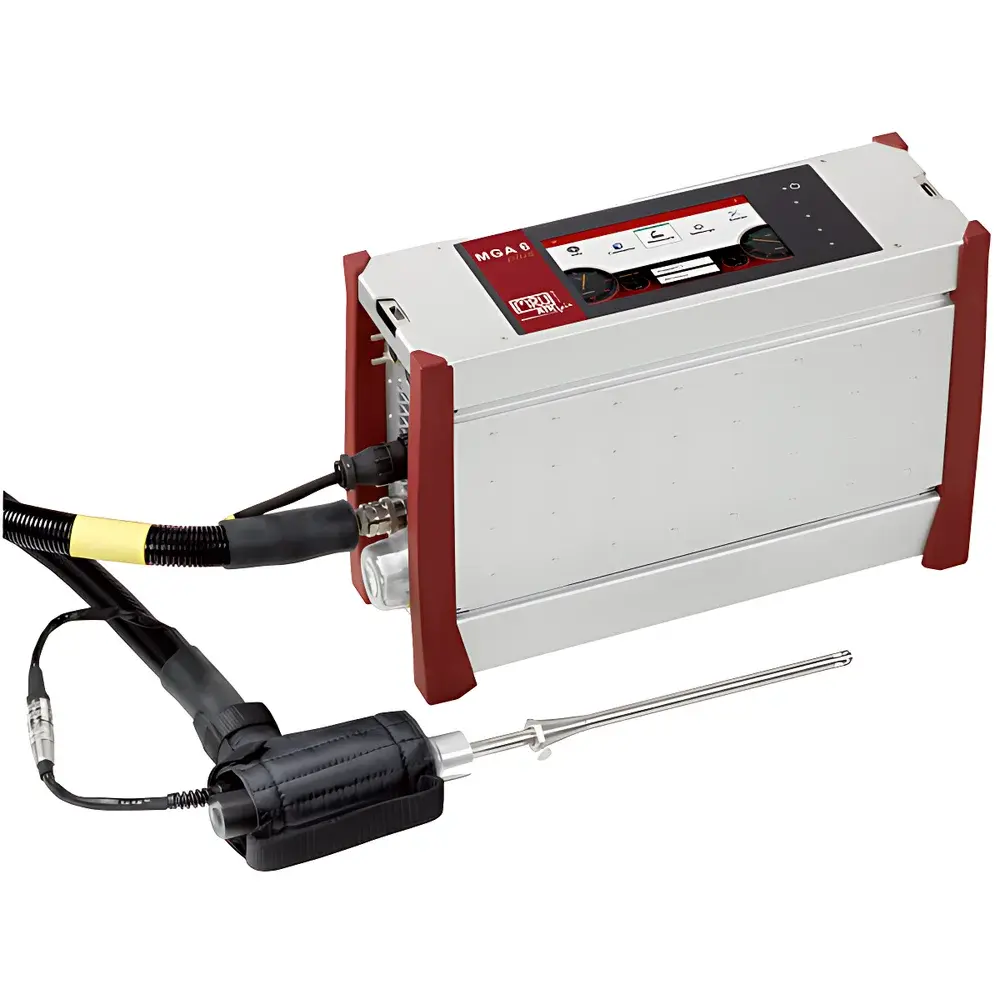
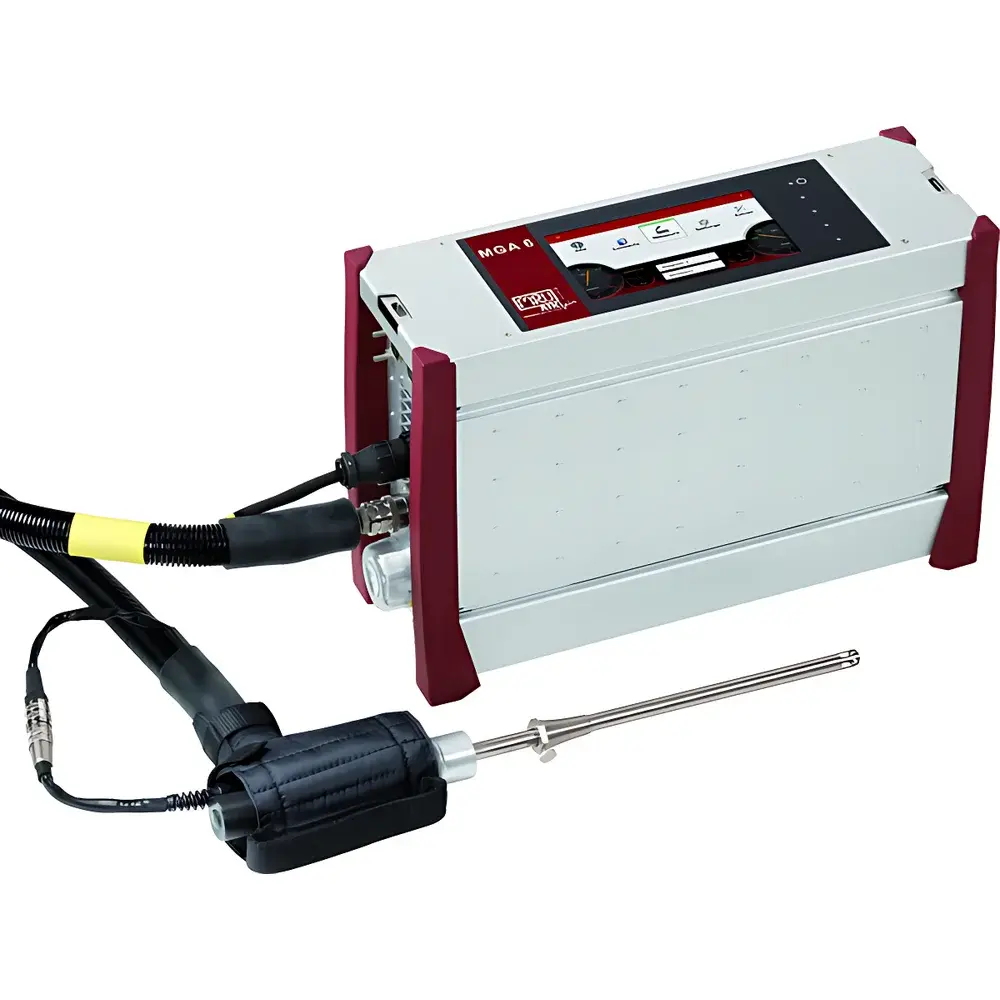
MRU MGA6plus Portable Infrared Flue Gas Analyzer
| Brand | MRU (Germany) |
|---|---|
| Origin | Germany |
| Model | MGA6plus |
| Instrument Type | Portable Flue Gas Analyzer |
| Measurement Principle | NDIR (Non-Dispersive Infrared) + Electrochemical Sensors |
| Measured Gases | O₂, CO₂, CO, NO, SO₂, NO₂, HC (C₃H₈/CH₄), N₂O |
| O₂ Sensor Options | Paramagnetic (5-year lifespan) or Electrochemical |
| Accuracy | ≤ ±2% FS |
| Repeatability | ≤ 2% FS |
| Response Time (T₉₀) | ≤ 20 s |
| Long-Term Stability | ≤ 2% FS over 30 days |
| Display | 7″ TFT Color Touchscreen (800 × 480) |
| Operating System | Embedded Linux |
| Connectivity | Bluetooth 5.0, WLAN (IEEE 802.11 b/g/n), RS485, 8× analog outputs (0–10 V / 4–20 mA), 4× analog inputs |
| Data Storage | Internal database with timestamped measurement logs |
| Reporting | CSV export, PDF report generation via MRU4U software |
| Compliance | Designed for EN 15267-3, EN 14181, ISO 12039, ISO 10849, and applicable EPA Method 6C/7E/8 requirements |
Overview
The MRU MGA6plus is a high-integrity portable flue gas analyzer engineered for continuous, field-deployable emission monitoring in industrial combustion processes. It integrates dual-sensing architecture—non-dispersive infrared (NDIR) spectroscopy for CO, CO₂, CH₄, C₃H₈, SO₂, NO, NO₂, and N₂O—and electrochemical or paramagnetic detection for O₂—enabling simultaneous, trace-level quantification of up to eight gas species in a single sampling stream. The instrument operates on a real-time embedded Linux platform, ensuring deterministic response, memory-resident calibration management, and immunity to OS-level vulnerabilities common in Windows-based field instruments. Its optical path is temperature-stabilized and pressure-compensated, minimizing drift under variable ambient conditions typical of boiler houses, turbine enclosures, kiln stacks, and marine engine rooms. Unlike benchtop analyzers requiring gas conditioning systems, the MGA6plus incorporates integrated particulate filtration, water trap condensation management, and heated sample line interface (optional), allowing direct probe insertion into flue ducts with minimal pre-treatment.
Key Features
- True multi-gas NDIR core: Eight independent infrared channels with thermoelectrically cooled detectors and precision interference filters—each optimized for spectral selectivity and cross-interference suppression (e.g., NO₂ compensation in NO measurement)
- O₂ flexibility: Selectable 5-year paramagnetic sensor (EN 15267-3 certified) or long-life electrochemical cell—both auto-compensated for barometric pressure and temperature
- Robust mechanical design: Anodized aluminum chassis with overmolded elastomeric bumper; IP54-rated ingress protection; shock-tested to MIL-STD-810G for drop resistance up to 1.2 m
- Intelligent combustion diagnostics: Real-time calculation of excess air ratio (λ), flue gas loss (qₐ), net thermal efficiency (ηₙ), dew point temperature, and adiabatic flame temperature using ASME PTC 4 and VDI 2046 algorithms
- Dynamic flow integration: Compatible with Pitot tube assemblies (via optional differential pressure module) for volumetric flow rate, mass flow, and emission rate (g/s, kg/h) derivation per EN 13284-1
- Calibration integrity: On-device zero/span verification logs with audit trail; support for multi-point linear and quadratic calibration curves per ISO 14050
Sample Compatibility & Compliance
The MGA6plus accepts raw, unconditioned flue gas at temperatures up to 200 °C (with optional high-temp probe) and particulate loadings < 50 mg/m³. It complies with the metrological and functional requirements of EN 15267-3 (QAL1 certification framework), EN 14181 (ASTM D6522 equivalent for QA/QC procedures), and ISO 12039 (CO/CO₂/SO₂/NOₓ determination). For regulatory reporting in EU Member States, it supports automated data upload to national emission registries via TLS-secured WLAN. All firmware updates are digitally signed and version-locked to ensure traceability during GLP/GMP audits. The device meets electromagnetic compatibility standards per EN 61326-1 and carries CE marking under the Measuring Instruments Directive (MID) Annex MI-005 for gas analyzers.
Software & Data Management
MRU4U—the official companion application—is available for Android and iOS platforms and provides full remote control, live parameter visualization, and configurable alarm thresholds. Logged measurements include synchronized timestamps, GPS coordinates (when enabled), ambient pressure, stack temperature, and sensor health indicators. Internal storage retains ≥100,000 records with cyclic overwrite protection. Export formats include ISO-compliant CSV (semicolon-delimited, UTF-8 encoded), XML (for integration with LIMS), and printable PDF reports with digital signature fields. RS485 Modbus RTU protocol enables integration into SCADA systems without middleware. Audit trails record all user actions—including calibration events, configuration changes, and firmware updates—in compliance with FDA 21 CFR Part 11 requirements when paired with enterprise identity management.
Applications
The MGA6plus serves as a primary verification tool for periodic stack testing and continuous compliance monitoring across regulated sectors: utility-scale coal- and gas-fired power plants; cement and lime kilns; waste-to-energy incinerators; refinery fired heaters; marine auxiliary engines (IMO MARPOL Annex VI); and district heating boiler stations. Its portability and battery life (>6 h continuous operation) make it suitable for fugitive emission surveys, commissioning verification (e.g., post-SCR retrofit validation), and troubleshooting incomplete combustion in reciprocating engines. In R&D labs, it supports stoichiometric optimization studies, catalyst performance evaluation, and low-NOₓ burner characterization under transient load profiles.
FAQ
Does the MGA6plus require daily calibration?
No—its NDIR optics and paramagnetic O₂ sensor are drift-stabilized for ≤2% FS variation over 30 days; however, quarterly QAL2 verification and annual QAL3 assessment per EN 14181 are recommended for regulatory compliance.
Can it measure hydrocarbons other than CH₄ and C₃H₈?
Yes—the NDIR channel for “HC” is factory-calibrated for total gaseous hydrocarbons expressed as propane-equivalent; custom calibrations for specific VOCs (e.g., benzene, toluene) are available upon request with certified standard gases.
Is wireless data transmission secure?
All WLAN and Bluetooth communications use AES-128 encryption; MRU4U enforces certificate-pinned TLS 1.2+ connections to prevent man-in-the-middle interception.
What maintenance intervals apply to the internal filters and sensors?
Particulate filter replacement is advised every 500 operating hours or after exposure to >100 mg/m³ dust loading; electrochemical cells have a 24-month service life; paramagnetic O₂ sensors are rated for 5 years under normal operating conditions.
How does the instrument handle cross-sensitivity between NO and NO₂?
It employs dynamic algorithmic correction based on real-time NO₂/NO ratio estimation from dual-wavelength NDIR absorption, validated against reference chemiluminescence analyzers per ISO 10849 Annex B.







