
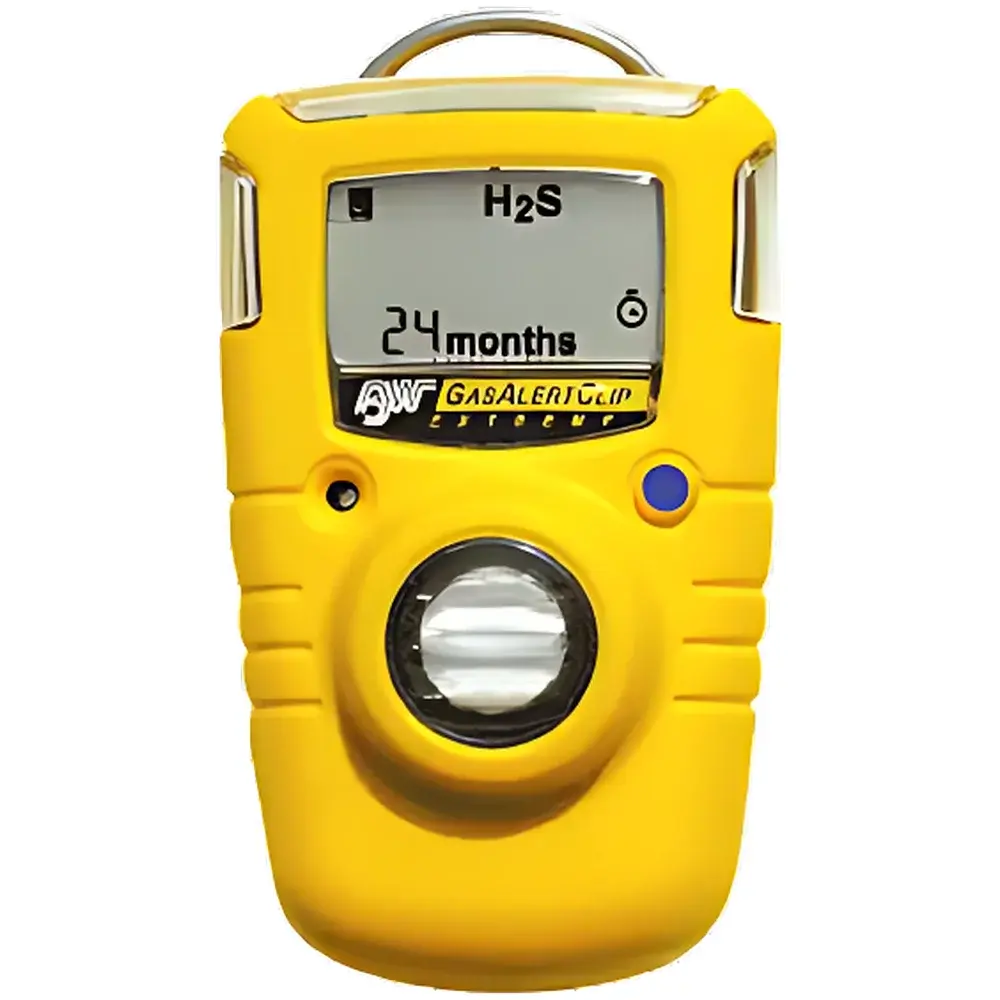
BW GasAlertExtreme Single-Gas Detector GAXT-Series
| Brand | BW |
|---|---|
| Origin | Canada |
| Model | GAXT-Series |
| Instrument Type | Portable |
| Detectable Gases | H₂S, SO₂, HCN, CO, NH₃, Cl₂, PH₃, O₃, NO, NO₂, ClO₂, ETO, O₂ |
| Response Time | ≤15 s |
| Measurement Accuracy | ±0.1 ppm |
| Measurement Ranges | 0–1 ppm, 0–50 ppm, 0–100 ppm, 0–1000 ppm |
| Display | Backlit LCD with real-time concentration readout |
| Alarm | Dual-mode (audible ≥95 dB @ 30 cm, visual high-intensity LED strobe), optional vibration alert |
| Calibration | Auto-zero and span calibration |
| Battery Life | Up to 2 years (typical usage, alkaline or rechargeable options) |
| Enclosure Rating | IP66/IP67 |
| Operating Temperature | –20 °C to +50 °C |
| Compliance | ATEX II 2G Ex ib IIC T4 Gb, IECEx Ex ib IIC T4 Gb, UL 913 Class I, Div 1, Groups A–D, T4, CSA C22.2 No. 152, EN 60079-0, EN 60079-11, EN 60079-26 |
| Data Logging | Internal memory for >100,000 timestamped events (gas readings, alarms, calibrations, faults) |
| User Interface | Multilingual (English, French, German, Spanish, Portuguese) with password-protected configuration |
Overview
The BW GasAlertExtreme GAXT-Series is a certified intrinsically safe, single-gas portable detector engineered for continuous personal exposure monitoring in industrial, municipal, and emergency response environments. Utilizing electrochemical sensor technology optimized for specific toxic gases—including hydrogen sulfide (H₂S), carbon monoxide (CO), sulfur dioxide (SO₂), hydrogen cyanide (HCN), chlorine (Cl₂), phosphine (PH₃), ozone (O₃), nitrogen oxides (NO/NO₂), ethylene oxide (ETO), ammonia (NH₃), and oxygen (O₂)—the instrument delivers rapid, stable, and repeatable measurements under variable ambient conditions. Its measurement principle relies on diffusion-driven gas interaction with a selective electrochemical cell, generating a linear current proportional to gas concentration (ppm-level resolution). Designed to meet stringent occupational hygiene requirements, the GAXT-Series supports time-weighted average (TWA) and short-term exposure limit (STEL) compliance tracking per OSHA, NIOSH, and ACGIH guidelines.
Key Features
- Intrinsically safe design certified to ATEX, IECEx, UL, and CSA standards for use in hazardous locations (Zone 0/1, Class I Div 1)
- Backlit, high-contrast LCD display providing real-time gas concentration, battery status, and operational diagnostics
- Response time ≤15 seconds (T90) across all configured gases, enabling timely hazard recognition
- Integrated dual-stage alarm system: audible (≥95 dB at 30 cm), visual (wide-angle pulsed LED strobe), and optional haptic vibration—critical in high-noise or low-visibility settings
- Robust, impact-resistant housing rated IP66/IP67 for dust and water immersion resistance
- Field-replaceable sensors and batteries—no tools required—minimizing downtime and lifecycle cost
- Automated start-up self-test verifying sensor functionality, circuit integrity, battery voltage, and alarm actuation
- MicroDock II compatibility enabling unattended bump testing, full calibration, data download, and firmware updates via centralized docking station
Sample Compatibility & Compliance
The GAXT-Series is validated for direct ambient air sampling without external pumping (diffusion mode), making it suitable for personal monitoring on belts, helmets, or lapels. Optional SamplerPak pump integration enables active sampling for confined space entry or low-diffusivity gas detection. All sensor variants comply with ISO 16000-23 (indoor air—determination of formaldehyde and other carbonyls), EN 45544-1 (electrochemical gas detectors—performance requirements), and OSHA 29 CFR 1910.120 (HAZWOPER) documentation protocols. Device firmware and data logging architecture support audit-ready records aligned with GLP and internal safety management systems. Full traceability is maintained through encrypted event logs including calibration dates, alarm timestamps, and user-initiated configuration changes.
Software & Data Management
Data retrieval is performed via infrared (IrDA) interface or USB connection using BW’s proprietary Companion Software. Logged data includes gas concentration history (1-second sampling interval), alarm events (type, duration, peak value), calibration records (span gas concentration, date, operator ID), and system faults. Export formats include CSV and PDF reports compliant with ISO/IEC 17025 documentation requirements. Password-protected configuration prevents unauthorized parameter modification—essential for regulated environments requiring 21 CFR Part 11–compliant audit trails. Firmware updates preserve calibration coefficients and historical datasets during version migration.
Applications
- Oil & gas upstream/downstream operations: H₂S and hydrocarbon leak detection during well servicing, pipeline maintenance, and refinery turnaround
- Municipal wastewater treatment plants: Real-time monitoring of H₂S, Cl₂, and NH₃ in headworks, digesters, and sludge handling areas
- Chemical manufacturing: Worker protection during synthesis, loading/unloading, and storage of toxic feedstocks (e.g., PH₃ fumigants, ClO₂ disinfectants)
- Emergency response: First-responder deployment for hazmat incidents involving industrial gas releases or clandestine lab exposures
- Confined space entry programs: Pre-entry verification and continuous atmospheric monitoring per OSHA 1910.146 standards
- Facility maintenance: Routine checks of ventilation efficacy, scrubber performance, and leak integrity in laboratories and cleanrooms
FAQ
What gases can the GAXT-Series detect?
The GAXT-Series is configured for one specific toxic or oxygen-deficient gas per unit. Available configurations include H₂S, CO, O₂, SO₂, HCN, Cl₂, PH₃, O₃, NO, NO₂, ClO₂, ETO, and NH₃.
Is the device suitable for use in explosive atmospheres?
Yes—each GAXT model carries ATEX, IECEx, UL, and CSA intrinsic safety certifications for Group IIC gases and temperature class T4, permitting deployment in Zone 0, Zone 1, and Class I Division 1 areas.
How often does the sensor require calibration?
BW recommends functional bump testing before each day’s use and full calibration every 6 months—or more frequently in harsh environments—per manufacturer guidelines and site-specific safety protocols.
Can historical data be exported for regulatory reporting?
Yes. Timestamped gas readings, alarm logs, calibration records, and fault events are exportable in CSV and PDF formats, supporting OSHA 300 logs, internal incident investigations, and ISO 45001 documentation.
Does the GAXT-Series support wireless connectivity?
No native Bluetooth or Wi-Fi; however, IrDA and USB interfaces enable secure, offline data transfer compatible with enterprise EHS software platforms via standardized import modules.
Related Products







