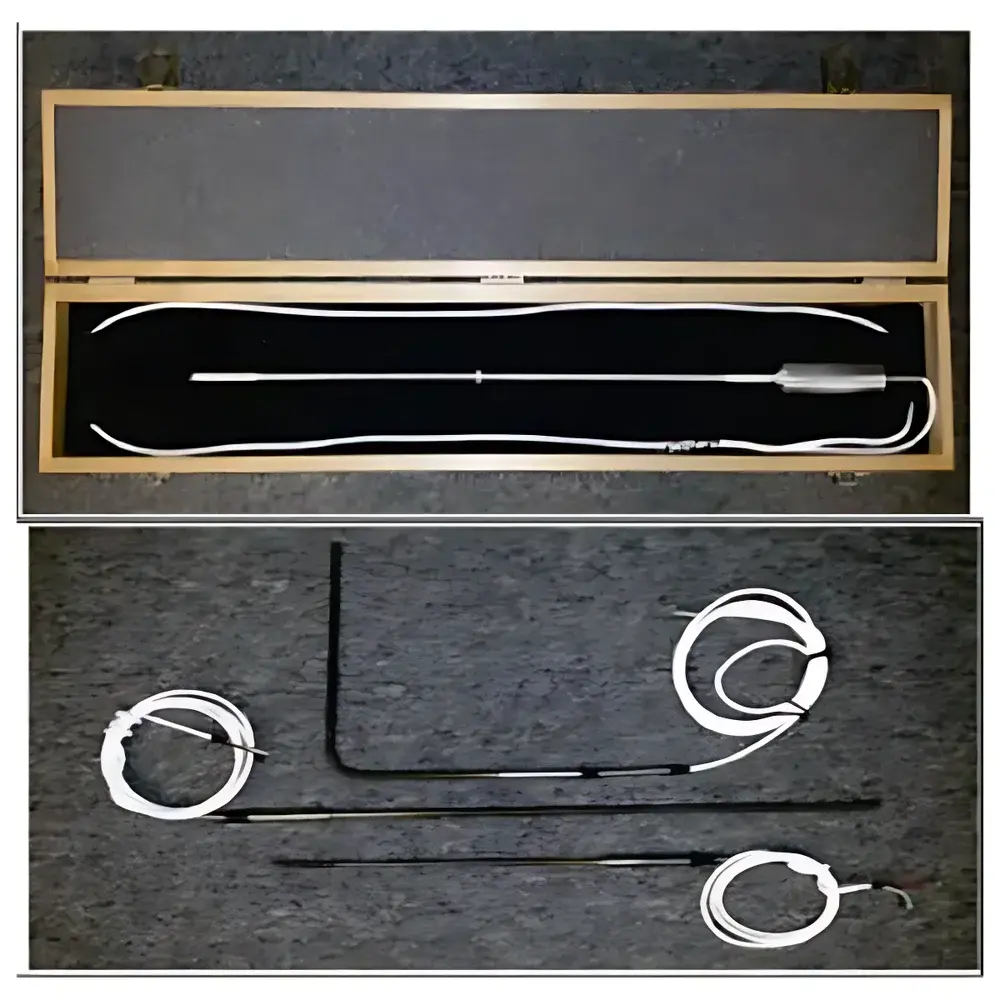
ASP YKI Series Precision Platinum Resistance Thermometers (PRTs) with Metal Sheath
| Brand | ASP / Advanced Sensing Products |
|---|---|
| Origin | USA |
| Model | YKI Series |
| Temperature Range | −200 °C to 1100 °C |
| Resistance at 0 °C | 10 Ω, 100 Ω, 500 Ω, or 1000 Ω (customizable) |
| TCR (α) | 0.003850 Ω/Ω/°C |
| Accuracy Class | IEC 60751 DIN Class A (±0.06 °C at 0 °C) or Class B (±0.12 °C at 0 °C) |
| Stability | R₀ drift < 0.002 °C after 1000 h at 300 °C |
| Repeatability | R₀ deviation < 0.002 °C over 100 cycles (25–300 °C) |
| Thermal Hysteresis | < 0.001 °C (−196 °C to 300 °C) |
| Sheath Material | Stainless steel or Inconel® alloy |
| Standard Diameter | 3–6.35 mm |
| Standard Length | 305–457 mm (12–18 in) |
| Vibration Resistance | 20 g from 10–5000 Hz |
Overview
The ASP YKI Series Precision Platinum Resistance Thermometers (PRTs) are high-stability, metal-sheathed temperature sensors engineered for metrological-grade accuracy and long-term reliability in demanding industrial, calibration, and research environments. Based on the fundamental principle of platinum’s predictable and highly repeatable resistive response to temperature—governed by the Callendar–Van Dusen equation—the YKI series delivers traceable, NIST-compatible measurements across an exceptionally wide operating range: −200 °C to 1100 °C. Each sensor employs a high-purity, strain-free platinum sensing element wound or deposited on a ceramic or glass substrate, hermetically sealed within a mechanically robust stainless steel or Inconel® sheath. This architecture ensures minimal thermal stress, low hysteresis, and immunity to oxidation or contamination—even under sustained high-temperature exposure. The YKI series is explicitly designed for use as a transfer standard in temperature calibration laboratories, serving as a reference for thermocouples, digital thermometers, data loggers, and process sensors in accordance with ISO/IEC 17025 requirements.
Key Features
- Ultra-wide temperature coverage: −200 °C to 1100 °C, segmented across five model variants (YKI300, YKI500, YKI660, YKI850, YKI1100) to optimize stability and longevity per application domain.
- Traceable accuracy per IEC 60751: DIN Class A (±0.06 °C at 0 °C) or Class B (±0.12 °C at 0 °C); YKI1100 supports Gallium-point validation (W(Ga) ≥ 1.11807) for primary-standard alignment.
- Exceptional long-term stability: Verified R₀ drift < 0.002 °C after 1000 hours at 300 °C; < 0.1 °C after 100 hours at 1100 °C—critical for unattended calibration baths and furnace qualification.
- Low thermal hysteresis: < 0.001 °C over −196 °C to 300 °C cycles; < 0.003 °C over −196 °C to 660 °C—ensuring measurement repeatability during thermal cycling in cryogenic and heat-treatment processes.
- High mechanical integrity: 20 g vibration resistance (10–5000 Hz), impact-resistant metal sheath (3–6.35 mm OD), and customizable geometry—including miniature diameters and extended probe lengths up to 450 mm.
- Configurable electrical characteristics: Standard 100 Ω nominal resistance at 0 °C; optional 10 Ω, 500 Ω, or 1000 Ω elements to match legacy instrumentation or minimize self-heating error in low-power applications.
Sample Compatibility & Compliance
The YKI series is compatible with all standard PRT readout systems—including precision resistance bridges (e.g., Fluke 1595A, Keysight 34970A with 34901A modules), digital thermometer calibrators (e.g., Hart 1550A, Ametek 9100), and automated calibration software platforms. Its metal-sheathed construction enables direct immersion in liquid nitrogen, molten salts, vacuum furnaces, and high-pressure autoclaves—provided appropriate pressure ratings and thermal gradients are observed. The sensors comply with IEC 60751:2022 for platinum resistance thermometer characteristics, ASTM E1137/E1137M for industrial PRT performance, and support GLP/GMP audit trails when integrated with compliant data acquisition systems. While not intrinsically rated for hazardous locations, explosion-proof housings and conduit adapters are available upon request for Class I Div 1/Zone 1 installations.
Software & Data Management
ASP provides comprehensive calibration support documentation—including individual sensor-specific Callendar–Van Dusen coefficients, R₀ values, and deviation tables referenced to ITS-90—delivered in CSV and Excel formats for seamless import into calibration management software (e.g., Beamex CMX, TÜV SÜD CalControl, MET/TEMP II). All YKI units ship with a NIST-traceable calibration certificate (optionally accredited to ISO/IEC 17025), including uncertainty budgets per GUM methodology. When paired with compliant DAQ systems, the YKI series supports full 21 CFR Part 11 compliance—including electronic signatures, audit trails, and user access controls—for regulated pharmaceutical, aerospace, and nuclear applications.
Applications
- Primary and secondary temperature calibration laboratories performing fixed-point validations (e.g., triple-point of water, zinc, aluminum, silver) and interpolation calibrations.
- Thermal validation of sterilization equipment (autoclaves, depyrogenation tunnels), ovens, and environmental chambers per ISO 13485 and FDA Process Validation Guidance.
- In-process monitoring of high-temperature metallurgical processes—including sintering, annealing, and crystal growth—where long-term drift must be minimized.
- Cryogenic system characterization (LNG, superconductivity testing) requiring sub-millikelvin repeatability across deep-cold excursions.
- Aerospace component testing under combined thermal-vibration profiles per MIL-STD-810 and RTCA DO-160.
FAQ
What is the recommended excitation current to minimize self-heating error?
For 100 Ω elements, ≤ 1 mA is recommended; for 1000 Ω elements, ≤ 0.25 mA ensures self-heating remains below 0.01 °C in still air.
Can YKI sensors be used in reducing atmospheres?
Yes—Inconel®-sheathed variants (YKI660 and above) maintain integrity in hydrogen-rich or vacuum-furnace environments where stainless steel may suffer embrittlement.
Is recalibration required before each use?
No—YKI sensors are supplied with a full-point calibration certificate; periodic verification (e.g., at ice point and 100 °C) is sufficient for routine QA unless subjected to mechanical shock or thermal overload.
Do you offer OEM integration support?
Yes—ASP provides custom lead-wire configurations (e.g., PTFE, fiberglass, mineral-insulated cable), connector types (DIN 43760, M8, LEMO), and OEM labeling with serialized traceability.
How is uncertainty calculated for YKI-based measurements?
Total uncertainty combines sensor-specific calibration uncertainty (typically ±0.005 °C at 0 °C for Class A), readout system contribution, lead-wire resistance compensation error, and thermal EMF effects—detailed in the included uncertainty budget report.