
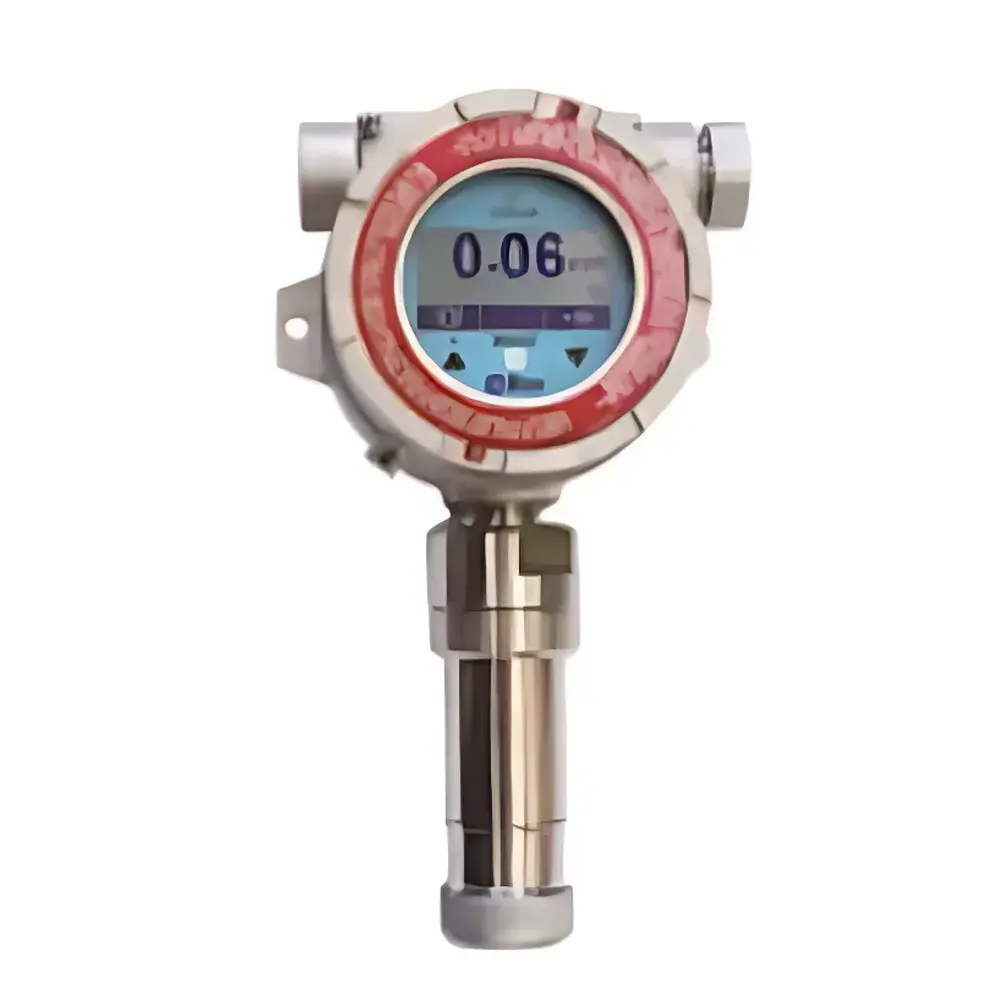
RAE Systems RAEGuard2 PID Fixed-Mount Photoionization Detector
| Brand | RAE Systems Inc. |
|---|---|
| Origin | USA |
| Model | RAEGuard2 PID |
| Sensor Type | Third-Generation Intrinsically Safe PID |
| Detection Principle | Photoionization Detection (PID) |
| Measurement Range | 0–10,000 ppm (isobutylene-equivalent), extendable via range scaling |
| Resolution | 1 ppb (typical for low-concentration VOCs) |
| Response Time (T90) | <10 s (with integrated sampling pump) |
| Operating Temperature | –30 °C to +55 °C |
| Enclosure Rating | IP66 / NEMA 4X |
| Certification | ATEX II 1G Ex d [ia] IIC T4 Ga, UL 913 Class I, Div 1, Groups B, C, D |
| Output Signals | 4–20 mA (3-wire), RS485 Modbus RTU, 3 configurable relay outputs (NO/NC) |
| Display | Backlit dot-matrix LCD with multilingual support (English/Chinese) |
| Housing Material | 316 stainless steel |
| Sampling Method | Integrated intrinsically safe diaphragm pump (pump-suction) |
| Calibration | Zero & span calibration supported offline or in-situ via magnetic wand |
| Compliance | Designed for compliance with OSHA PELs, ACGIH TLVs®, EPA Method TO-15 & TO-17, and ISO 16000-6 for indoor air VOC screening |
Overview
The RAE Systems RAEGuard2 PID is a fixed-mount, continuous organic vapor monitoring instrument engineered for industrial hygiene, process safety, and environmental compliance applications. It utilizes photoionization detection (PID) technology — a non-destructive, real-time analytical method based on ultraviolet (UV) photon-induced ionization of volatile organic compounds (VOCs) and certain inorganic gases. When target molecules absorb UV photons from the lamp (typically 10.6 eV), they eject electrons, generating an ion current proportional to concentration. This principle enables broad-spectrum detection across thousands of compounds—including benzene, toluene, xylene, styrene, chlorinated solvents, amines, and sulfur-containing species—without requiring compound-specific sensors. The RAEGuard2 PID integrates a third-generation intrinsically safe PID sensor with enhanced humidity resistance, sub-10-second T90 response, and a calibrated measurement range up to 10,000 ppm (isobutylene-equivalent), making it suitable for both ambient air quality surveillance and high-concentration leak detection in hazardous areas.
Key Features
- Third-generation intrinsically safe PID sensor with proprietary self-cleaning electrode architecture, reducing drift and extending operational life between calibrations.
- Integrated explosion-proof diaphragm sampling pump delivering consistent flow rates under variable backpressure—enabling reliable detection at distances up to 30 meters via sample tubing.
- Open 3G gas path design increasing effective detection volume by 2× and accelerating response time by ≥10 seconds compared to legacy configurations.
- Advanced temperature and zero-point compensation algorithms ensuring stable baseline performance across wide ambient operating ranges (–30 °C to +55 °C).
- Tool-free, hot-swappable sensor module compatible with RAE’s full suite of PID lamps (9.8 eV, 10.0 eV, 10.6 eV, 11.7 eV) for optimized selectivity and sensitivity tuning.
- 316 stainless steel housing rated IP66/NEMA 4X, certified for Zone 1/Division 1 hazardous locations per ATEX, UL, CSA, and IECEx standards.
Sample Compatibility & Compliance
The RAEGuard2 PID detects any compound with an ionization energy (IE) below the installed UV lamp’s photon energy—supporting identification of >99% of commonly regulated VOCs. Its onboard gas library includes over 2,500 compounds with preloaded response factors, enabling direct concentration readout in ppm or ppb without manual correction. The instrument meets requirements for workplace exposure monitoring per OSHA 29 CFR 1910.1200 (HazCom) and ACGIH TLV® guidelines. For regulatory reporting, data output aligns with EPA Methods TO-15 (canister-based ambient VOC analysis) and TO-17 (sorbent tube thermal desorption), supporting validation against reference methods. All firmware and configuration logs maintain audit trails compliant with GLP/GMP documentation practices.
Software & Data Management
Configuration, calibration, and diagnostics are performed locally via magnetic wand interface—eliminating need for opening enclosures in classified zones. Optional RAE Link™ software enables remote device management, historical trend review, alarm event logging, and automated report generation in PDF or CSV format. Data streams support integration into DCS, SCADA, or cloud-based EMS platforms via Modbus RTU over RS485 or 4–20 mA analog output. Relay outputs can be assigned to LEL equivalents, TWA/STEL thresholds, or custom logic sequences—facilitating interlock activation per IEC 61511 SIL-2 functional safety requirements.
Applications
- Petrochemical & refining: Fence-line monitoring, flare stack emissions verification, tank farm vapor recovery system oversight.
- Chemical manufacturing: Reactor vent scrubber efficiency validation, solvent recovery unit leak detection, loading rack fugitive emission surveys.
- Wastewater treatment: Odorant (e.g., mercaptans, H₂S) and disinfection byproduct (e.g., chloroform) monitoring in headspace and effluent streams.
- Indoor air quality: Real-time assessment of VOCs in laboratories, cleanrooms, printing facilities, and remediation sites per ISO 16000-6 protocols.
- Emergency response: Integration into mobile command units for rapid hazard zone delineation during chemical spills or confined space entry operations.
FAQ
What gases can the RAEGuard2 PID detect?
It detects all VOCs and select inorganic gases with ionization energies below the installed lamp’s photon energy (e.g., 10.6 eV lamp detects compounds with IE < 10.6 eV, including aromatics, ketones, aldehydes, amines, and sulfides).
Is field calibration possible without opening the enclosure?
Yes—zero and span calibration can be executed using a magnetic wand through the front window, maintaining intrinsic safety integrity.
Does the instrument support multi-gas detection with a single sensor?
While it provides broadband VOC response, quantitative multi-gas analysis requires application-specific response factor correction; the built-in gas library automates this for over 2,500 compounds.
Can the RAEGuard2 PID be integrated into existing plant control systems?
Yes—it supports standard 4–20 mA, RS485 Modbus RTU, and three programmable relay outputs for seamless DCS/PLC interfacing.
What maintenance intervals are recommended for long-term deployment?
Under typical industrial conditions, sensor replacement is recommended every 18–24 months; lamp life exceeds 12,000 hours; pump diaphragms require inspection every 12 months.







