
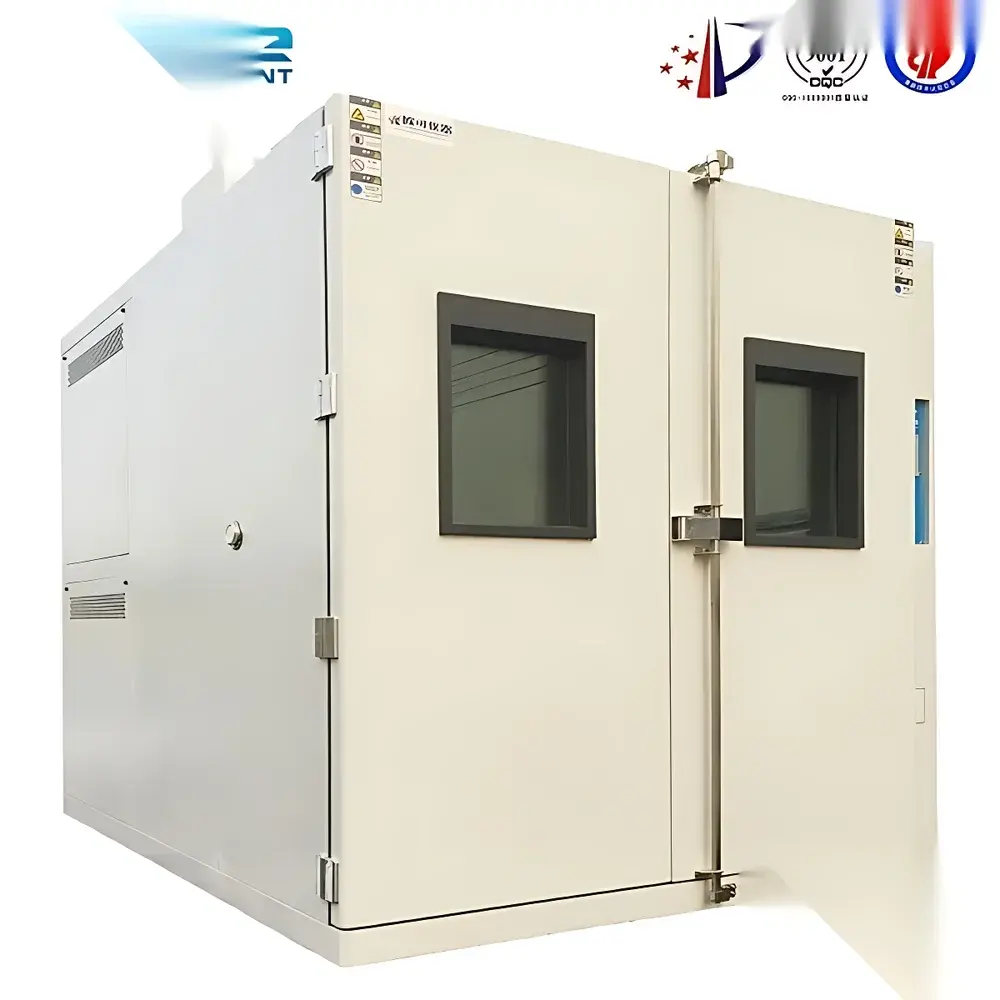
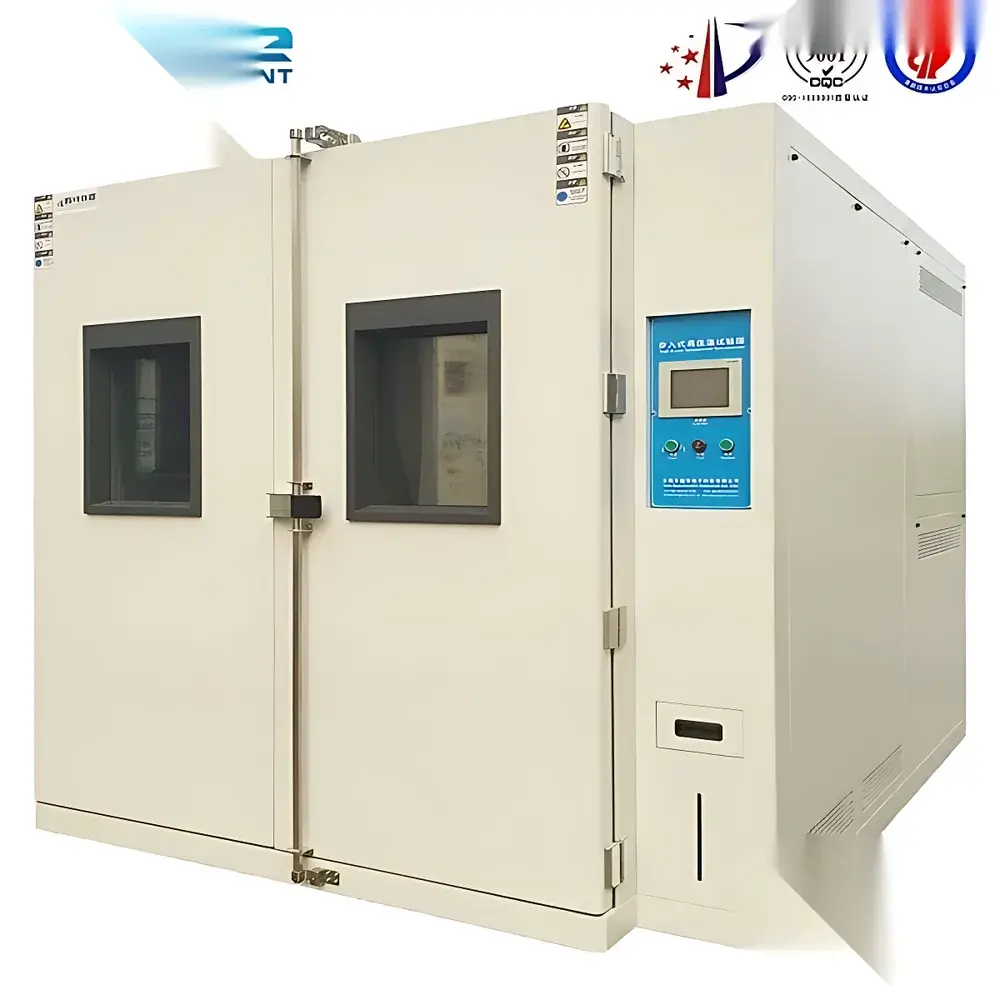
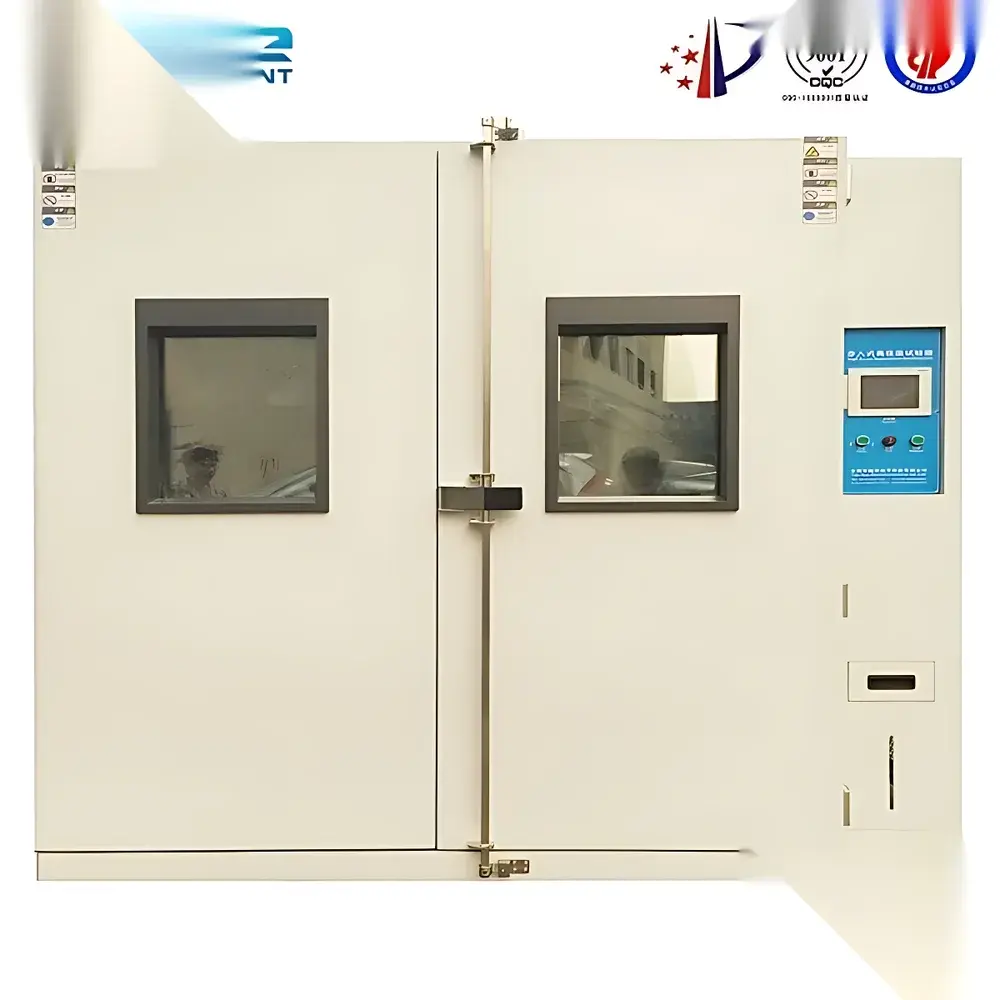
Environmental Stress Screening Chamber – Temperature and Humidity Controlled Test Room
| Brand | OEM / Custom Brand Available |
|---|---|
| Origin | Imported |
| Manufacturer Type | Authorized Distributor |
| Pricing | USD 11,200 (FOB) |
| Compliance | GB/T 2423.1–2023, GB/T 2423.2–2023, IEC 60068-2-1, IEC 60068-2-2, GJB 1032A–2012, MIL-STD-2164A |
| Cooling Water Requirement | 10–28°C, 0.1–0.3 MPa |
| Operating Ambient | 25°C ±6°C, Unloaded |
| Control Method | PID-Based Balanced Temperature & Humidity Control (BTHC) |
| Refrigerant | R404A (Non-CFC, ODP = 0) |
| Compressor | Tecumseh/Taikang Hermetic Scroll Compressor |
| Noise Level | ≤60 dB(A) |
Overview
The Environmental Stress Screening Chamber – Temperature and Humidity Controlled Test Room is an engineered environmental test system designed for accelerated reliability assessment and stress screening of electronic, electro-mechanical, and structural components under dynamically controlled thermal and hygrometric conditions. Based on the principle of balanced heating, cooling, humidification, and dehumidification—regulated via a closed-loop PID-controlled BTHC (Balanced Temperature & Humidity Control) architecture—the chamber maintains precise, stable setpoints across wide operating ranges. It supports both steady-state conditioning (e.g., 25°C/60% RH for long-term stability evaluation) and dynamic cycling (e.g., rapid transitions between −40°C/10% RH and +85°C/95% RH), enabling rigorous validation per military, aerospace, automotive, and industrial electronics standards. The chamber’s thermodynamic architecture integrates capillary tube-based refrigeration, high-efficiency steam humidification with distilled water recovery, and intelligent load-adaptive capacity modulation—ensuring reproducible thermal ramp rates and humidity response times even under variable specimen mass, thermal mass, and surface emissivity conditions.
Key Features
- Robust multi-layer safety architecture: dry-run protection for humidifiers, independent overtemperature cutoffs, low-water-level interlocks, compressor overload/overheat/overcurrent protection, high-pressure refrigerant cut-off switches, molded-case circuit breakers, and residual-current devices (RCDs).
- Modular stainless-steel interior with seamless welds and double-wall insulated construction; external cladding in powder-coated steel or optional electropolished stainless steel.
- Touchscreen programmable controller with intuitive GUI, real-time trend logging, and dual-language interface (English/Chinese default; customizable to German, Japanese, Korean, or French upon request).
- Distilled water recycling system reduces consumable usage by up to 40%; integrated municipal water filtration eliminates dependency on deionized or reverse-osmosis feed water.
- Energy-optimized refrigeration circuit featuring full-capillary flow control and adaptive compressor staging—reducing power consumption by ≥30% versus conventional expansion valve systems.
- Standard accessories include two-tier adjustable stainless-steel sample racks, calibration certificate traceable to NIST-equivalent national metrology institutes, factory acceptance test (FAT) report, and comprehensive GLP-compliant documentation package.
Sample Compatibility & Compliance
The chamber accommodates specimens up to 1.5 m × 1.2 m × 1.0 m (W × D × H), with custom internal dimensions available upon engineering review. Load-dependent performance specifications—including temperature ramp rates (e.g., −40°C to +85°C in ≤60 min, air-averaged per GB/T 2423.1) and humidity settling time (<15 min from 10% to 95% RH at 25°C)—are validated under ISO/IEC 17025-accredited third-party calibration. All units comply with electromagnetic compatibility (EMC) per EN 61326-1 and safety requirements per IEC 61010-1. Full traceability is maintained for all critical components, including temperature/humidity sensors (Pt100 Class A, capacitive RH sensor ±1.5% RH accuracy), SSR actuators, and refrigerant charge records—supporting FDA 21 CFR Part 11 audit readiness when paired with optional electronic signature and audit trail modules.
Software & Data Management
The embedded control firmware supports automated test sequencing, real-time data streaming via Ethernet (Modbus TCP, optional OPC UA), and local SD-card logging at user-defined intervals (1 s to 60 min). Optional PC-based software provides advanced analysis tools—including deviation mapping, cycle count tracking, failure mode correlation, and export to CSV, PDF, or XML for integration into LIMS or PLM platforms. All logged datasets include timestamped metadata (operator ID, chamber ID, calibration status, ambient conditions), fulfilling GLP/GMP documentation requirements. Firmware updates are delivered via secure HTTPS portal with SHA-256 signature verification; version history and change logs are retained for regulatory review.
Applications
This chamber serves as a core platform for environmental stress screening (ESS) and qualification testing across multiple sectors:
- Aerospace & defense: compliance verification per MIL-STD-2164A, GJB 1032A, and DO-160 Section 4/5.
- Automotive electronics: AEC-Q200 stress profiling, ISO 16750-4 temperature/humidity durability, and IATF 16949 process validation.
- Consumer electronics: JEDEC JESD22-A104 (temperature cycling), JESD22-A110 (highly accelerated temperature-humidity stress test), and IPC-9701 reliability benchmarking.
- Medical device manufacturing: ISO 14971 risk mitigation testing and IEC 60601-1 environmental clause validation.
- Materials science labs: polymer aging studies, coating adhesion assessment under cyclic humidity, and battery electrolyte stability evaluation.
FAQ
What is the typical temperature and humidity range for this chamber?
Standard configuration operates from −40°C to +150°C and 10% to 98% RH; extended low-temperature (−70°C) and high-humidity (99.9% RH) variants are available upon engineering consultation.
Is third-party calibration included with shipment?
Yes—a NIST-traceable calibration certificate covering temperature uniformity (±0.5°C), humidity accuracy (±2.0% RH), and controller linearity is supplied with each unit.
Can the chamber be integrated into an existing MES or SCADA infrastructure?
Absolutely. Standard Modbus TCP support enables direct integration; optional OPC UA gateway and REST API modules facilitate cloud-based monitoring and Industry 4.0 deployment.
How is condensation managed during rapid cooling cycles?
The system employs active dew-point suppression, pre-cooled air bypass, and programmable anti-condensation hold phases—preventing moisture accumulation on test specimens and internal surfaces.
What maintenance intervals are recommended for long-term reliability?
Compressor oil and refrigerant analysis every 24 months; humidifier tank cleaning weekly; filter replacement quarterly; full preventive maintenance (including sensor recalibration and refrigerant leak check) annually per ISO 55001 guidelines.



