YK100100 Towed Pitot-Static Cone Probe for RVSM Static Source Error Calibration
| Brand | Not specified |
|---|---|
| Origin | Beijing, China |
| Manufacturer Type | Authorized Distributor |
| Country of Origin | China |
| Model | YK100100 |
| Pricing | Upon Request |
| Length × Diameter | 36 in (914 mm) × 10 in (254 mm) |
| Mass | 100 oz (3.11 kg) |
| Max Calibrated Equivalent Airspeed | 0.9 Mach |
| Heating | Optional (Static/Total Pressure Ports Unheated by Default) |
| Compliance | RVSM (Reduced Vertical Separation Minimum) Static Source Error Calibration Requirements |
Overview
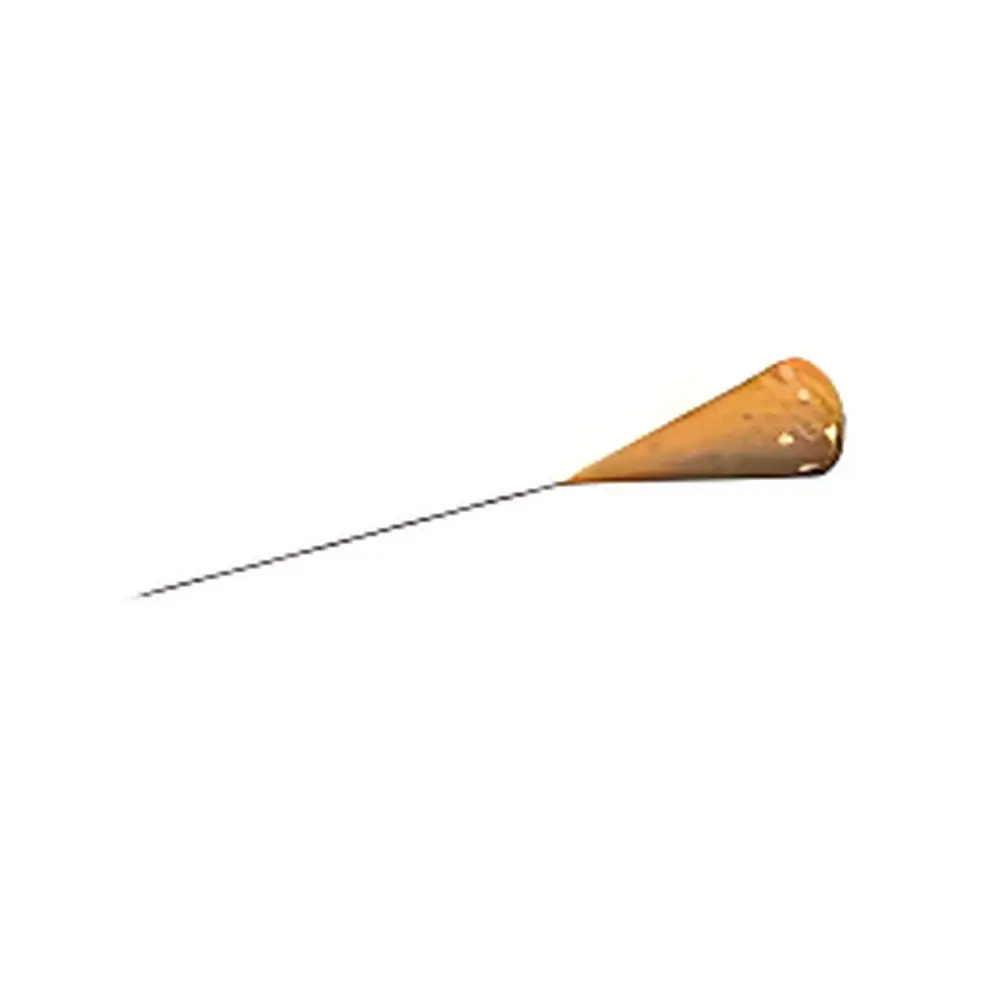
The YK100100 Towed Pitot-Static Cone Probe is a precision-engineered flight test instrumentation device designed for high-fidelity static source error (SSE) calibration of aircraft pressure systems under real atmospheric conditions. It operates on the fundamental principle of comparative pressure measurement: the probe—towed behind a chase or calibration aircraft—provides traceable, spatially isolated reference static and total pressure data, independent of the test aircraft’s fuselage-mounted ports. This enables quantitative determination of position error, installation error, and airflow distortion effects across the operational flight envelope—from sea level to FL410 and up to 0.9 Mach. Its conical geometry and optimized stagnation line alignment minimize flow separation and dynamic pressure interference, ensuring stable, repeatable measurements during coordinated maneuvers, level flight, and controlled accelerations. The probe is explicitly configured for Reduced Vertical Separation Minimum (RVSM) compliance validation, supporting regulatory audits per EASA AMC 20-18 and FAA AC 20-132A.
Key Features
- Robust aluminum alloy construction with anodized surface finish for corrosion resistance and thermal stability in variable ambient conditions.
- Integrated dual-pressure port configuration: one calibrated total pressure orifice aligned at the cone apex, and six symmetrically distributed static pressure orifices along the mid-cone section to average local static pressure gradients.
- Standard 0.25-inch NPT pressure fittings compatible with industry-standard tubing, transducers, and data acquisition systems (e.g., DAS-2000, AIMS-7000).
- Low-drag aerodynamic profile validated via wind tunnel testing at Reynolds numbers > 5 × 10⁶, minimizing wake-induced turbulence and ensuring minimal perturbation to the tow aircraft’s flight dynamics.
- Modular cable interface with shielded, twisted-pair wiring for low-noise analog signal transmission; optional MIL-DTL-38999 circular connector variant available upon request.
- Designed for external carriage using certified tow booms or pylon mounts; includes mounting flange with 4 × 0.375-in UNC threaded holes and alignment dowel pins per ASME B18.8.2 specifications.
Sample Compatibility & Compliance
The YK100100 is compatible with fixed-wing commercial transport, regional jet, business aviation, and military trainer platforms operating within RVSM airspace (FL290–FL410). It supports both heated and unheated configurations—though static and total pressure outlets are supplied unheated as standard, consistent with RTCA DO-160G Section 22 Category L requirements for non-critical environmental testing. Calibration certificates include NIST-traceable pressure transducer calibrations (per ISO/IEC 17025), documented uncertainty budgets (< ±0.15% FS for static pressure at 10 kPa), and flight envelope verification reports. The probe meets applicable portions of ASTM E2500-21 (Verification and Validation of Aerospace Systems) and aligns with EASA Part 21.G subpart G design assurance criteria for Level B airborne equipment. Documentation packages include full dimensional drawings (ACIS .sat format), material certifications (AMS 4027), and electromagnetic compatibility (EMC) test summaries per DO-160G Section 20.
Software & Data Management
While the YK100100 is a passive sensing probe requiring no onboard electronics, it integrates seamlessly with industry-standard flight test software suites including FlightStream™, TMS-5000, and NI VeriStand. Raw pressure signals are digitized using 24-bit sigma-delta ADCs with programmable gain amplifiers, enabling resolution down to 0.01 hPa in static pressure channels. All post-flight analysis workflows support automatic application of temperature-compensated air data equations (ISA-76 and ICAO Annex 10 Vol I), including compressibility and viscosity corrections. Audit-ready data export formats include CSV, HDF5, and ARINC 717-compliant PCM frames. For GLP/GMP-aligned operations, system integration supports FDA 21 CFR Part 11-compliant electronic signatures and audit trails when paired with validated DAQ hardware and secure server infrastructure.
Applications
- Routine RVSM recertification of static source systems following airframe modifications, avionics upgrades, or maintenance events.
- Developmental flight testing of new aircraft types where static port placement optimization is required prior to certification.
- Investigation of altitude discrepancies between primary and standby altimeters during inflight diagnostics.
- Validation of computational fluid dynamics (CFD) models predicting static pressure distribution on complex fuselage geometries.
- Ground-based wind tunnel correlation studies using scaled-down probe variants (available upon request).
FAQ
Is the YK100100 probe certified for use in EASA or FAA-approved RVSM surveillance flights?
Yes—when operated in accordance with approved flight test procedures and supported by NIST-traceable calibration documentation, the probe satisfies the technical requirements for RVSM SSE assessment under EASA AMC 20-18 and FAA AC 20-132A.
Can the probe be used for supersonic calibration?
No—the YK100100 is rated for a maximum calibrated equivalent airspeed of 0.9 Mach. Supersonic operation introduces shockwave-induced pressure anomalies that fall outside its validated measurement envelope.
Does the probe include built-in temperature compensation?
No—temperature compensation is applied externally in the data processing stage using ambient total air temperature (TAT) inputs from the chase aircraft’s sensor suite.
What is the recommended tow cable length and breaking strength?
A minimum tow distance of 15 meters (50 ft) is advised to ensure flow field independence; certified stainless steel towing cables with ≥2,200 lbf (9.8 kN) breaking strength are recommended.
Are CAD files provided with purchase?
Yes—ACIS (.sat) format CAD models, including complete GD&T annotations and assembly constraints, are delivered with every unit.