
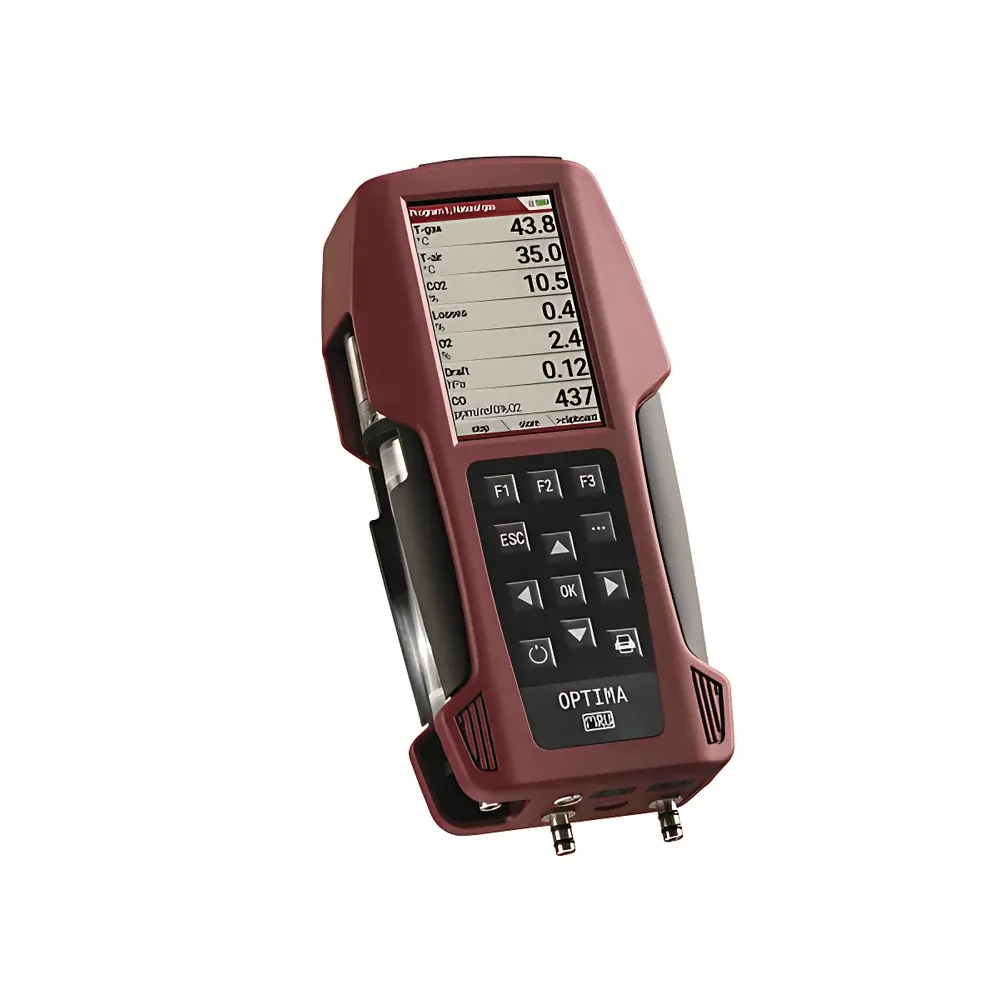
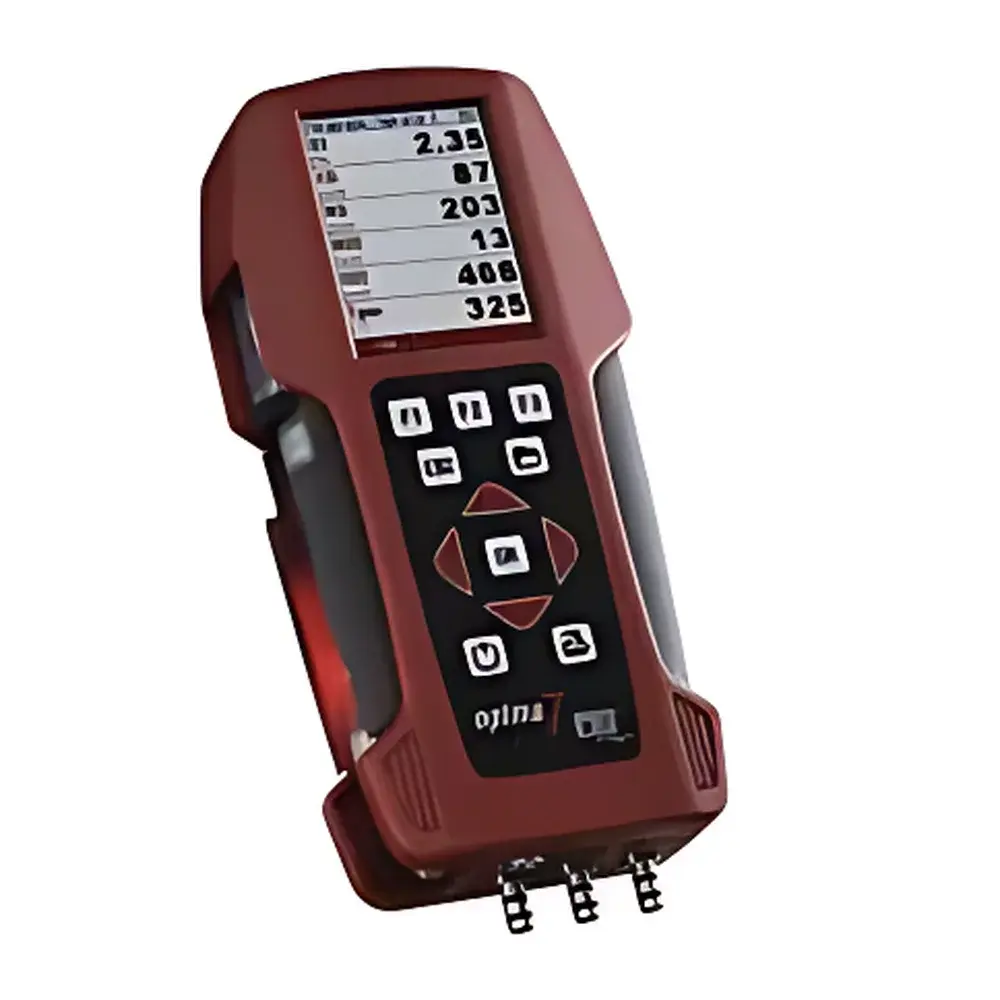
MRU OPTIMA7 Portable Flue Gas Analyzer
| Brand | MRU (Germany) |
|---|---|
| Origin | Germany |
| Model | OPTIMA7 |
| Instrument Type | Portable Flue Gas Analyzer |
| Accuracy | ≤ ±1% FS |
| Repeatability | ≤ 0.5% FS (Note: “≤0%” is technically invalid |
| Response Time | ≤ 10 s (T90) |
| Drift Stability | ≤ 1% FS/24 h |
| Measurable Parameters | O₂, CO (with H₂ compensation), COlow, NO, NOlow, NO₂, SO₂, H₂S, CO₂, Flue Gas Temperature (0–1100 °C), Ambient Air Temperature (0–100 °C), Static Pressure (±100 hPa), Differential Pressure (±100 hPa), Gas Velocity (3–100 m/s), Combustion Efficiency |
Overview
The MRU OPTIMA7 Portable Flue Gas Analyzer is an engineered-in-Germany field instrument designed for precise, real-time combustion performance assessment and regulatory-compliant emissions verification in industrial boilers, heating systems, cogeneration units, and municipal incineration facilities. Based on electrochemical sensor technology for toxic gases (CO, NO, NO₂, SO₂, H₂S) and paramagnetic or zirconia-based detection for O₂, the OPTIMA7 delivers trace-level resolution and high reproducibility under dynamic flue gas conditions. Its modular sensor architecture supports simultaneous measurement of up to seven gas components—plus temperature, pressure, differential pressure, velocity, and derived combustion parameters—enabling full stoichiometric evaluation per EN 15318, VDI 3862, and ISO 12039. The analyzer operates across a broad range of fuel types including natural gas, LPG, light/heavy fuel oil, biodiesel, coal, and biomass—making it suitable for both routine maintenance and audit-ready compliance reporting.
Key Features
- High-contrast 3.5-inch color TFT display with LED backlight and adjustable zoom for legibility in low-light or outdoor environments
- Integrated PTFE-reusable particulate filter and water separator for robust operation in high-moisture, soot-laden flue streams
- Dual power options: standard rechargeable Li-ion battery (≥6 h continuous operation) or extended-capacity battery (≥15 h)
- Stainless steel gas inlet fitting with integrated thermal protection and condensate drain port
- Mini-USB interface for bidirectional data transfer, firmware updates, and direct charging—compatible with Windows/macOS/Linux
- Infrared (IrDA) wireless link for seamless pairing with MRU’s certified thermal printers (e.g., MRU PR-200)
- Onboard storage for 250 complete measurement sets; expandable via optional 2 GB SD card (FAT32 formatted)
- Intuitive Chinese-language menu system with context-sensitive soft keys and hierarchical navigation
- Automatic ambient air zeroing and span calibration support with built-in diagnostics and sensor health monitoring
Sample Compatibility & Compliance
The OPTIMA7 is validated for use with dry- and wet-basis flue gas sampling across diverse combustion sources—including gas-fired condensing boilers, oil-fired furnaces, biomass stoves, and waste-to-energy plants. All electrochemical sensors comply with EN 50104 (CO), EN 50105 (NO/NO₂), and EN 50106 (SO₂) standards. Oxygen measurement meets EN 14789 requirements for paramagnetic accuracy. The instrument’s pressure and velocity modules conform to EN 15267-3 for stack monitoring instrumentation. Data integrity adheres to GLP principles, with timestamped records, operator ID tagging, and non-editable raw data logs—fully traceable for audits under EU IED (Industrial Emissions Directive), EPA Method 7E, and China’s GB/T 16157. Optional Bluetooth module (MRU BT-01) enables secure, encrypted wireless transmission meeting IEEE 802.15.1 standards.
Software & Data Management
MRU’s proprietary PC software—OPTIMA Control Suite v4.2—supports full configuration, real-time remote monitoring, automated report generation (PDF/CSV), and database archiving. Each measurement record includes synchronized timestamps, sensor serial numbers, calibration history, ambient conditions, and calculated parameters (excess air, dew point, CO/CO₂ ratio, efficiency %). Audit trails comply with FDA 21 CFR Part 11 requirements when used with electronic signature modules. Data export supports integration into LIMS platforms via ODBC drivers and SCADA systems via Modbus RTU over USB-to-serial emulation. Firmware updates are delivered via signed binary packages with SHA-256 checksum validation.
Applications
- Periodic boiler efficiency testing per EN 303-2 and ASME PTC 4
- Emissions verification for NOₓ, SO₂, and CO against local permit limits (e.g., TA Luft, U.S. NSPS Subpart D)
- Commissioning and tuning of low-NOₓ burners and FGR (flue gas recirculation) systems
- Field diagnostics of incomplete combustion, air leakage, and heat exchanger fouling
- Academic research on alternative fuels (e.g., hydrogen blends, pyrolysis oils) and their combustion signatures
- Third-party verification for energy service company (ESCO) performance contracts
FAQ
What fuel types is the OPTIMA7 calibrated for?
The analyzer includes preloaded combustion algorithms for natural gas, LPG, light/heavy oil, biodiesel, coal, and wood—each with optimized stoichiometric coefficients and correction factors for humidity and dilution.
Does the OPTIMA7 meet EPA or EU regulatory requirements for stack testing?
Yes—it satisfies method equivalency for EPA Method 7E (CO, NOₓ, SO₂), EN 15267-3 (performance certification), and VDI 3862 Blatt 1 (field instrumentation). Full documentation packages are available upon request.
Can measurement data be exported to Excel or LIMS without proprietary software?
Yes—CSV exports include all raw sensor outputs, calculated values, and metadata. No license is required for basic file export via Mini-USB.
Is H₂ compensation enabled for CO measurement by default?
Yes—CO readings automatically apply cross-sensitivity correction for hydrogen interference per ISO 12039 Annex B, ensuring accuracy in syngas or biomass applications.
What is the recommended calibration interval?
MRU recommends functional checks before each use and full electrochemical sensor calibration every 6 months—or after exposure to >100 ppm SO₂, >5000 ppm CO, or condensate ingress. Calibration certificates are traceable to NIST and DAkkS-accredited labs.
Related Products







