VNIIOFI Eutectic Point Fixed-Point Cell for High-Temperature Blackbody Calibration
| Brand | VNIIOFI |
|---|---|
| Origin | Russia |
| Product Type | Eutectic Fixed-Point Cell (for High-Temperature Blackbody Radiance Calibration) |
| Compatible Radiation Sources | BB3500, BB3500MP, BB3200pg, BB3500-M, BB3200pg (Re-C) |
| Eutectic Temperatures | 2474 °C to 3185 °C |
| Crucible Material | Graphite |
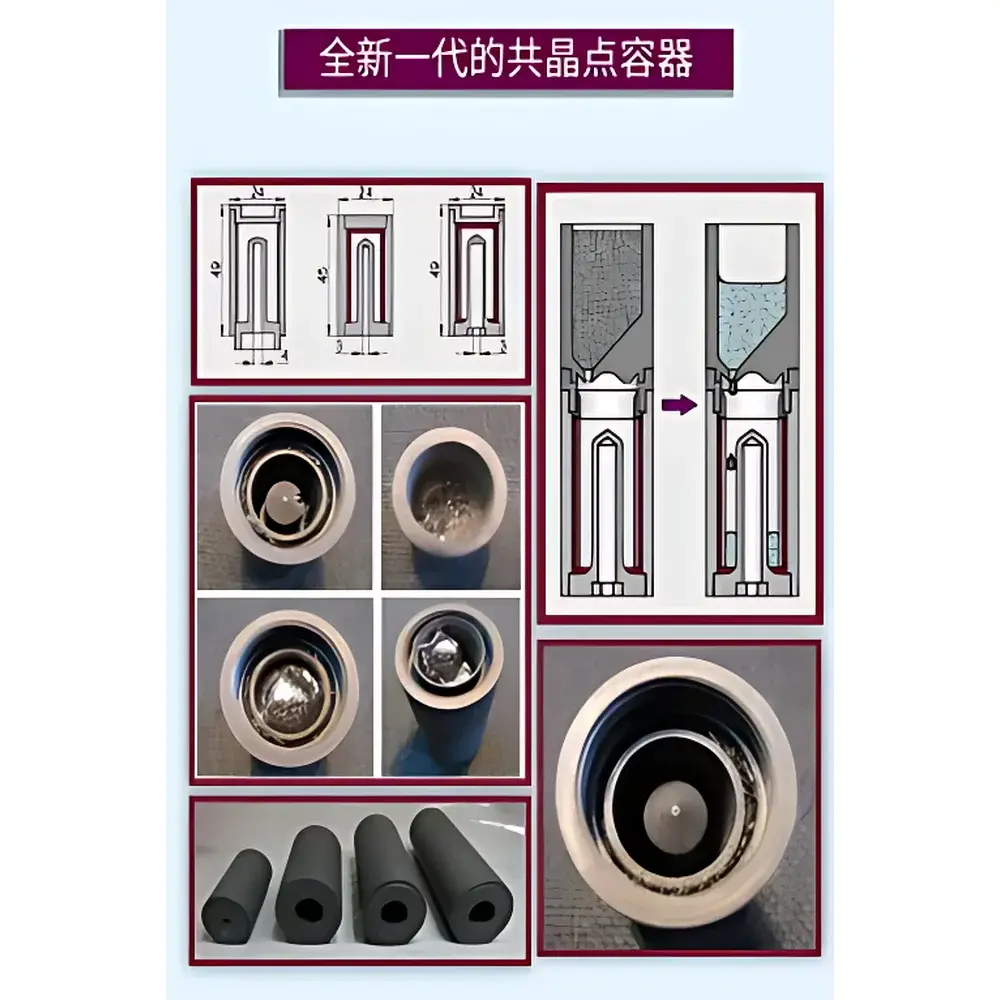
| Cavity Material Options | HfC–C, ZrC–C, TiC–C, δ(MoC)–C, Re–C |
| Effective Emissivity | 0.999 to 0.99994 |
| Cavity Dimensions (L×W×D) | 54×24×34 mm to 124×164×43×4 mm (varies by model and source) |
Overview
The VNIIOFI Eutectic Point Fixed-Point Cell is a primary standard reference device engineered for the realization and dissemination of high-temperature radiance scales above 2400 °C. Developed by the All-Russian Research Institute for Optical and Physical Measurements (VNIIOFI)—a federal metrology institute under Rosstandart—it serves as a stable, reproducible thermodynamic fixed point in radiation thermometry calibration chains. Unlike traditional melting-point cells, eutectic fixed-point cells operate on the invariant equilibrium of two or more refractory phases (e.g., metal–carbide or carbide–carbon systems) coexisting at a precisely defined temperature under quasi-adiabatic conditions. These cells are not standalone instruments but integral components of high-temperature blackbody radiation sources—such as the MIKRON BB3500, BB3500MP, BB3200pg, and BB3500-M series—where they define the effective cavity temperature with minimal uncertainty contribution from phase transition hysteresis or kinetic supercooling. Each cell is calibrated and certified in accordance with ISO/IEC 17025:2017 by VNIIOFI’s accredited thermometry laboratory and traceable to the International Temperature Scale of 1990 (ITS-90) via extrapolation protocols validated by CCT (Consultative Committee for Thermometry) key comparisons.
Key Features
- Ultra-high-temperature eutectic fixed points spanning 2474 °C (Re–C) to 3185 °C (HfC–C), enabling calibration coverage beyond the copper point (1084.62 °C) and up to the upper limit of practical radiation thermometry.
- Graphite crucibles with optimized geometry and surface finish to ensure uniform thermal gradient distribution and minimize axial temperature gradients during operation.
- High-purity refractory cavity inserts (ZrC–C, TiC–C, δ(MoC)–C, Re–C, HfC–C) fabricated via spark plasma sintering (SPS) to achieve stoichiometric consistency and phase stability under prolonged exposure to >2500 °C ambient conditions.
- Effective spectral emissivity ≥0.999, verified via absolute radiometric measurement at 650 nm using cryogenic radiometers traceable to PTB and NIST standards.
- Customized mechanical interfaces—including flange dimensions, insertion depth, and thermal anchoring profiles—designed to match specific blackbody source cavities (BB3500, BB3200pg, etc.) without compromising vacuum integrity or thermal symmetry.
- Accompanied by a full metrological dossier including phase transition plateau duration, repeatability data (k = 2, ≤ ±0.15 °C), and cavity temperature uniformity maps generated under operational load conditions.
Sample Compatibility & Compliance
The VNIIOFI eutectic cells are exclusively intended for integration into high-temperature blackbody radiation sources operating under high-vacuum (≤10⁻³ Pa) or inert gas (Ar, He) environments. Compatibility is strictly model-specific: HfC–C cells require the BB3500’s extended cavity depth and graphite-lined furnace architecture; ZrC–C and TiC–C variants are qualified for both BB3500MP and BB3200pg platforms, while Re–C cells are validated only for BB3200pg configurations due to differential thermal expansion constraints. All cells conform to the dimensional and thermal interface requirements specified in ASTM E2753–21 (Standard Practice for High-Temperature Fixed-Point Calibration of Radiation Thermometers) and support compliance with ISO/IEC 17025:2017 Clause 6.5.2 (Reference Materials). They are routinely deployed in NMIs participating in EURAMET.QM-S1 and CCT-K9 key comparisons, and their use satisfies traceability requirements for ISO/IEC 17025-accredited calibration laboratories performing radiation thermometer verification per FDA 21 CFR Part 11–compliant audit trails.
Software & Data Management
While the eutectic cell itself is a passive physical artifact, its metrological application is supported by VNIIOFI’s proprietary calibration software suite (ThermoCal v4.2), which integrates with MIKRON blackbody control systems to automate plateau detection, uncertainty budgeting, and ITS-90 extrapolation. The software implements the CCT-recommended “multi-point slope method” for sub-point interpolation and provides automated generation of calibration certificates compliant with ILAC-P10:2022. All raw plateau data, thermal imaging logs, and emissivity correction factors are stored in encrypted SQLite databases with SHA-256 hashing and timestamped audit logs—enabling full GLP/GMP-compliant data integrity and electronic record retention for ≥15 years.
Applications
- Primary calibration of radiation thermometers (including filter radiometers and FTIR-based spectroradiometers) used in aerospace turbine testing, nuclear fuel rod monitoring, and semiconductor crystal growth furnaces.
- Validation of high-temperature blackbody sources against international reference standards in national metrology institutes (NMIs) and accredited calibration laboratories.
- Supporting the development of next-generation pyrometers for Industry 4.0 process control, where real-time temperature feedback must meet ±0.25 °C expanded uncertainty targets at 3000 °C.
- Participation in international key comparisons coordinated by BIPM and regional metrology organizations to maintain global equivalence of high-temperature radiance scales.
- Research into thermodynamic properties of refractory eutectics, including phase diagram refinement, enthalpy of transformation, and long-term stability under thermal cycling (≥50 cycles at rated temperature).
FAQ
What is the difference between a eutectic fixed point and a pure-element melting point?
Eutectic systems exhibit a sharp, invariant phase transition at a single temperature (unlike pure metals, which melt over a range), offering superior reproducibility (±0.05 °C vs. ±0.15 °C) and reduced susceptibility to supercooling—critical for uncertainties below 0.1 °C at >2500 °C.
Can the same eutectic cell be used across different blackbody models?
No. Mechanical fit, thermal anchoring, and cavity depth are source-specific. A ZrC–C cell designed for BB3200pg cannot be physically or metrologically substituted into BB3500 without recalibration and revalidation.
How often does an eutectic cell require recalibration?
VNIIOFI recommends recalibration every 2 years or after 20 operational cycles—whichever occurs first—to verify phase purity, cavity emissivity, and plateau shape integrity using in-situ radiometric monitoring.
Is the cell compatible with vacuum or inert gas atmospheres only?
Yes. Operation under oxidizing or reducing atmospheres (e.g., H₂, CO) degrades carbide–carbon stoichiometry and compromises phase stability; strict adherence to Ar or He purge protocols is mandatory.
Does the cell include a certificate of calibration?
Yes. Each unit ships with a VNIIOFI-issued certificate (in English and Russian) listing realized temperature, expanded uncertainty (k = 2), plateau duration, and traceability path to ITS-90 via CCT-approved extrapolation methodology.