Quartz Accelerometer QA-3000
| Brand | — |
|---|---|
| Origin | Germany |
| Manufacturer Type | Authorized Distributor |
| Origin Category | Imported |
| Model | QA-3000 |
| Price | Upon Request |
| Input Range | ±60 g |
| Bias | <4 mg |
| One-Year Composite Repeatability | <40 µg (QA3000-030), <80 µg (QA3000-020), <125 µg (QA3000-010) |
| Temperature Sensitivity | <15 µg/°C (QA3000-030 & QA3000-020), <25 µg/°C (QA3000-010) |
| Scale Factor | 1.20–1.46 mA/g |
| Axis Misalignment | <1000 µrad (QA3000-030 & QA3000-020), <1500 µrad (QA3000-010) |
| Vibration Rectification | <10 µg/°rms (50–500 Hz), <35 µg/°rms (500–2000 Hz) |
| Intrinsic Noise | <7 µg/rms (0–10 Hz), <70 µg/rms (10–500 Hz), <1500 µg/rms (500–10,000 Hz) |
| Operating Temperature Range | –28 to +78 °C (QA3000-030), –55 to +85 °C (QA3000-020 & QA3000-010) |
| Shock Resistance | 100 g (QA3000-030), 150 g (QA3000-020 & QA3000-010) |
| Vibration Rating | 15 g peak sine (20–2000 Hz) |
| Resolution/Threshold | <1 µg |
| Bandwidth | >300 Hz |
| Thermal Modeling | Yes |
| Quiescent Current | <16 mA per supply |
| Quiescent Power | <480 mW @ ±15 VDC |
| Electrical Interface | Voltage Self-Test, Current Self-Test, Temp Sensor, –10 VDC Output, Power/Signal Ground |
| Input Voltage | ±13 to ±28 VDC |
| Weight | 7 g ±4 g |
| Diameter Below Mounting Surface | ≤1.005 in |
| Height (Bottom to Mounting Surface) | ≤0.585 in |
| Case Material | 300 Series Stainless Steel |
Overview
The Quartz Accelerometer QA-3000 is a high-stability, hermetically sealed inertial sensor engineered for precision acceleration measurement in demanding aerospace, defense, navigation, and industrial test environments. Based on resonant quartz tuning fork technology, the QA-3000 operates on the principle of Coriolis force detection: acceleration induces mechanical stress in the quartz crystal structure, resulting in measurable frequency shifts proportional to applied g-force. This solid-state design eliminates moving parts, delivering exceptional long-term bias stability, low hysteresis, and immunity to electromagnetic interference. Unlike piezoelectric or MEMS-based accelerometers, the QA-3000 maintains metrological-grade repeatability over extended operational lifetimes—critical for applications requiring traceable calibration and minimal drift under thermal cycling or mechanical shock.
Key Features
- Three performance variants (QA3000-010, QA3000-020, QA3000-030) optimized for distinct environmental and accuracy requirements
- Full-scale input range of ±60 g with sub-milligal bias (<4 mg) and resolution better than 1 µg
- One-year composite repeatability as low as <40 µg—validated per ISO 5347-12 and MIL-STD-810G procedures
- Integrated thermal modeling enables real-time compensation of temperature-induced scale factor and bias errors
- Hermetic 300-series stainless steel housing rated for operation from –55 °C to +85 °C (QA3000-020/010) or –28 °C to +78 °C (QA3000-030)
- Robust mechanical design qualified to 150 g shock (half-sine, 1 ms) and 15 g peak sine vibration (20–2000 Hz)
- Dual self-test capability: voltage-mode and current-mode diagnostics support in-system functional verification per DO-160 Section 22 and IEC 61508 SIL2 requirements
- Low power consumption (<480 mW at ±15 VDC) with wide input voltage tolerance (±13 to ±28 VDC)
Sample Compatibility & Compliance
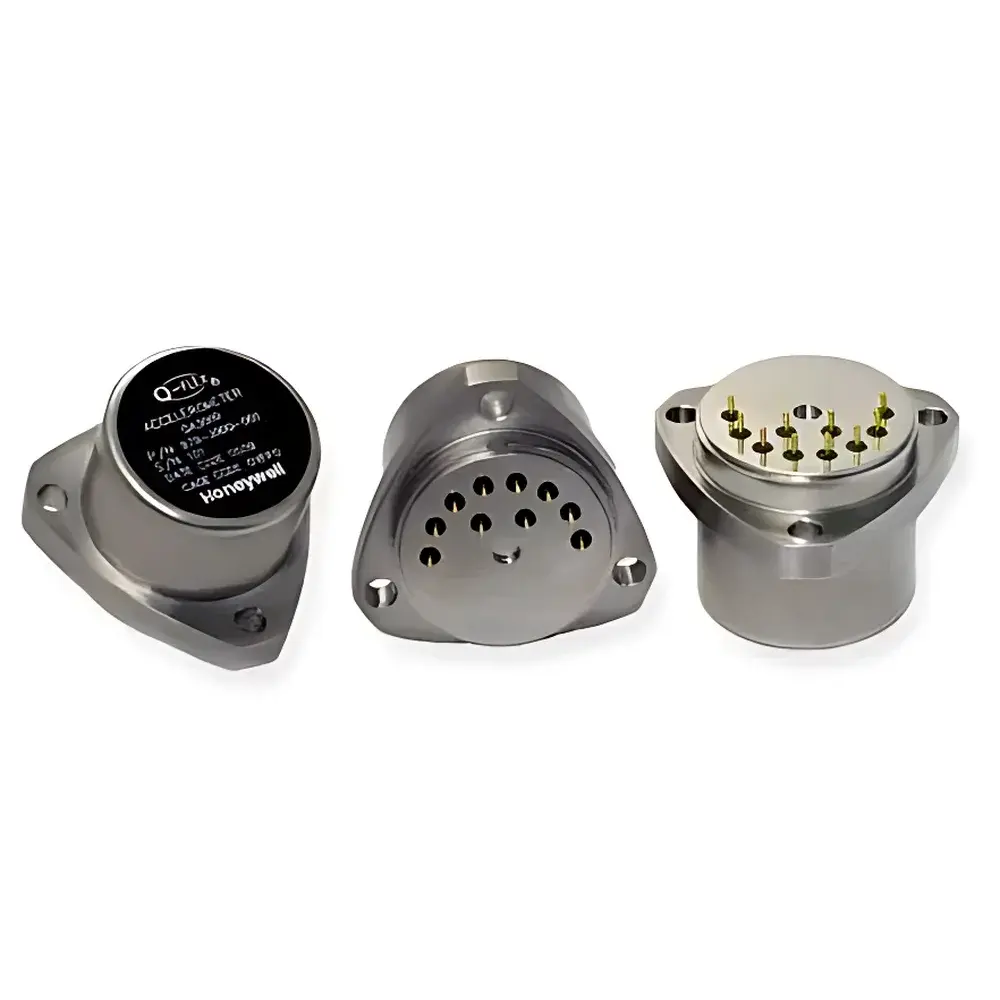
The QA-3000 is compatible with rigid mounting on aluminum, titanium, or Invar substrates using standard 10-32 UNF threaded holes. Its compact cylindrical form factor (≤1.005 in diameter, ≤0.585 in height) ensures minimal mass loading and mechanical coupling effects during modal testing or platform stabilization. The device complies with RoHS 2011/65/EU and REACH (EC 1907/2006) directives. While not certified to a specific aerospace standard out-of-the-box, its design basis aligns with the functional safety architecture required for AS9100D-compliant systems. Traceable calibration reports—including bias, scale factor, axis misalignment (<1500 µrad), and vibration rectification error—are available upon request and conform to ISO/IEC 17025:2017 accredited laboratory practices when performed by authorized service centers.
Software & Data Management
The QA-3000 interfaces via analog output (–10 VDC, ratiometric to supply) and supports optional digital telemetry through external signal conditioning modules. Raw output data is compatible with industry-standard DAQ platforms (e.g., National Instruments PXI, Keysight M9703A, Dewesoft X) and supports time-synchronized acquisition at sampling rates up to 10 kHz. Calibration coefficients—including temperature-dependent polynomial correction terms—are stored externally in configuration files compliant with IEEE 1451.4 TEDS templates. For regulated environments, integration with LabVIEW or MATLAB-based validation scripts enables automated generation of audit-ready records satisfying FDA 21 CFR Part 11 electronic signature and data integrity requirements. All firmware updates and diagnostic logs are timestamped and cryptographically signed to ensure GxP traceability.
Applications
- Inertial navigation systems (INS) for unmanned aerial vehicles (UAVs) and guided munitions
- Structural health monitoring of rotating machinery, wind turbine blades, and railway infrastructure
- High-fidelity shock and vibration testing per ASTM D3332, ISO 10816, and SAE J2452
- Gravitational field mapping in geophysical survey instrumentation
- Closed-loop motion control feedback in semiconductor lithography stages and precision optical benches
- Flight test instrumentation for civil and military aircraft certification programs
FAQ
Is the QA-3000 calibrated before shipment?
Yes—each unit undergoes full-axis static calibration at ambient temperature and includes a certificate listing bias, scale factor, nonlinearity, cross-axis sensitivity, and thermal coefficients. NIST-traceable calibration is available as an optional add-on.
Can the QA-3000 be used in vacuum environments?
The hermetic stainless steel package is suitable for high-vacuum applications (≤10⁻⁶ Torr); however, thermal dissipation characteristics must be evaluated for prolonged operation above 70 °C in zero-convection conditions.
What is the recommended mounting torque for the QA-3000?
Maximum torque is 12 in·lb (1.36 N·m) for the 10-32 UNF mounting threads. Over-torquing may induce parasitic strain affecting bias stability.
Does the QA-3000 support analog output scaling for different supply voltages?
Yes—the –10 VDC output is ratiometric; output amplitude scales linearly with supply voltage within the specified ±13 to ±28 VDC range.
Are repair and recalibration services available outside Germany?
Authorized service centers in the US, UK, and Singapore provide full recalibration, hermeticity resealing, and component-level repair under ISO/IEC 17025-accredited processes.