
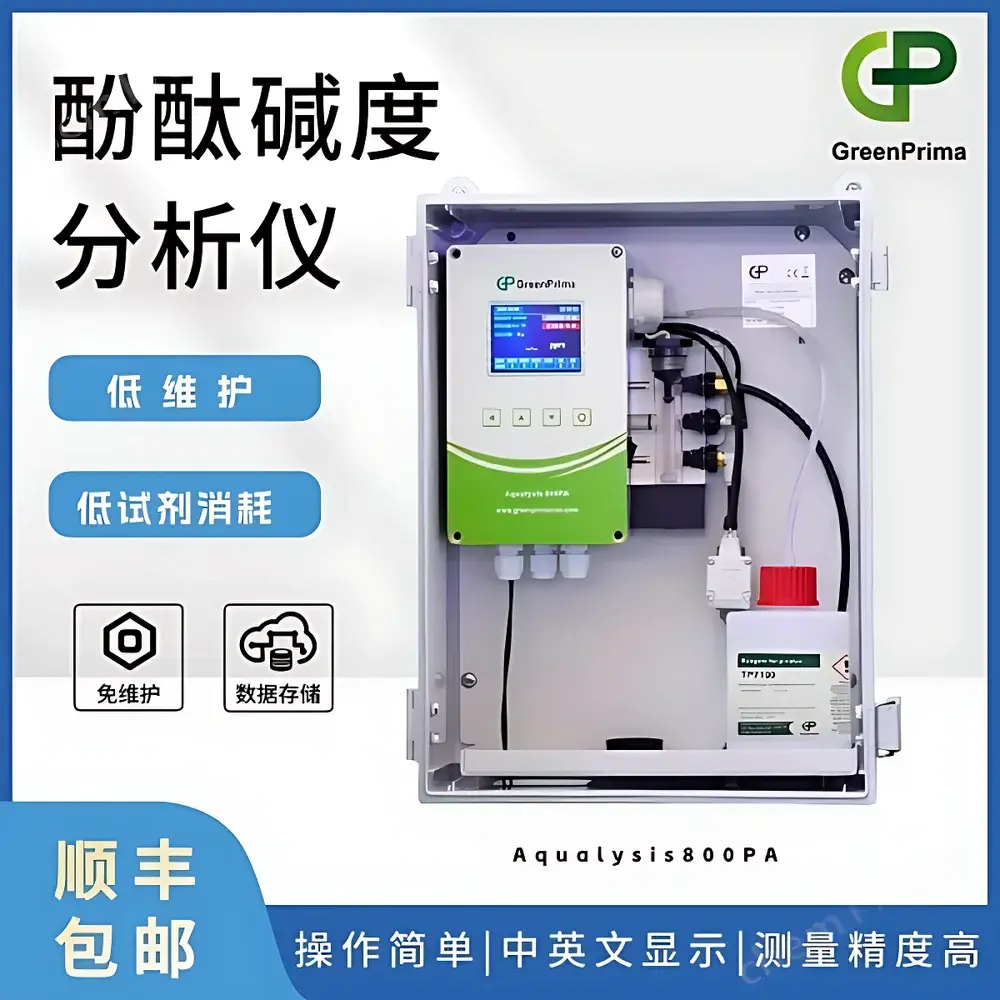
GreenPrima Aqualysis 800PA Phenolphthalein Alkalinity Analyzer
| Brand | GreenPrima |
|---|---|
| Origin | United Kingdom |
| Manufacturer Type | Manufacturer |
| Origin Category | Imported |
| Model | Aqualysis 800PA |
| Price | Upon Request |
Overview
The GreenPrima Aqualysis 800PA Phenolphthalein Alkalinity Analyzer is a fully automated, benchtop-to-industrial inline analyzer engineered for continuous or interval-based determination of phenolphthalein alkalinity (P-alkalinity) in process and environmental water streams. It operates on the principle of potentiometrically assisted acid–base titration coupled with photometric endpoint detection: a precisely metered volume of standardized hydrochloric acid is dosed into the sample until the pH drops below ~8.3, at which point phenolphthalein transitions from pink to colorless; a photometric sensor monitors absorbance change at a defined wavelength (typically 540–560 nm), enabling accurate identification of the stoichiometric endpoint. This method conforms to standard practices referenced in ISO 9963-1, ASTM D1067, and APHA Standard Methods 2320 B, ensuring regulatory traceability for industrial water quality management systems operating under GLP or GMP frameworks.
Key Features
- Integrated microprocessor-controlled analysis cycle with automatic acid dosing, indicator reagent delivery, mixing, and photometric endpoint recognition
- Compact footprint (400 × 300 × 180 mm) and low mass (4 kg), suitable for panel mounting or standalone deployment in utility rooms, cooling towers, or metallurgical plant control cabins
- True plug-and-play operation: pre-calibrated reagent kits, self-diagnostic routines, and auto-zero compensation minimize operator intervention
- Dual operational modes — continuous monitoring or programmable interval analysis (1–360 minutes), triggered by timer, external pulse signal, or flow-activated sampling
- IP65-rated enclosure for resistance to dust ingress and low-pressure water jets, enabling installation in semi-outdoor or high-humidity industrial environments
- Low reagent consumption (≤1.2 mL per analysis) and extended maintenance intervals (>6 months between service cycles under typical duty)
- Configurable 4-channel relay outputs (250 V AC / 4 A max) and two digital inputs for integration with PLCs, SCADA systems, or multi-channel selector manifolds (e.g., GreenPrima MCS series)
Sample Compatibility & Compliance
The Aqualysis 800PA is validated for use with turbid, moderately conductive, non-oily aqueous matrices including blast furnace gas scrubber water, turbid recirculating cooling water, boiler feedwater, and closed-loop industrial process streams. Sample compatibility requires adherence to defined physicochemical constraints: pH 4–10, dissolved iron < 3 ppm, copper < 0.2 ppm, aluminum < 0.1 ppm, manganese < 0.2 ppm. Operating temperature ranges are 10–40 °C ambient and 5–40 °C for incoming sample water; inlet pressure must be maintained between 0.2–5 bar (optimal: 1–2 bar). All wetted components (tubing, valves, measurement cell) are constructed from chemically resistant PTFE, EPDM, and borosilicate glass to ensure long-term stability against acidic reagents and scaling ions. The analyzer supports audit-ready data logging compliant with FDA 21 CFR Part 11 requirements when paired with optional secure software modules.
Software & Data Management
The embedded firmware provides real-time display of measured P-alkalinity values in user-selectable units (°dH, °f, ppm CaCO₃, mmol/L), alongside system status, error codes, and calibration history. All measurements, alarms, and maintenance events are timestamped and stored internally (≥12 months of 5-minute interval data). Communication interfaces include isolated RS485 (Modbus RTU protocol), analog 4–20 mA output (750 Ω load max), and configurable digital I/O. Optional cloud-enabled gateway modules allow remote configuration, firmware updates, and secure data export to LIMS or enterprise SCADA platforms. Data integrity safeguards include cyclic redundancy checks (CRC), write-protected memory partitions, and tamper-evident event logs.
Applications
This analyzer is deployed in steelmaking facilities for real-time control of descaling rinse water and oxygen converter gas cleaning circuits; in power generation plants for boiler water alkalinity optimization to prevent caustic embrittlement; in HVAC systems to maintain corrosion-inhibiting alkalinity levels in closed cooling loops; and in municipal industrial pretreatment units where effluent alkalinity must comply with discharge consent limits. Its robustness and tolerance to moderate turbidity make it especially suited for “dirty water” applications where conventional online pH-stat titrators fail due to electrode fouling or optical interference.
FAQ
What alkalinity parameter does the Aqualysis 800PA measure?
It measures phenolphthalein alkalinity (P-alkalinity), corresponding to hydroxide and half the carbonate alkalinity (OH⁻ + ½CO₃²⁻) expressed as mg/L CaCO₃ or mmol/L.
Can it distinguish between total alkalinity and phenolphthalein alkalinity?
No — it is dedicated to P-alkalinity only. Total alkalinity (T-alkalinity) requires a second endpoint at pH ~4.5, which is not implemented in this model.
Is manual calibration required?
No — the system performs automatic zero and span verification using factory-certified reference solutions; full calibration is recommended every 30 days or after reagent replacement.
What is the typical analysis time per sample?
2–8 minutes, depending on sample alkalinity concentration and selected acid strength; lower alkalinity samples require longer titration times to achieve photometric resolution.
Does it support remote diagnostics and firmware updates?
Yes — via RS485/Modbus or optional Ethernet gateway; firmware updates are digitally signed and validated prior to installation to ensure system integrity.
Related Products







