
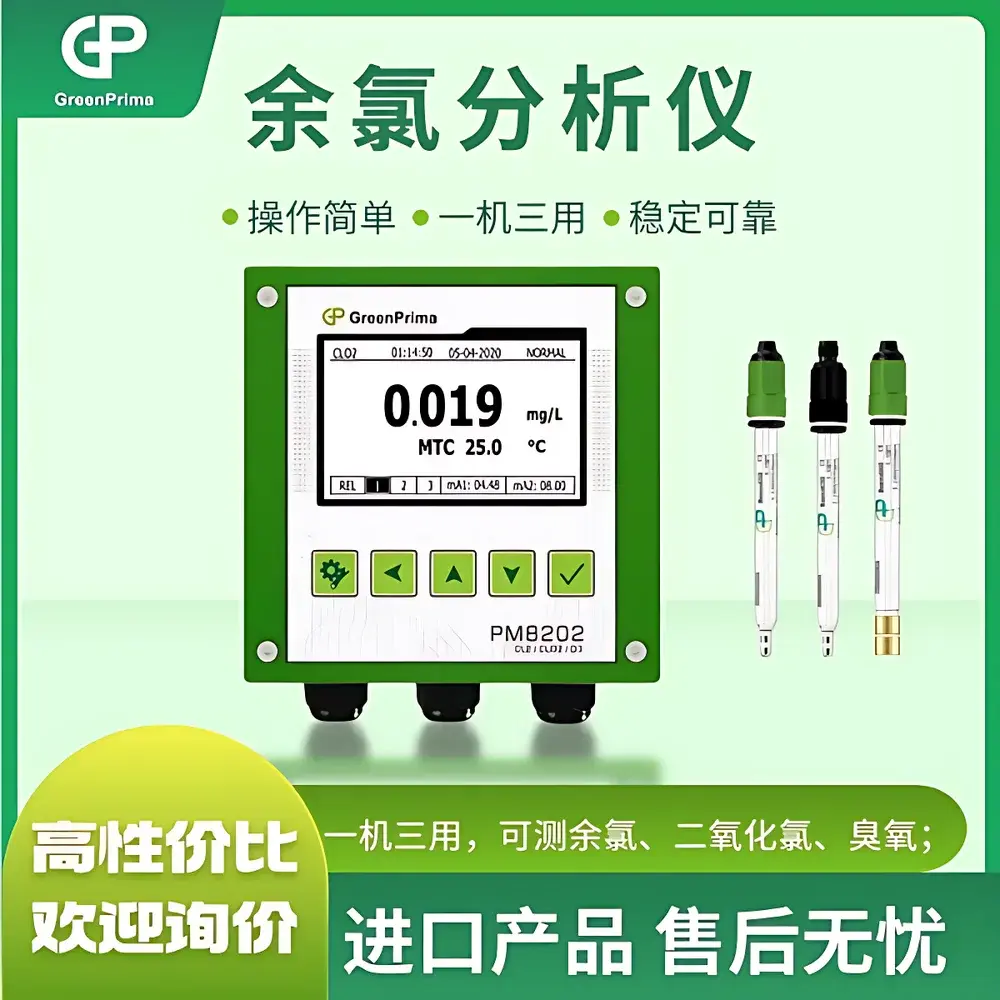
GreenPrima PM8202CL Residual Chlorine and Chlorine Dioxide Analyzer
| Brand | GreenPrima |
|---|---|
| Origin | United Kingdom |
| Manufacturer Type | Original Equipment Manufacturer (OEM) |
| Product Category | Imported Instrument |
| Model | PM8202CL |
| Instrument Type | Online Analyzer |
| Measurement Principle | Amperometric Detection at Fixed Potential (Constant Voltage Method) |
| Measured Parameters | Free Chlorine, Total Chlorine, Chlorine Dioxide, Ozone |
| Range | 0.00–20.00 ppm / 0.00–200.00 ppb |
| Resolution | 0.001 ppm / 0.01 ppm |
| Accuracy | ±2% of Full Scale |
| Temperature Compensation | -10 to 130 °C (NTC10K or PT1000 selectable) |
| Operating Temperature | -10 to 70.0 °C |
| Storage Temperature | -20 to 70.0 °C |
| Display | Backlit Graphic LCD (Chinese/English Switchable) |
| Data Storage | 600,000 records |
| Power Supply | 90–260 VAC, 50/60 Hz or 24 VDC optional |
| Output | Dual isolated 4–20 mA (≤500 Ω, 0.1% FS), RS485 Modbus RTU |
| Relay Outputs | 2 programmable SPDT relays (5 A / 250 VAC / 30 VDC) |
| Cleaning Control | Adjustable interval (0.1–1000 h) and duration (1–1000 s) |
| Alarm Logic | Dual independent Hi/Lo setpoints with hysteresis |
| Enclosure Rating | IP65 |
| Dimensions | 144 × 144 × 108 mm |
| Panel Cutout | 138 × 138 mm |
| Weight | 0.87 kg |
Overview
The GreenPrima PM8202CL is a high-stability online amperometric analyzer engineered for continuous, reagent-free monitoring of residual oxidants in water systems. It operates on the constant-voltage amperometric principle—applying a fixed potential across a dual-platinum (Bsens650) or gold (Bsens660) working electrode assembly immersed in flowing sample water. This electrochemical configuration enables selective reduction of free chlorine (HOCl/OCl⁻), chlorine dioxide (ClO₂), and ozone (O₃) at distinct redox potentials, generating current signals linearly proportional to their concentrations. Unlike colorimetric or DPD-based methods, the PM8202CL eliminates chemical reagents, membrane replacements, and electrolyte refills—reducing maintenance burden while maintaining measurement integrity across wide dynamic ranges (0.00–20.00 ppm and 0.00–200.00 ppb). Its integrated BAF615 flow-controlled cell ensures laminar, pressure-stabilized sample delivery, minimizing turbulence-induced signal drift and enabling long-term reproducibility in unattended operation.
Key Features
- Triple-analyte capability: Simultaneous or sequential measurement of free chlorine, chlorine dioxide, and ozone without hardware modification
- Reagent-free, membrane-free sensing architecture: Eliminates consumables, calibration drift from membrane aging, and interference from turbidity or colored organics
- Dual-platinum electrode (Bsens650) with anti-fouling geometry: Optimized for high chloride matrix stability and robust performance in wastewater and secondary distribution networks
- Temperature-compensated electronics with NTC10K or PT1000 sensor support: Automatic compensation across -10 to 130 °C, critical for thermal variability in industrial cooling loops and hospital sterilization effluents
- Configurable cleaning cycle control: Programmable ultrasonic or air-pulse cleaning intervals (0.1–1000 hours) and durations (1–1000 seconds) to mitigate biofilm accumulation on electrode surfaces
- Industrial-grade I/O suite: Two isolated 4–20 mA analog outputs (configurable for concentration and temperature), RS485 Modbus RTU for SCADA integration, and two SPDT relays with adjustable hysteresis for process alarms or dosing control
- Secure operational interface: Password-protected parameter configuration, audit-ready event logging, and dual-language (English/Chinese) graphic LCD with backlight for low-illumination environments
Sample Compatibility & Compliance
The PM8202CL is validated for use in potable water distribution, hospital wastewater disinfection verification, pharmaceutical clean-in-place (CIP) rinse monitoring, food & beverage process water, and municipal secondary supply networks. Its amperometric design exhibits minimal cross-sensitivity to common interferents including nitrite (<5% signal contribution at 10 mg/L), bromide (<3%), and hydrogen peroxide (<2%) under standard operating conditions. The analyzer meets EN ISO 7888:2019 (water quality — determination of residual chlorine), ASTM D1253-21 (standard test method for residual chlorine in water), and supports compliance with US EPA Method 334.0 for chlorine dioxide. Its firmware architecture includes configurable data logging timestamps and user-access logs—facilitating GLP/GMP-aligned record retention and FDA 21 CFR Part 11 readiness when deployed with validated networked data servers.
Software & Data Management
Data acquisition and system configuration are managed via the onboard graphic interface or remotely through Modbus RTU commands. All measurements—including raw current output, compensated concentration, temperature, electrode status, cleaning events, and alarm triggers—are time-stamped and stored locally in non-volatile memory (600,000 records capacity). Export is supported via serial dump or periodic polling by supervisory systems. Configuration parameters—including range scaling, relay thresholds, cleaning schedules, and language selection—are retained during power loss. Optional PC-based configuration utility (GreenPrima ConfigTool v3.x) provides batch setup, firmware update, and diagnostic waveform capture for electrode health assessment—supporting predictive maintenance planning without field service intervention.
Applications
- Real-time validation of chlorine residual in municipal drinking water storage tanks and booster stations
- Verification of ClO₂ efficacy in poultry processing plant chill water systems per USDA-FSIS guidelines
- Ozone decay monitoring in pharmaceutical purified water (PW) and water-for-injection (WFI) distribution loops
- Automated feedback control of sodium hypochlorite dosing in hospital wastewater treatment prior to discharge
- Process water quality assurance in semiconductor fab ultra-pure water (UPW) sub-loops where oxidant carryover must be quantified below 10 ppb
- Regulatory reporting compliance for WHO Guideline Limits (0.2–5 mg/L free chlorine) and EU Drinking Water Directive (98/83/EC) Annex I parametric values
FAQ
Does the PM8202CL require daily calibration or zero-point adjustment?
No. The amperometric sensor is factory-calibrated and maintains stable baseline response over extended periods. Field verification using certified standard solutions (e.g., NIST-traceable chlorine standards) is recommended quarterly or after sensor replacement.
Can the same sensor measure both free chlorine and chlorine dioxide simultaneously?
Not concurrently—but the instrument supports rapid sequential measurement by switching applied potential via software command. Each analyte requires its own optimized voltage setting; auto-switching profiles can be scheduled for multi-parameter trending.
Is the BAF615 flow cell compatible with pressurized pipeline installations?
Yes. The BAF615 is rated for continuous operation at up to 6 bar (87 psi) and integrates directly into DN15–DN50 piping via standard tri-clamp or BSP threaded fittings. Flow rate is internally regulated to 150–300 mL/min, independent of upstream pressure fluctuations.
How does the system handle high-suspended-solid content in wastewater applications?
The dual-platinum electrode’s surface geometry and programmable cleaning cycles significantly reduce fouling. For influent streams >50 NTU, optional inline filtration (50 µm stainless steel mesh) upstream of the BAF615 is advised to prevent particulate clogging of the flow channel.
What cybersecurity provisions are included for Modbus communications?
Modbus RTU operates over RS485 in master-slave mode with no inherent encryption. Secure deployment requires physical network segmentation, firewall rules limiting access to authorized SCADA masters, and disabling unused communication ports—consistent with IEC 62443-3-3 Level 1 recommendations for basic industrial device hardening.







