
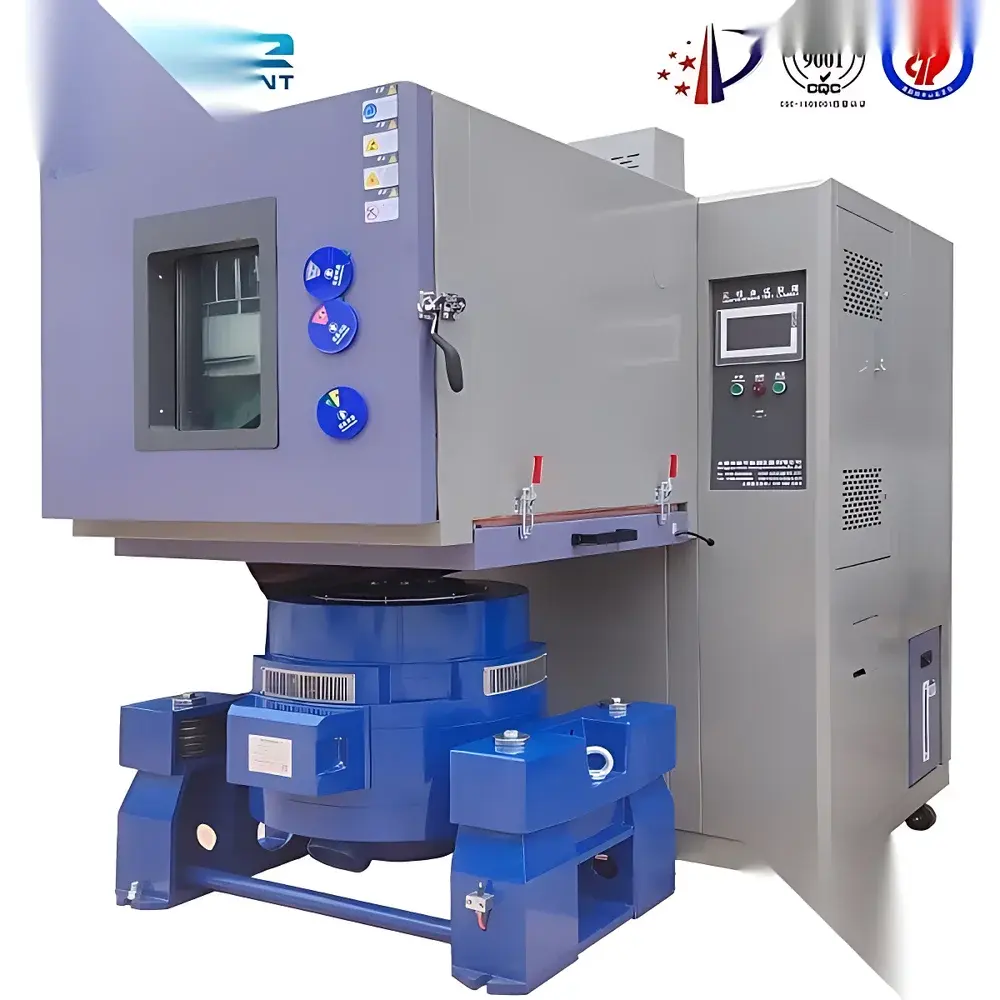
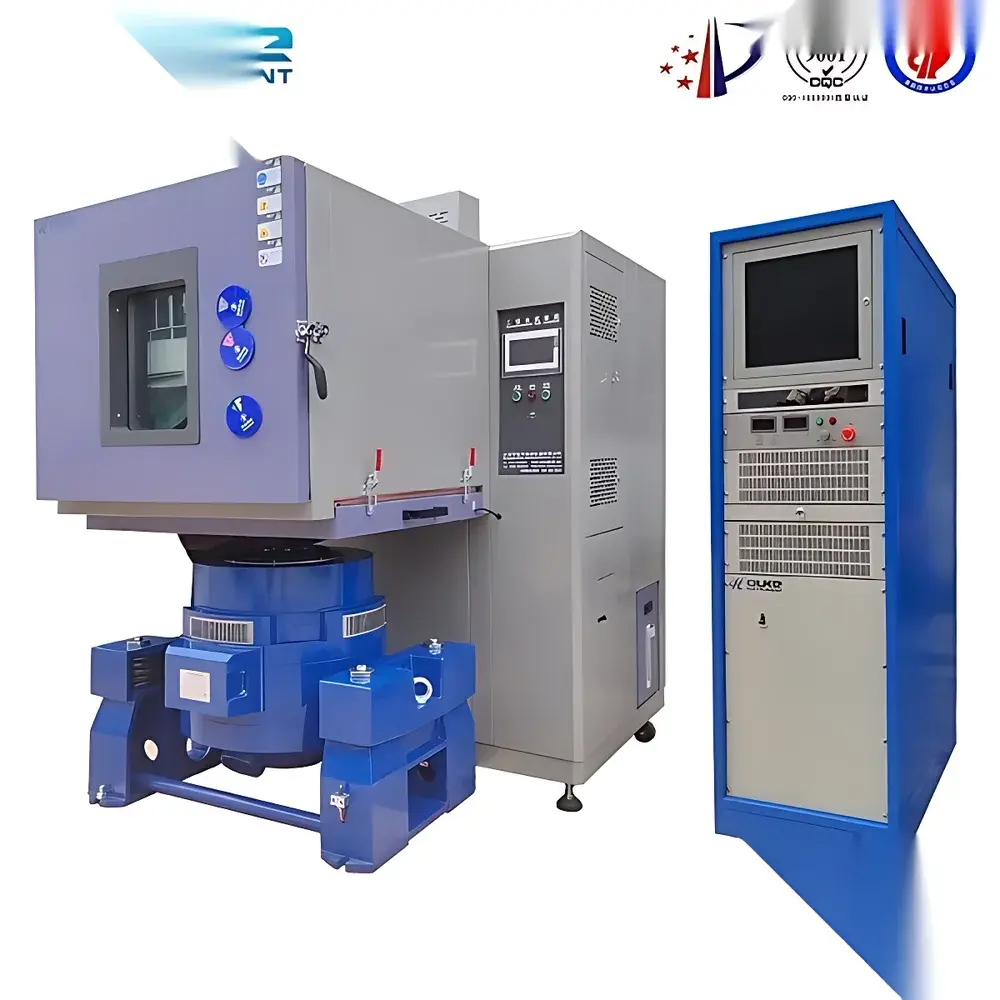
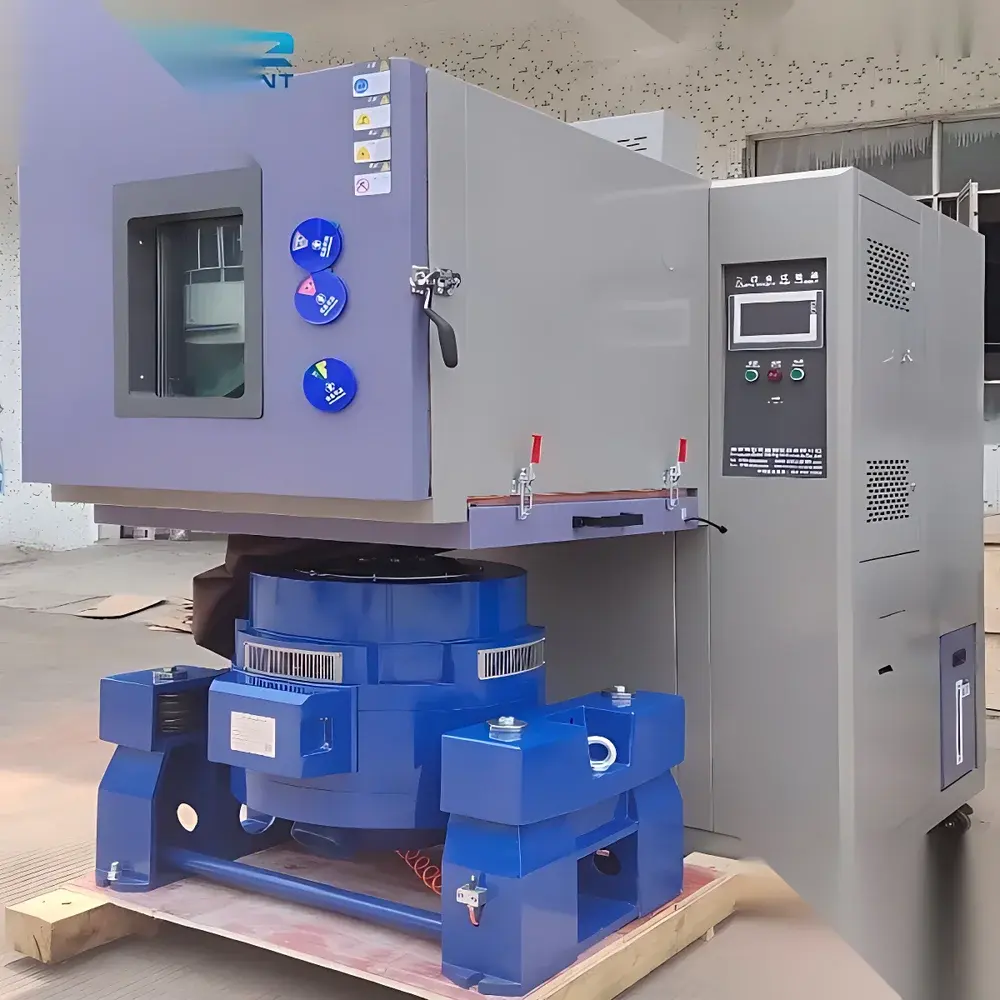
Combined Temperature-Humidity-Vibration Environmental Test System
| Key | Brand: OEM/Custom OEM |
|---|---|
| Origin | Imported |
| Manufacturer Type | Authorized Distributor |
| Price | USD 21,500 (FOB) |
| Vibration Frequency Range | 0.5–600 Hz |
| Axes Configuration | Simultaneous X/Y/Z (Triaxial), Vertical/Horizontal/Longitudinal |
| Vibration Modes | Sinusoidal (half/full wave), Sweep, Programmable, Octave, Logarithmic, Acceleration/Displacement Control, Time-Controlled, Random (Multi-Order), Road Profile Simulation, 6-DOF Coupled Motion |
| Control System | Digital PID Frequency Controller with Interference-Resistant Circuitry |
| Base Construction | Heavy-Duty Steel Frame with Vibration-Damping Elastomeric Mounts |
| Compliance | Designed to support ASTM D999, IEC 60068-2-64, ISO 16750-3, MIL-STD-810H Method 514.8, GB/T 2423.10, GB/T 2423.3, GB/T 2423.17 |
Overview
The Combined Temperature-Humidity-Vibration Environmental Test System is an integrated triaxial environmental stress screening platform engineered for concurrent application of thermal, hygrothermal, and mechanical dynamic loads. Unlike sequential or single-stress test chambers, this system enables true simultaneous exposure—where temperature (typically −70 °C to +180 °C), relative humidity (10–98% RH), and controlled mechanical vibration (0.5–600 Hz across X/Y/Z axes) operate in real-time on a single test specimen. Its core architecture employs a high-rigidity electromagnetic shaker assembly mounted directly within the conditioned chamber cavity, eliminating thermal lag and mechanical decoupling inherent in external shaker configurations. This design ensures phase-coherent stimulus delivery critical for accelerated life testing, HALT/HASS validation, and failure mode identification in electronics, automotive ECUs, aerospace avionics, and medical device packaging.
Key Features
- Triaxial electromagnetic vibration table with full 6-degree-of-freedom (6-DOF) coupling capability—supporting synchronized vertical, lateral, and longitudinal motion under programmable amplitude/acceleration profiles.
- Digital PID-controlled frequency generator with real-time sweep rate adjustment, harmonic suppression, and anti-resonance avoidance algorithms to maintain spectral integrity during extended tests.
- Integrated environmental chamber featuring stainless-steel interior, double-wall vacuum-insulated construction, and direct-expansion refrigeration with cascade compressor staging for rapid thermal ramping (up to 10 °C/min) and stable humidity control.
- Heavy-gauge steel base frame with pre-compressed elastomeric isolation mounts—eliminating the need for floor anchoring while maintaining <±0.05 g peak-to-peak displacement accuracy at 500 Hz.
- EMI-hardened control electronics including shielded signal paths, optical isolation interfaces, and active noise filtering—certified to IEC 61000-4-3 Level 3 immunity standards.
- Programmable test sequencer supporting multi-step profiles: e.g., dwell at −40 °C/10% RH → sinusoidal vibration (10–500 Hz, 5 g RMS) → ramp to +85 °C/85% RH → random vibration (20–2000 Hz, 0.04 g²/Hz PSD).
Sample Compatibility & Compliance
The system accommodates specimens up to 150 kg (static load) and 100 kg (dynamic load) with standard 600 × 600 mm mounting surface. Fixture adaptability supports DIN 50018, ASTM D4728, and IPC-9701-compliant test fixtures—including PCB carriers, chassis mounts, and vehicle component brackets. It meets functional requirements for qualification per ISO 16750-3 (road vehicle vibration), MIL-STD-810H Method 514.8 (vibration), IEC 60068-2-64 (random vibration), and GB/T 2423.10 (sinusoidal vibration), while its environmental section complies with IEC 60068-2-1 (cold), -2 (dry heat), and -3 (damp heat, cyclic). Full traceability logs—including temperature/humidity setpoints, vibration spectra (PSD/time-history), and system fault registers—are retained for GLP/GMP audit readiness.
Software & Data Management
The embedded controller runs a deterministic real-time OS with dual-channel data acquisition (24-bit ADC, 100 kHz sampling). The companion PC software provides ISO/IEC 17025-aligned test definition, live spectral monitoring (FFT, PSD, SRS), automated report generation (PDF/CSV), and electronic signature support compliant with FDA 21 CFR Part 11. All test parameters—including PID tuning coefficients, calibration offsets, and user access permissions—are stored in encrypted non-volatile memory. Audit trails record operator ID, timestamp, parameter changes, and system alarms with immutable SHA-256 hashing. Remote monitoring via secure TLS 1.3 API enables integration into enterprise MES/QMS platforms.
Applications
This system is deployed in R&D labs and QC departments for validating product robustness under compound stress conditions. Typical use cases include: thermal cycling of MEMS sensors under broadband vibration to detect solder joint fatigue; humidity-induced corrosion testing of battery enclosures subjected to road-simulated multi-axis excitation; verification of display module adhesion integrity during combined high-humidity and resonant-frequency shaking; and reliability screening of 5G base station RF modules operating at elevated ambient temperatures with mechanical shock superposition. It serves as a primary tool for compliance with AEC-Q200, JEDEC JESD22-B103, and UL 62368-1 Annex G requirements.
FAQ
What is the maximum payload capacity for simultaneous temperature/humidity/vibration testing?
The system supports up to 100 kg under full dynamic vibration while maintaining chamber uniformity (±2 °C, ±3% RH) across the working volume.
Does the system support third-party transducer integration (e.g., accelerometers, thermocouples)?
Yes—it features eight analog input channels (±10 V, 24-bit resolution) with configurable scaling and linearization tables for calibrated sensor inputs.
Is calibration documentation NIST-traceable?
Each unit ships with factory calibration certificates for temperature, humidity, and acceleration channels, all traceable to NIST or PTB standards via accredited metrology labs.
Can vibration profiles be imported from external sources (e.g., road data files)?
Yes—the software accepts ASCII-based time-history files (.txt) and binary PSD definitions (.sdf), with automatic resampling and coherence validation prior to execution.
What maintenance intervals are recommended for long-term operational stability?
Compressor oil and desiccant filters require replacement every 2,000 operating hours; shaker armature alignment and coil resistance verification are advised annually by certified field service engineers.



