
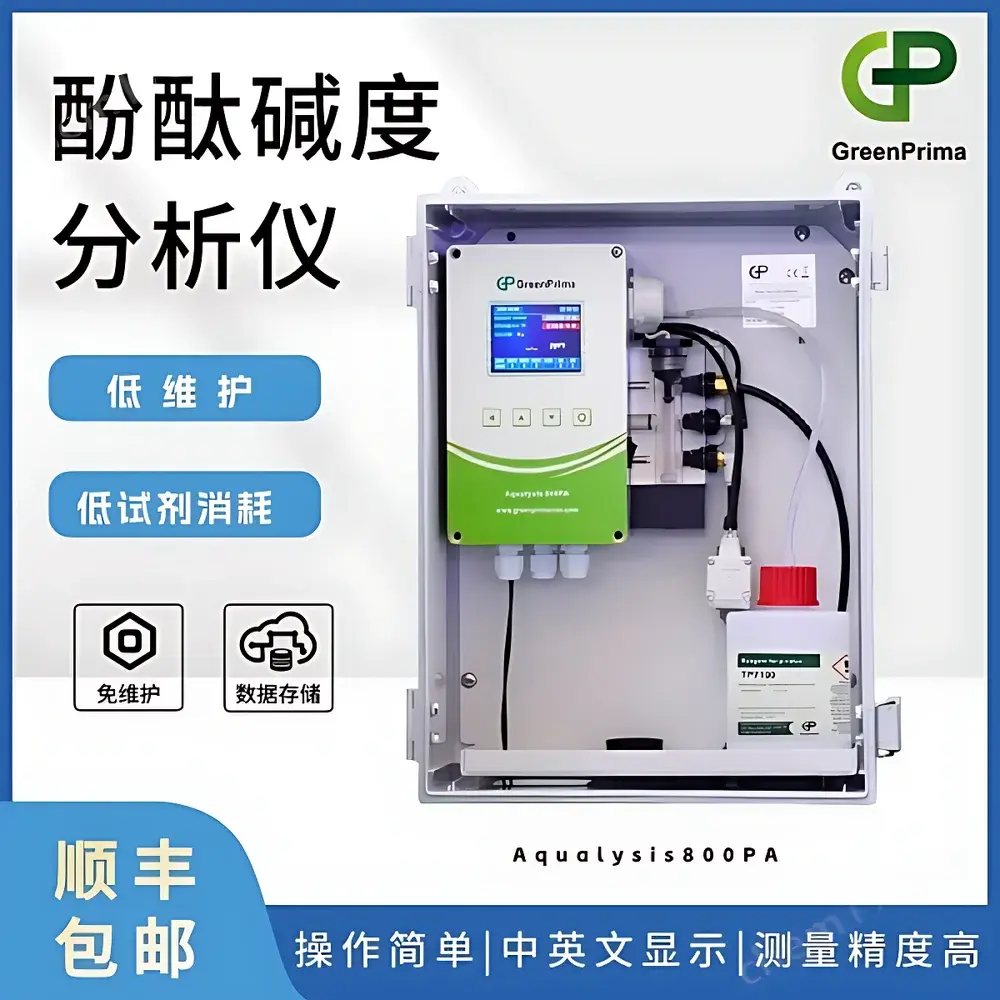
GreenPrima Aqualysis800PA Online Phenolphthalein Alkalinity Analyzer
| Brand | GreenPrima |
|---|---|
| Origin | United Kingdom |
| Manufacturer Type | Manufacturer |
| Origin Category | Imported |
| Model | Aqualysis800PA |
| Price | Upon Request |
Overview
The GreenPrima Aqualysis800PA Online Phenolphthalein Alkalinity Analyzer is a fully automated, benchtop-mounted process analyzer engineered for continuous, real-time quantification of phenolphthalein alkalinity (P-alkalinity) in industrial water streams. It operates on the principle of potentiometrically guided acid–base titration coupled with photometric endpoint detection: a precisely metered volume of standardized hydrochloric acid is dosed into the sample until the pH drops below ~8.3—the transition point at which phenolphthalein indicator shifts from pink to colorless. An integrated spectrophotometric sensor monitors absorbance change at 550 nm, enabling high-reproducibility endpoint recognition. This method complies with standard wet-chemistry protocols aligned with ISO 9963-1 (Water quality — Determination of alkalinity — Part 1: Determination of total and hydroxide alkalinity) and ASTM D1067 (Standard Test Methods for Acidity or Alkalinity of Water), making it suitable for regulated environments requiring traceable, auditable measurements.
Key Features
- Automated titration cycle with dual-stage reagent delivery: acid titrant followed by phenolphthalein indicator solution, both metered via peristaltic dosing pumps with pulse-controlled precision
- Integrated 4.3-inch TFT color LCD touchscreen interface supporting both English and Chinese languages, with intuitive navigation and real-time graphical trend display
- Compact footprint (400 × 300 × 180 mm; 4 kg) and IP65-rated enclosure for installation in demanding industrial settings—e.g., steel mill basements, cooling tower rooms, or boiler feedwater control panels
- Low-maintenance architecture: no moving parts in the optical path; self-cleaning flow cell; reagent consumption ≤ 1.2 mL per analysis cycle; typical reagent cartridge life ≥ 30 days at 15-min interval measurement
- Flexible operation modes: continuous monitoring, timed interval analysis (programmable from 1 to 360 minutes), or external trigger via digital input (IN1/IN2) or flow-pulse signal
- Comprehensive I/O suite: four programmable relay outputs (250 V AC / 4 A), two digital inputs, one isolated 4–20 mA analog output (max. 750 Ω load), and RS485 Modbus RTU for SCADA integration
- Onboard data logging: stores up to 10,000 measurement records with timestamps, calibration history, fault codes, and diagnostic logs—retained during power loss
Sample Compatibility & Compliance
The Aqualysis800PA is validated for use with clarified, low-turbidity aqueous samples meeting defined physicochemical constraints: pH 4–10, dissolved iron < 3 mg/L, copper < 0.2 mg/L, aluminum < 0.1 mg/L, and manganese < 0.2 mg/L. Sample temperature must remain between 5°C and 40°C; inlet pressure range is 0.2–5 bar (optimal: 1–2 bar). The analyzer meets CE marking requirements under the EU Electromagnetic Compatibility Directive 2014/30/EU and Low Voltage Directive 2014/35/EU. Its firmware supports audit-trail functionality—including user login tracking, parameter change logging, and calibration event timestamping—enabling alignment with GLP and GMP documentation practices where required.
Software & Data Management
The embedded microprocessor executes all analytical sequences—including blank correction, slope-based endpoint interpolation, and drift compensation—without external PC dependency. Data export is supported via USB flash drive (CSV format) or RS485 Modbus RTU to DCS/PLC systems. Optional GreenPrima MCS-series multi-channel selector modules (MCS-2 to MCS-8) enable unattended sequential analysis across up to eight independent sample lines without interrupting ongoing measurements. Firmware updates are performed via secure USB or remote OTA (over-the-air) protocol with SHA-256 signature verification.
Applications
This analyzer delivers robust performance in closed-loop water treatment processes where rapid P-alkalinity feedback informs chemical dosing decisions. Primary deployment scenarios include:
- Oxygen converter (BOF) gas scrubber water circuits, where rapid alkalinity decay signals lime slurry underfeed or system leakage
- Turbid recirculating cooling water systems in metallurgical plants, where phenolphthalein alkalinity correlates with carbonate scaling potential
- Low-pressure boiler feedwater monitoring, where elevated P-alkalinity may indicate caustic embrittlement risk
- Pre-treatment validation for ion exchange or reverse osmosis units, ensuring upstream softening efficiency
- Environmental compliance reporting for effluent discharge permits referencing phenolphthalein alkalinity limits
FAQ
What is the difference between phenolphthalein alkalinity and total alkalinity?
Phenolphthalein alkalinity (P-alkalinity) measures hydroxide (OH⁻) and half the carbonate (CO₃²⁻) content, titrated to pH ≈ 8.3. Total alkalinity includes all buffering species (OH⁻, CO₃²⁻, HCO₃⁻) and is determined to pH ≈ 4.5.
Can the Aqualysis800PA measure total alkalinity as well?
No—it is specifically configured for phenolphthalein endpoint detection. For total alkalinity, GreenPrima recommends the Aqualysis800TA variant, which uses methyl orange indicator and extended acid dosing.
Is calibration traceable to NIST standards?
Yes—calibration solutions are certified reference materials traceable to NIST SRM 3152a (standardized HCl) and ISO-certified phenolphthalein indicator solutions.
How often does the system require maintenance?
Routine maintenance consists of quarterly tubing inspection, biannual photometer verification using neutral density filters, and annual pump roller replacement—no optical alignment or electronic recalibration is required under normal operating conditions.
Does the unit support 21 CFR Part 11 compliance?
While the base firmware provides audit trail and user access control, full 21 CFR Part 11 compliance (electronic signatures, role-based permissions, system validation documentation) requires optional Validation Support Package (VSP-AQ800) and IQ/OQ protocol execution by certified field engineers.
Related Products







