GreenPrima PROCON2000 Online Colorimeter for Industrial Wastewater Monitoring
| Brand | GreenPrima |
|---|---|
| Origin | United Kingdom |
| Manufacturer Type | Original Equipment Manufacturer (OEM) |
| Product Origin | Imported |
| Model | PROCON2000 |
| Pricing | Available Upon Request |
Overview
The GreenPrima PROCON2000 Online Colorimeter is an industrial-grade, real-time optical analyzer engineered for continuous color measurement in liquid streams using UV-VIS absorption spectroscopy. It operates on the principle of spectrophotometric quantification of absorbance at defined wavelengths—primarily within the visible spectrum (400–700 nm)—correlated to the Pt-Co (Platinum-Cobalt) color scale, a standardized metric adopted globally for water and wastewater characterization. Unlike traditional wet-chemistry methods or benchtop colorimeters requiring manual sampling and reagent addition, the PROCON2000 performs non-invasive, in-line analysis directly in process pipelines or open-channel flows. Its optical architecture employs dual-beam referencing with temperature-stabilized tungsten-halogen and deuterium light sources, ensuring long-term photometric stability and minimizing drift from ambient thermal fluctuations. Designed specifically for harsh industrial environments—including pulp & paper mills, textile dye houses, chemical synthesis plants, and municipal wastewater treatment facilities—the instrument delivers trace-level color sensitivity while maintaining compliance with ISO 7887, ASTM D1209, and APHA Standard Methods 2120B.
Key Features
- Ultra-low detection limit optimized for subtle color shifts in low-turbidity effluents and high-purity process waters
- Flexible operational modes: manual spot-checking, programmable timed measurements (1–1440 min intervals), and continuous real-time monitoring
- Reagent-free operation—eliminates chemical consumption, hazardous waste generation, and associated disposal costs
- Extended service life: LED-stabilized broadband light source rated for >10 years (≥100,000 hours) with no consumables or lamp replacements
- Robust flow cell design featuring quartz optical windows and chemically inert wetted materials (quartz, polypropylene, FPM fluoroelastomer, SS316L, borosilicate glass) to resist fouling and cross-contamination from suspended solids or sludge
- Sub-5-second measurement cycle with full auto-sequence execution: auto-zero, auto-calibration (using internal reference standards), auto-measurement, auto-rinse, and self-diagnostic recovery
- Maintenance-free pre-filtration module with backflush capability—no scheduled cleaning or filter changes required under normal operating conditions
Sample Compatibility & Compliance
The PROCON2000 accommodates a broad range of aqueous matrices without sample dilution or pretreatment: municipal sewage influent/effluent, industrial process water, cooling tower blowdown, textile dye bath returns, pulp mill bleach plant discharges, seawater desalination brine, potable water distribution networks, and surface runoff. All wetted components comply with USP Class VI and FDA 21 CFR §177.2470 for indirect food contact. The system meets IP65 ingress protection for dust and low-pressure water jet resistance, and optional ATEX certification (Zone 1 or Zone 2, II 2G Ex db IIB T4 Gb) ensures safe deployment in potentially explosive atmospheres. Measurement traceability aligns with ISO/IEC 17025 requirements when operated under documented GLP procedures; data integrity supports 21 CFR Part 11-compliant audit trails via integrated timestamped event logging.
Software & Data Management
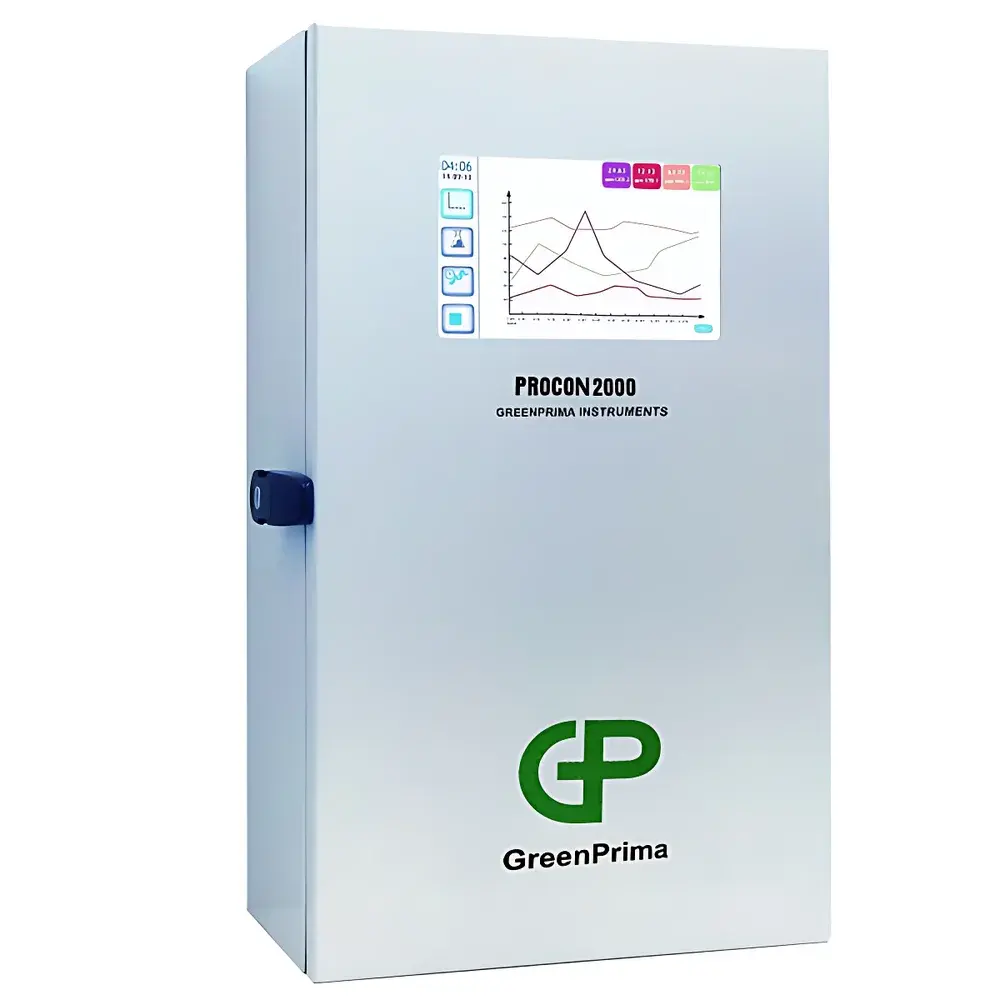
The embedded controller features an 8.5-inch TFT color touchscreen (800 × 480 resolution, LED backlight) with intuitive icon-driven navigation and multilingual UI (English, German, French, Spanish). Local data storage utilizes an industrial-grade 8 GB SD card supporting cyclic logging of up to 12 months of second-resolution color values, diagnostic flags, and maintenance events. Data export is enabled via USB 2.0 mass storage mode or Modbus RTU over RS485 (slave/master configurable). Analog 4–20 mA output provides galvanically isolated, NIST-traceable signal transmission to DCS/SCADA systems with ≤0.5% full-scale accuracy. Relay outputs support configurable alarm thresholds (e.g., color excursion, flow loss, calibration overdue) with dry-contact ratings of 5 A (NO) / 3 A (NC) at 277 VAC.
Applications
- Real-time optimization of coagulation/flocculation dosing in wastewater treatment based on color trends rather than surrogate parameters like turbidity
- Process endpoint detection in textile dyeing and printing—monitoring rinse water clarity to minimize freshwater use and reduce COD load
- Quality assurance in pulp bleaching lines where residual lignin-derived chromophores directly correlate with brightness and environmental impact
- Regulatory compliance reporting for discharge permits (e.g., EPA NPDES, EU Urban Wastewater Treatment Directive) requiring Pt-Co or Hazen unit tracking
- Early warning of upstream process upsets—e.g., accidental dye spills, resin leaching from ion exchange columns, or microbial bloom events in recirculating systems
FAQ
What color scales does the PROCON2000 support?
The instrument reports results in Pt-Co (Hazen) units by default; custom calibration curves for ADMI, Gardner, or custom spectral indices can be loaded via firmware update.
Can it operate under variable flow conditions?
Yes—the flow cell is validated for laminar-to-transitional flow regimes (0–2 L/min); integrated flow sensing triggers automatic hold-and-measure logic during transient conditions to ensure optical path consistency.
Is remote calibration possible?
Field calibration requires physical insertion of certified Pt-Co standard solutions into the sample loop; however, zero-point verification and span validation routines are fully automated and remotely executable via Modbus commands.
How is optical fouling mitigated in high-solids applications?
The flow cell incorporates ultrasonic transducers (optional) and programmable air-pulse cleaning cycles synchronized with measurement pauses; quartz windows exhibit <0.05% transmission loss after 6 months in activated sludge effluent per third-party validation reports.
Does the system support predictive maintenance alerts?
Yes—onboard diagnostics monitor light source intensity decay, detector signal-to-noise ratio, and rinse cycle efficacy; alerts are logged and transmitted via relay or Modbus register for integration into CMMS platforms.