
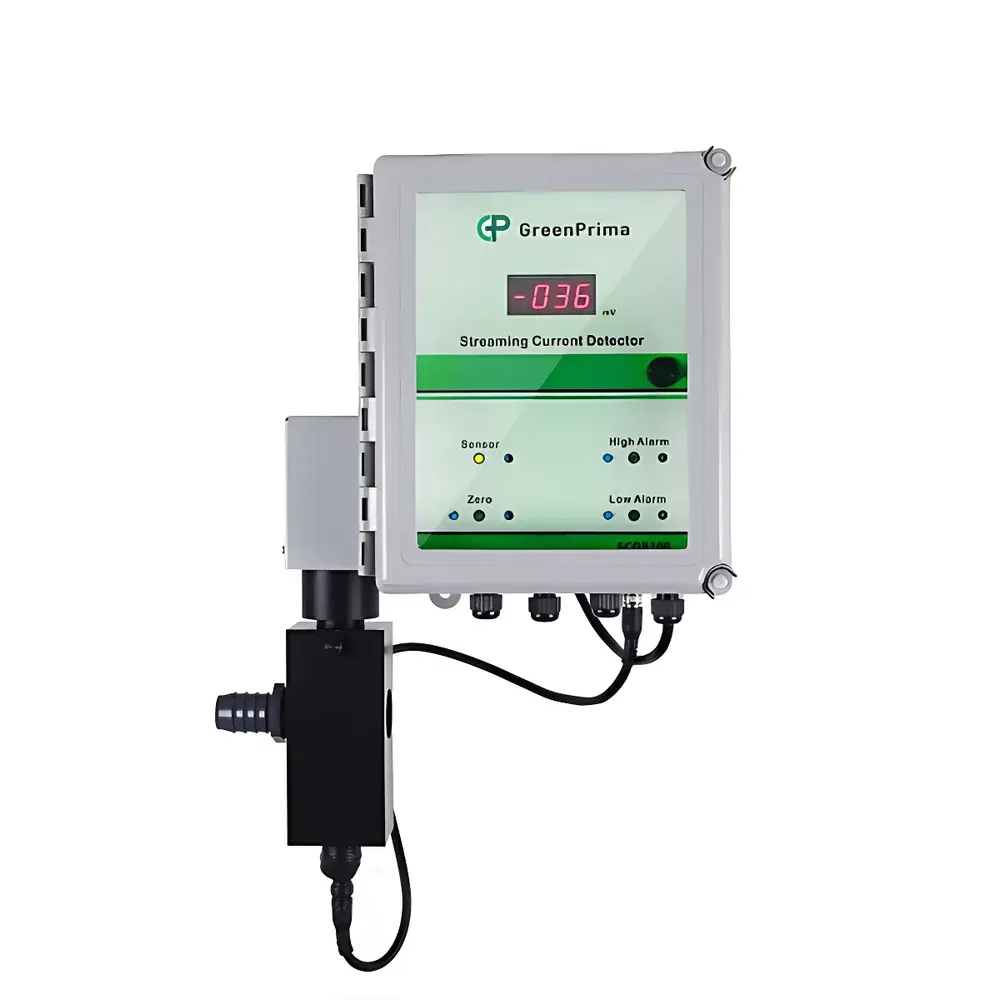
GreenPrima SCD8200 Streaming Current Detector
| Brand | GreenPrima |
|---|---|
| Origin | USA |
| Manufacturer Type | Original Equipment Manufacturer (OEM) |
| Product Category | Imported Instrument |
| Model | SCD8200 |
| Power Supply | 230 VAC |
| Measurement Range | −1000 to +1000 mV |
| Accuracy | ±0.1% of full scale |
| Flow Rate | 1 L/min (≈0.264 GPM) |
| Response Time | 1 second |
| Display | LED |
| Output Signals | 4–20 mA, −10 to +10 V, 0–10 V |
| Communication | Modbus RTU (optional) |
| Alarm Outputs | Hi/Lo relay contacts |
| Enclosure Rating | NEMA 4X / IP65 |
| Inlet Port | 1/2″ barbed fitting |
| Outlet Port | 3/4″ barbed fitting |
| Sensor Housing Material | Chemically resistant non-metallic polymer |
| Weight | 9 kg |
| Dimensions | 11″ × 6″ (279 mm × 152 mm) |
Overview
The GreenPrima SCD8200 Streaming Current Detector is an inline electrokinetic sensor engineered for real-time optimization of coagulant dosing in potable water treatment, wastewater clarification, and membrane pre-treatment systems. It operates on the principle of streaming current measurement — a well-established electrophoretic technique that quantifies the net surface charge density of colloidal particles suspended in flowing water. As water passes through a capillary or annular gap within the sensor cell, shear forces displace counter-ions in the electrical double layer, generating a measurable streaming potential proportional to the zeta potential of the colloids. This signal provides direct, dynamic feedback on coagulation status — enabling precise, adaptive control of cationic polymer or metal salt dosing without reliance on offline jar testing or turbidity proxies.
Key Features
- Real-time streaming current measurement with 1-second response time for rapid process adaptation
- High-stability electrode architecture with chemically inert, non-metallic sensor housing resistant to chlorine, ferric chloride, and polyaluminum chloride (PACl)
- Dual-range analog outputs (4–20 mA and ±10 V) compatible with PLCs, DCS, and SCADA systems
- Field-adjustable zero offset and signal gain to accommodate site-specific hydraulic and chemical conditions
- NEMA 4X/IP65-rated non-metallic enclosure with latch-closure design, rated for outdoor, wet, and corrosive environments
- Integrated self-diagnostic LED indicator for sensor status, flow verification, and fault detection
- Modbus RTU serial communication option for integration into centralized data historians and supervisory control platforms
- Barbed inlet (1/2″) and outlet (3/4″) fittings enable rapid installation into existing bypass loops or sidestream sampling lines
Sample Compatibility & Compliance
The SCD8200 is validated for continuous operation in raw surface water, settled effluent, filtered water, and clarified secondary wastewater streams with turbidity up to 100 NTU and total suspended solids (TSS) ≤ 150 mg/L. It complies with ANSI/AWWA B100-2021 guidelines for coagulation control instrumentation and supports adherence to EPA Guidance for Coagulant Optimization (EPA 815-R-19-002). Its analog output architecture meets IEC 61000-6-2/6-4 immunity and emission standards. While not certified under FDA 21 CFR Part 11, its audit-trail-capable Modbus interface and configurable alarm relays support GLP/GMP-aligned operational protocols when integrated with compliant SCADA infrastructure.
Software & Data Management
The SCD8200 operates as a standalone analog transmitter but is fully interoperable with industry-standard automation platforms via 4–20 mA loop integration or optional Modbus RTU. When deployed with a programmable logic controller (PLC), it enables closed-loop coagulant feed control using PID or fuzzy-logic algorithms. Data logging—when routed through a central historian—supports trend analysis of coagulation efficiency over time, correlation with raw water quality parameters (e.g., pH, alkalinity, DOC), and generation of compliance reports per state primacy requirements. Optional configuration software (via USB-to-serial adapter) permits field calibration verification, alarm threshold setting, and firmware updates without hardware disassembly.
Applications
- Optimization of aluminum sulfate, ferric chloride, and cationic polymer dosing in municipal drinking water plants
- Stabilization of filtration performance in conventional and direct filtration plants
- Prevention of fouling in low-pressure reverse osmosis (RO) and ultrafiltration (UF) pretreatment trains
- Dynamic control of dewatering polymer addition in belt filter press and centrifuge operations
- Early detection of coagulant underdosing or overdosing events during source water quality shifts (e.g., seasonal algae blooms or runoff events)
- Supporting ISO 24510-based asset management strategies through predictive maintenance triggers based on signal drift trends
FAQ
How does the SCD8200 differ from turbidity or zeta potential analyzers?
Unlike turbidity meters—which measure light scattering—and benchtop zeta potential instruments—which require offline sample dilution and electrophoretic cell setup—the SCD8200 measures streaming current directly in flowing process water, providing continuous, in-situ electrokinetic feedback with no reagent consumption or sample handling.
Can the SCD8200 be installed in high-pressure distribution lines?
No. It is designed for low-pressure sidestream applications (≤ 60 psi) with nominal flow of 1 L/min. A pressure-reducing valve and flow restrictor must be used if tapping from pressurized mainlines.
Is sensor cleaning required? How often?
Yes. Routine cleaning with citric acid (5%) or diluted HCl (0.1 N) is recommended every 2–4 weeks depending on feed water fouling potential. The sensor’s modular design allows tool-free removal without system shutdown.
Does the instrument support automatic temperature compensation?
No. Streaming current is inherently temperature-sensitive; however, the SCD8200’s high signal-to-noise ratio and fast response minimize thermal drift impact. For critical applications, pairing with a PT100 temperature sensor and external compensation algorithm is advised.
What maintenance certifications apply to the NEMA 4X enclosure?
The enclosure conforms to UL 50E, CSA C22.2 No. 94.1, and IEC 60529 for ingress protection, corrosion resistance, and UV stability—validated for continuous outdoor exposure in temperate and humid subtropical climates.
Related Products







