
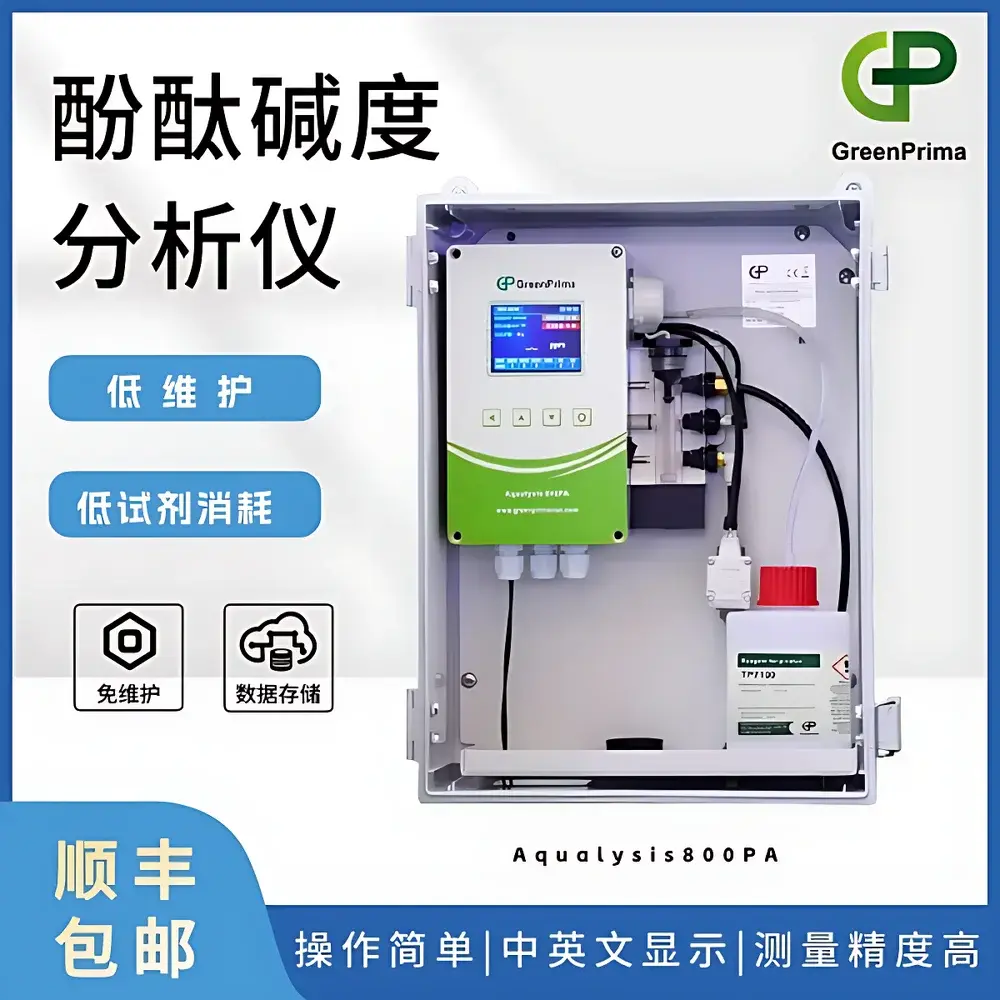
GreenPrima Aqualysis 800PA Phenolphthalein Alkalinity Analyzer
| Brand | GreenPrima |
|---|---|
| Origin | United Kingdom |
| Manufacturer Type | Manufacturer |
| Origin Category | Imported |
| Model | Aqualysis 800PA |
| Price | Upon Request |
Overview
The GreenPrima Aqualysis 800PA Phenolphthalein Alkalinity Analyzer is a fully automated, benchtop-to-industrial inline analyzer engineered for precise, continuous determination of phenolphthalein alkalinity (P-alkalinity) in aqueous process streams. It operates on the principle of potentiometrically guided acid–base titration coupled with photometric endpoint detection—specifically optimized for the pH 8.3 endpoint characteristic of phenolphthalein indicator transition. Unlike generic pH-based estimations, this system delivers traceable, chemically grounded alkalinity quantification by dynamically dosing standardized hydrochloric acid while monitoring spectral absorbance shifts (typically at 550 nm) induced by the indicator’s colorimetric response. The integrated microprocessor controls reagent delivery, mixing kinetics, optical measurement timing, and endpoint validation—ensuring compliance with standard methods including ISO 9963-1, ASTM D1067, and APHA Standard Method 2320 B. Designed for unattended operation in demanding industrial water environments, it eliminates manual titration variability and supports regulatory data integrity requirements under GLP and GMP frameworks.
Key Features
- Automated titration–photometry hybrid methodology with dual-stage endpoint verification
- Self-calibrating optical path using stable LED light source and interference-filtered photodiode detection
- Low-reagent-consumption architecture: ≤1.2 mL HCl (0.1 N) and ≤0.8 mL phenolphthalein indicator per analysis cycle
- Compact footprint (400 × 300 × 180 mm) and IP65-rated enclosure for semi-outdoor or utility corridor installation
- Full-color LCD touchscreen interface with bilingual (English/Chinese) menu navigation and real-time trend visualization
- Configurable measurement modes: continuous (fixed interval) or event-triggered (via digital input, flow pulse, or external PLC signal)
- Four programmable relay outputs (250 VAC / 4 A) for alarm, dosing control, or sample diversion logic
- Embedded non-volatile memory storing ≥12 months of timestamped results, calibration logs, and fault diagnostics
- Power-efficient design: 25 VA operational draw; 3.5 VA standby consumption
Sample Compatibility & Compliance
The Aqualysis 800PA is validated for use with cooling tower makeup water, blast furnace gas scrubber effluent, boiler feedwater, and closed-loop recirculating systems where suspended solids remain <10 mg/L and turbidity <5 NTU. Sample compatibility requires adherence to specified matrix constraints: pH 4–10, dissolved Fe <3 ppm, Cu <0.2 ppm, Al <0.1 ppm, Mn <0.2 ppm. Operating temperature range spans 5–40 °C for sample inlet and 10–40 °C ambient. Pressure tolerance is 0.2–5 bar (recommended 1–2 bar), with optional pressure-regulated sample conditioning kits available. All wetted materials—including fluoropolymer tubing, ceramic metering valves, and PTFE-coated photometric cuvettes—meet USP Class VI and FDA 21 CFR 177.2460 compliance for contact with potable and industrial process water. System firmware supports audit trail generation and electronic signature capability per FDA 21 CFR Part 11 Annex 11 requirements.
Software & Data Management
The embedded firmware provides configurable data handling via three native output protocols: isolated 4–20 mA analog output (750 Ω max load), RS485 Modbus RTU (slave ID configurable), and dry-contact relay signals. Historical datasets are exportable via USB flash drive in CSV format, preserving timestamps, raw absorbance values, calculated alkalinity (reported in mmol/L, ppm CaCO₃, °dH, or °f), and diagnostic flags. Remote configuration and firmware updates are supported through secure HTTP(S) interface with role-based access control (admin/operator/guest). Optional integration with GreenPrima’s MCS Series Multi-Channel Selector enables seamless expansion to up to eight independent sample streams without interrupting ongoing measurements—ideal for multi-point monitoring across distributed water treatment infrastructure.
Applications
This analyzer serves critical process control functions in metallurgical gas cleaning systems (e.g., oxygen converter off-gas scrubbers), HVAC cooling water management, high-pressure steam generation plants, and municipal pre-treatment facilities where rapid detection of carbonate/bicarbonate equilibrium shifts informs lime dosing, acid feed control, and corrosion inhibition strategies. Its robustness against moderate chloride interference and resistance to organic fouling make it suitable for reclaimed water reuse loops and zero-liquid-discharge (ZLD) pretreatment trains. Field deployments confirm repeatability within ±1% of full-scale range and accuracy within ±2% of certified reference material values across 5–250 mg/L CaCO₃ equivalent alkalinity ranges.
FAQ
What alkalinity species does the Aqualysis 800PA specifically quantify?
It measures phenolphthalein alkalinity (P-alkalinity), corresponding to hydroxide (OH⁻) and one-half the carbonate (CO₃²⁻) concentration at pH 8.3.
Can the instrument differentiate between total alkalinity and phenolphthalein alkalinity?
No—it is dedicated solely to P-alkalinity. Total alkalinity requires a separate methyl orange endpoint (pH 4.5), which is not supported by this model.
Is method validation documentation available for regulatory submissions?
Yes—GreenPrima provides IQ/OQ documentation packages, ASTM/ISO method correlation reports, and instrument-specific uncertainty budgets upon request.
How often must reagents be replaced during continuous operation?
At 10-minute intervals, HCl and indicator reservoirs typically last 3–4 weeks; replacement frequency scales inversely with analysis frequency and selected reagent concentration.
Does the system support remote diagnostics and predictive maintenance alerts?
Yes—built-in self-diagnostics monitor valve actuation cycles, pump backpressure, optical drift, and reagent depletion, triggering configurable notifications via relay or Modbus register status codes.
Related Products







