
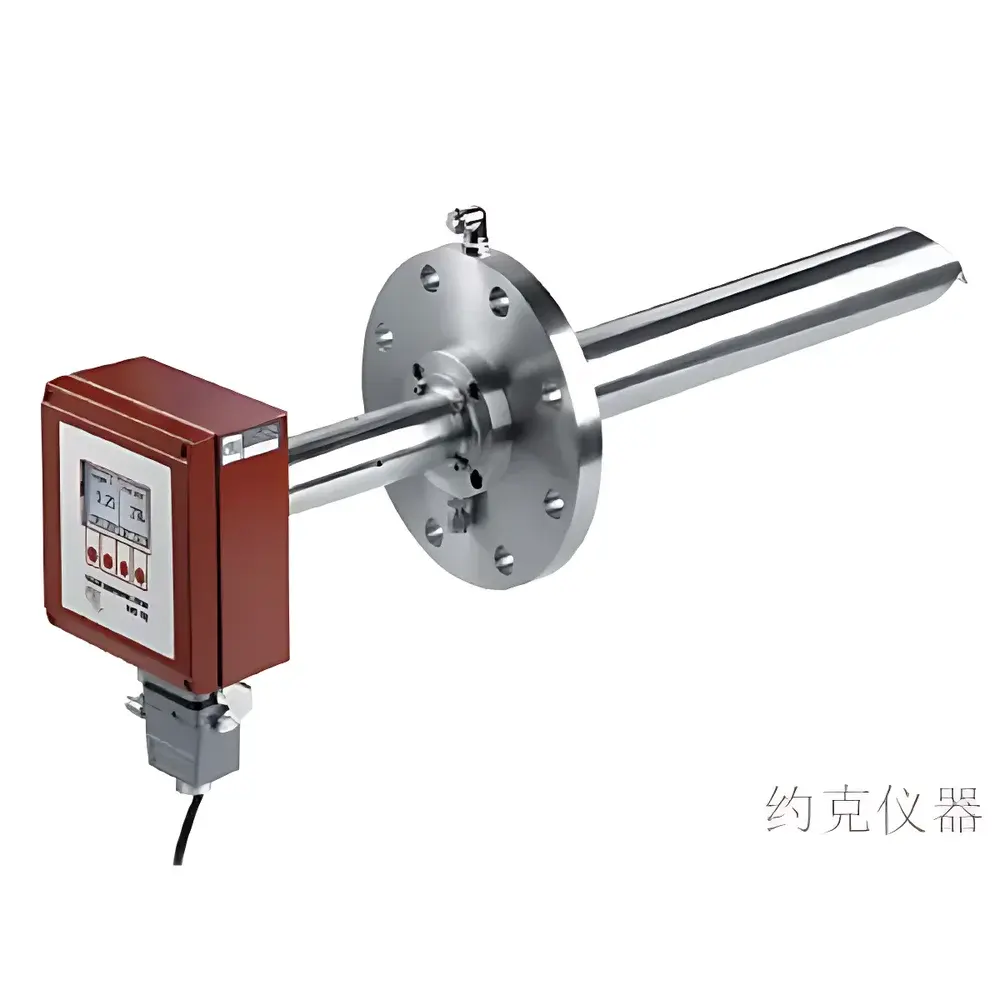
MRU OMS420 Zirconia-Based Oxygen and Combustion Efficiency Online Monitoring System
| Brand | MRU (Germany) |
|---|---|
| Origin | Germany |
| Model | OMS420 |
| Response Time | < 10 s |
| Measurement Principle | ZrO₂ Electrochemical Cell |
| Optional Sensor | COe (Combustible Gas Equivalent) |
| O₂ Range | 0–25% vol |
| COe Range (optional) | 0–1000 ppm |
| Accuracy | ±0.2% O₂ or ±5% of reading (whichever is greater) |
| Repeatability | ≤ ±1% FS |
| Warm-up Time | 30 min |
| Service Life | > 5 years |
| Analog Outputs | Dual 4–20 mA (user-configurable range) |
| Digital Interface | RS485 (Modbus RTU) |
| Power Supply | 18–24 VDC / 90–100 W |
| Calibration Port | Threaded connection for 6/4 mm tubing |
| Purge Air Interface | Quick-connect fitting, 8 mm, 6–8 bar compressed air required |
| Operating Ambient Temperature (electronics) | –20 °C to +60 °C |
| Enclosure Rating | IP65 |
Overview
The MRU OMS420 is a robust, field-proven zirconia-based online monitoring system engineered for continuous, real-time measurement of oxygen concentration and combustion efficiency in industrial flue gas streams. Unlike extractive systems requiring complex sample conditioning, the OMS420 employs a direct-insertion, non-dispersive electrochemical sensing architecture grounded in high-temperature solid electrolyte (ZrO₂) technology. This principle enables stable, drift-resistant O₂ quantification across the full 0–25% vol range under varying stack conditions—including high moisture content—without reliance on reference air. When equipped with the optional COe (combustible gas equivalent) sensor, the system calculates combustion efficiency by concurrently measuring residual unburnt species (primarily CO, H₂, and hydrocarbons) alongside O₂, enabling precise stoichiometric assessment per ISO 5167 and EN 15318 guidelines. The probe assembly remains permanently installed in the duct; only the transmitter module is serviceable onsite—eliminating hot-work permits and process downtime associated with full probe extraction.
Key Features
- True wet-gas measurement capability: Delivers accurate O₂ and COe readings without prior drying, with automatic compensation to dry-basis values per EN 14792 and EPA Method 3A.
- Modular transmitter design: Field-replaceable electronics unit—no need to remove the sampling probe from the flue during maintenance or calibration.
- Integrated purge and auto-calibration options: Supports scheduled or manual zero/span calibration via the PU420 pneumatic control unit, eliminating manual probe handling.
- No reference oxygen requirement: Self-contained ZrO₂ cell eliminates dependency on ambient air reference lines, enhancing reliability in confined or pressurized environments.
- High environmental resilience: IP65-rated enclosure and operating temperature range of –20 °C to +60 °C ensure stable performance in harsh plant environments.
- Dual analog outputs and Modbus RTU interface: Enables seamless integration into DCS, SCADA, and PLC systems for regulatory reporting and process optimization.
Sample Compatibility & Compliance
The OMS420 is validated for use with flue gases from coal-, oil-, gas-, and biomass-fired boilers; waste incinerators; cement kilns; and thermal oxidizers. It maintains accuracy in gas streams containing up to 30% water vapor, particulate loadings up to 10 g/Nm³ (with purge air), and temperatures up to 200 °C at the probe tip (OMS420HT variant extends this to 400 °C). All configurations comply with CE marking requirements under the EU Measuring Instruments Directive (MID 2014/32/EU) and electromagnetic compatibility standards (EN 61326-1). Data integrity meets GLP/GMP-aligned traceability expectations, with configurable audit trails for calibration events, output changes, and firmware updates—supporting FDA 21 CFR Part 11 readiness when deployed with compliant host software.
Software & Data Management
While the OMS420 operates as a standalone analyzer, its RS485 Modbus RTU interface allows bidirectional communication with third-party supervisory systems. Users can configure scaling factors, alarm thresholds, and data logging intervals remotely. The PU420 pneumatic unit provides programmable calibration sequences—including zero (N₂), span (air or certified gas), and intermediate checks—with timestamped event logs stored in non-volatile memory. No proprietary software is required for basic operation; however, MRU’s optional WinControl Suite supports advanced diagnostics, trend analysis, and automated report generation aligned with ISO 17025 documentation requirements.
Applications
- Real-time combustion optimization in utility and industrial boilers to minimize excess air and reduce NOₓ emissions.
- Continuous compliance monitoring for regulatory frameworks including EU IED (Industrial Emissions Directive), US EPA 40 CFR Part 60, and China’s GB 13223–2011.
- Efficiency auditing of thermal processes in petrochemical, pulp & paper, and food processing facilities.
- Performance verification of low-NOₓ burners and flue gas recirculation (FGR) systems.
- Integration into energy management systems (ISO 50001) for fuel consumption tracking and carbon intensity reporting.
FAQ
Does the OMS420 require reference air for O₂ measurement?
No. The zirconia sensor operates autonomously using an internal reference electrode, eliminating dependence on ambient air supply lines.
Can the system operate reliably in high-humidity flue gas?
Yes. The OMS420 performs wet-basis measurements and includes built-in algorithms to convert results to dry-basis values per standard methods.
What is the maximum allowable flue gas temperature at the probe tip?
Standard OMS420 models support up to 200 °C; the OMS420HT variant with ceramic-lined probe and jet-cooled mounting flange is rated for continuous operation at 400 °C.
Is remote calibration possible without interrupting the process?
Yes—when paired with the PU420 pneumatic unit, fully automated zero and span calibrations can be triggered remotely via Modbus command or scheduled timer.
How is particulate fouling mitigated?
The system incorporates a purge air interface (6–8 bar) for periodic reverse-flow cleaning of the sampling tube and sensor surface, minimizing ash deposition and extending maintenance intervals.







