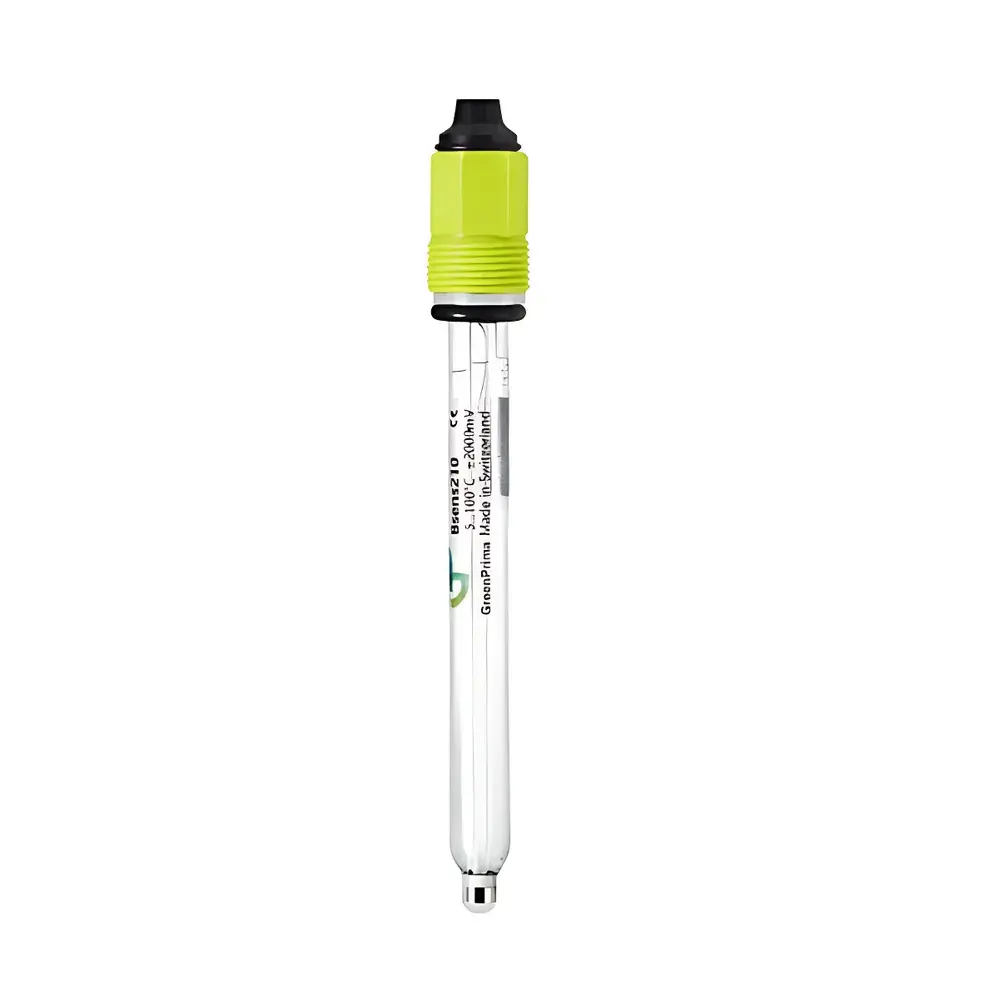
GreenPrima BSENS210 ORP Electrode
| Brand | GreenPrima |
|---|---|
| Origin | Switzerland |
| Manufacturer Type | Manufacturer |
| Product Origin | Imported |
| Model | BSENS210 |
| Measurement Range | −2000 to +2000 mV |
| Resolution | 1 mV |
| Accuracy | ±1 mV |
| Electrode Material | Glass body with platinum sensing element |
| Operating Temperature | −5 to 70.0 °C |
| Maximum Pressure Rating | 3.5 bar |
| Electrolyte | Polymer-based gel electrolyte |
| Connection Type | Fixed PG13.5 threaded fitting |
| Cable Length | 5 m |
Overview
The GreenPrima BSENS210 ORP (Oxidation-Reduction Potential) electrode is a robust, field-deployable potentiometric sensor engineered for continuous and spot monitoring of redox activity in aqueous industrial process streams. Based on the fundamental Nernst principle, the electrode measures the thermodynamic tendency of a solution to gain or lose electrons relative to a stable reference—here realized via an integrated polymer-gel reference system and a catalytically inert platinum sensing surface. Unlike conventional liquid-junction electrodes, the BSENS210 employs a solid-state polymer electrolyte that eliminates leakage, minimizes junction potential drift, and ensures long-term stability under fluctuating flow, pressure, and temperature conditions. Its design conforms to ISO 10523 and ASTM D1293 guidelines for redox measurement integrity, making it suitable for environments where regulatory traceability and operational reliability are non-negotiable.
Key Features
- Integrated platinum sensing element housed in chemically resistant borosilicate glass, delivering high catalytic surface area and rapid response kinetics across broad redox gradients.
- Polymer-based gel electrolyte with low migration rate and zero free liquid, eliminating clogging risks and reducing maintenance frequency in suspended-solids-laden media such as wastewater and fermentation broths.
- PG13.5 fixed-thread process connection compliant with DIN 40430 and IEC 60529 IP68-rated sealing, enabling direct insertion into pressurized pipelines or tanks up to 3.5 bar static pressure.
- Extended operational temperature range (−5 °C to +70.0 °C) validated per IEC 60751 Class B tolerance, supporting use in both chilled bioreactors and warm effluent channels without thermal compensation drift.
- 5-meter shielded, low-noise coaxial cable with integral grounding braid, pre-terminated with industrial-grade connector compatible with standard pH/ORP transmitters (e.g., Emerson DeltaV, Endress+Hauser Liquiline, Siemens Desigo).
Sample Compatibility & Compliance
The BSENS210 demonstrates proven compatibility with aggressive matrices including chlorinated municipal wastewater, anaerobic digester supernatant, pharmaceutical clean-in-place (CIP) rinse water, and saline aquaculture effluents. Its platinum/glass construction resists sulfide poisoning and halogen interference better than silver/silver chloride alternatives. The electrode meets material compliance requirements under RoHS 2011/65/EU and REACH Annex XVII. For regulated industries, its stable output supports audit-ready data acquisition when paired with transmitters compliant with FDA 21 CFR Part 11 (electronic records/signatures) and GLP/GMP environmental monitoring protocols.
Software & Data Management
While the BSENS210 is an analog sensor requiring external signal conditioning, it integrates seamlessly with modern SCADA, DCS, and LIMS platforms via 4–20 mA or RS-485 Modbus RTU outputs (when used with compatible GreenPrima or third-party transmitters). Calibration verification logs—including timestamped offset checks against certified Zobell’s or quinhydrone standards—can be archived with full audit trail functionality. Firmware-upgradable transmitters support automated calibration scheduling, drift trending, and predictive maintenance alerts based on impedance monitoring of the reference junction.
Applications
- Municipal and industrial wastewater treatment: real-time monitoring of denitrification, chlorination, and ozonation stages.
- Power generation: feedwater and condensate redox control to prevent corrosion in boiler circuits.
- Pharmaceutical manufacturing: redox profiling during sterilization validation and bioburden reduction verification.
- Aquaculture and hydroponics: dissolved oxygen surrogate tracking via ORP correlation in recirculating systems.
- Chemical process safety: detection of unintended oxidation reactions in storage tanks and reactor overflow lines.
FAQ
What reference system does the BSENS210 employ?
It uses an internal polymer-gel reference element with Ag/AgCl chemistry, eliminating liquid junctions and associated contamination pathways.
Can the electrode be used in high-solids slurry applications?
Yes—the rugged glass body and clog-resistant gel junction enable reliable operation in activated sludge, digestate, and lime-treated effluents without frequent cleaning.
Is temperature compensation automatic?
No; temperature compensation must be applied externally via the connected transmitter using a separate Pt100 or NTC sensor input.
What is the recommended recalibration interval?
Under continuous operation in stable matrices, quarterly verification is typical; in variable or aggressive media, monthly offset checks are advised per ISO/IEC 17025 QA practices.
Does GreenPrima provide calibration certificates traceable to NIST?
Yes—factory calibration reports include uncertainty budgets and traceability statements aligned with UKAS and DAkkS-accredited reference standards.