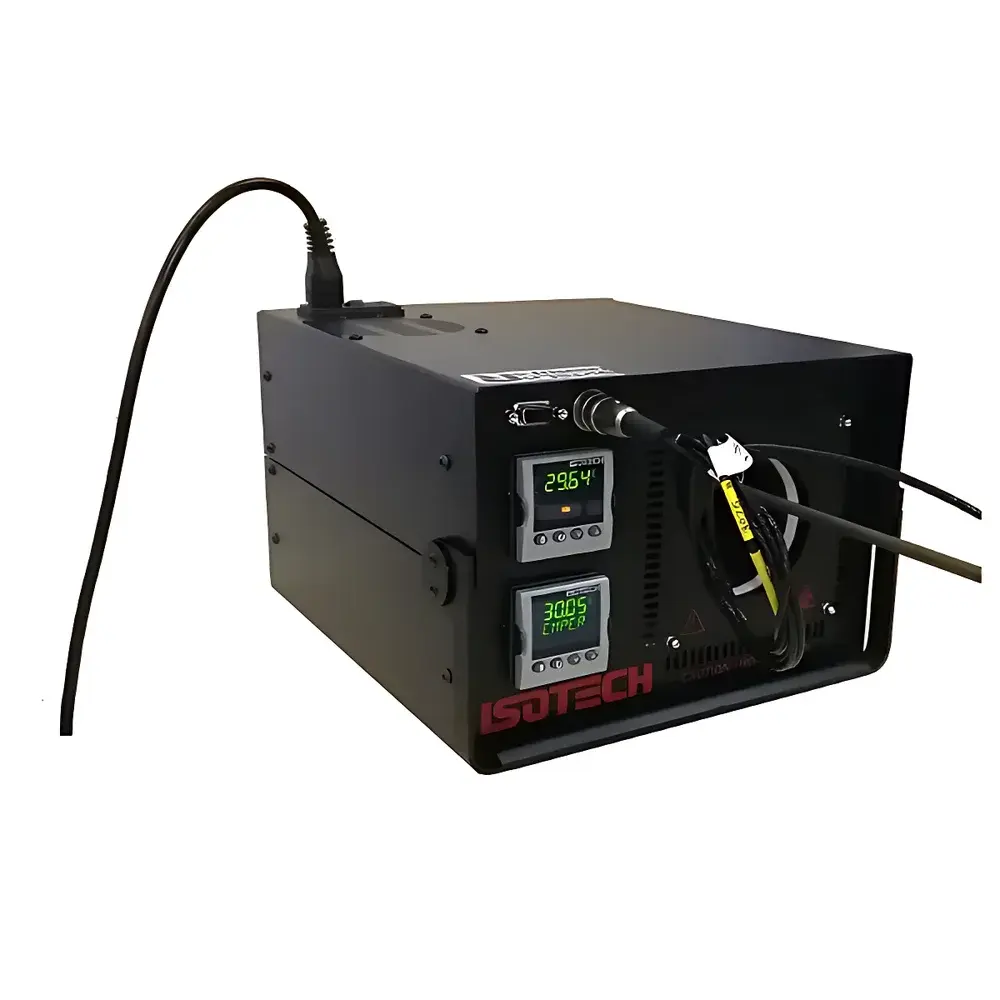
ISOTECH R976-550/700 Medium-Temperature Blackbody Radiation Source
| Brand | ISOTECH |
|---|---|
| Origin | United Kingdom |
| Model | R976-550/700 |
| Temperature Range | 30 °C to 550 °C / 700 °C |
| Aperture Diameter | 65 mm |
| Cavity Depth | 160 mm |
| Emissivity | >0.995 |
| Temperature Resolution | 0.01 °C (≤100 °C), 0.1 °C (>100 °C) |
| Stability | ≤ max(0.1 °C, 0.1%·t) over 10 min |
| Uniformity | ≤ ±max(0.15 °C, 0.15%·t) |
| Display | External Pt100 input with independent digital indicator |
| Interface | RS232 |
| Dimensions | 310 mm (H) × 265 mm (W) × 200 mm (L) |
| Weight | 10 kg |
Overview
The ISOTECH R976-550/700 is a precision-engineered medium-temperature blackbody radiation source designed for primary and secondary calibration of radiation thermometers, infrared thermal imagers, and radiometric sensors in metrology laboratories and industrial QA/QC environments. Based on the fundamental principle of Planck’s law of blackbody radiation, the R976 generates spectrally stable, spatially uniform, and highly emissive thermal radiation within a temperature range of 30 °C to 550 °C (standard configuration) or up to 700 °C (high-temperature variant). Its cylindrical cavity—65 mm in diameter and 160 mm deep—is lined with high-emissivity coating and thermally optimized to achieve an effective emissivity exceeding 0.995 across the entire operational band (typically 3–14 µm), satisfying ISO/IEC 17025 requirements for accredited calibration services and complying with national verification regulations including JJG 856–2015 (China), DIN 5030–7 (Germany), and ASTM E2847–21 for infrared thermometer calibration.
Key Features
- High-Emissivity Cavity: Precision-machined, conical-cylindrical cavity with proprietary high-emissivity coating ensures spectral uniformity and minimizes reflection errors—validated per ASTM E1541 and ISO 18434–1.
- Dual-Channel Temperature Monitoring: Integrated PID controller regulates cavity temperature, while an independent digital display accepts external Pt100 sensor input for real-time, traceable cavity wall temperature readout—enabling direct comparison between setpoint and physical cavity temperature.
- Traceability Architecture: Supports both component-level traceability (via calibrated Pt100 probe + reference thermometer) and full-system calibration (cavity + controller + display as a single unit), facilitating compliance with ISO/IEC 17025 Clause 6.6 and EURAMET cg-18 guidelines.
- RS232 Interface & Automation Ready: Standard serial port enables bidirectional communication with host PCs; compatible with ISOTECH-provided calibration software for automated ramp/soak sequences, data logging, and uncertainty budgeting per GUM (JCGM 100:2008).
- Modular Aperture Control: Optional adjustable diaphragm kit (10–50 mm apertures) allows field adaptation to different instrument FOVs—critical for calibrating spot-radiometers per IEC 62942–2 and thermal imagers per VDI/VDE 2655 Part 3.
- Portable Metrology Platform: Compact footprint (310 × 265 × 200 mm) and 10 kg mass support routine inter-laboratory transfer and on-site calibration audits without compromising thermal stability or repeatability.
Sample Compatibility & Compliance
The R976-550/700 is validated for use with all radiation-based temperature measurement devices operating in the mid- to long-wave infrared spectrum. It meets the geometric and radiometric requirements for calibrating handheld infrared thermometers (per ISO 8301 and ASTM E1256), fixed-mount pyrometers (per IEC 61238), and matrix-based thermal imaging systems (per ASTM E1933 and ISO 18434–2). Its cavity geometry and thermal time constant (<60 s to reach equilibrium at 500 °C) are optimized for dynamic calibration protocols, including minimum resolvable temperature difference (MRTD) and thermal sensitivity evaluation. All units ship with a UKAS-accredited calibration certificate (traceable to NPL standards) and optional fixed-point insert compatibility (e.g., Sn, Zn, Al freezing points) for enhanced uncertainty reduction in high-accuracy applications.
Software & Data Management
ISOTECH provides dedicated Windows-compatible software supporting full instrument control, automated calibration routines (including multi-point drift checks and hysteresis mapping), and raw data export in CSV and XML formats. The software implements audit-trail functionality compliant with FDA 21 CFR Part 11 requirements—including electronic signatures, user access levels, and immutable event logs. Calibration reports generated include expanded uncertainty calculations (k=2), environmental condition metadata (ambient T/RH), and traceability chain documentation aligned with ILAC-P10:2022. Data synchronization supports integration into LIMS environments via ODBC drivers and RESTful API extensions (available under extended support contract).
Applications
- Radiation thermometer calibration (field and laboratory) per ISO/IEC 17025 and national verification规程
- Infrared camera accuracy verification and thermal sensitivity assessment (NETD, MRTD)
- Thermal imager uniformity and linearity testing across multiple temperature plateaus
- Validation of non-contact temperature measurement in pharmaceutical cleanrooms (GMP Annex 1) and semiconductor process tools
- Supporting thermographic NDT qualification per ASNT SNT-TC-1A and EN 473
- Reference source for research in emissivity modeling, atmospheric transmission correction, and IR signature simulation
FAQ
What temperature ranges does the R976-550/700 support, and how is the upper limit selected?
The standard R976-550 operates from 30 °C to 550 °C; the R976-700 variant extends to 700 °C using upgraded heating elements and insulation. Selection is model-specific at time of order—no field conversion is supported.
Is the cavity emissivity independently verified, and what uncertainty is associated with it?
Yes—each unit undergoes cavity reflectance mapping at three wavelengths (3.9 µm, 8–12 µm, and 10.6 µm) using FTIR-based methods. Emissivity uncertainty is ±0.0015 (k=2), reported in the UKAS certificate.
Can the R976 be used for calibration under GLP or GMP conditions?
Yes—the system supports full 21 CFR Part 11 compliance when used with the licensed software package, including role-based access, electronic signatures, and secure audit trails required for regulated environments.
Does ISOTECH provide on-site calibration or training for this instrument?
Yes—on-site installation verification, operator training, and annual recalibration services are available globally through ISOTECH’s certified metrology partners and regional service centers.
What is the recommended recalibration interval for accredited use?
ISO/IEC 17025 recommends a maximum 12-month interval; however, frequency should be risk-assessed based on usage intensity, thermal cycling history, and uncertainty targets—typically every 6–12 months for primary standards labs.