
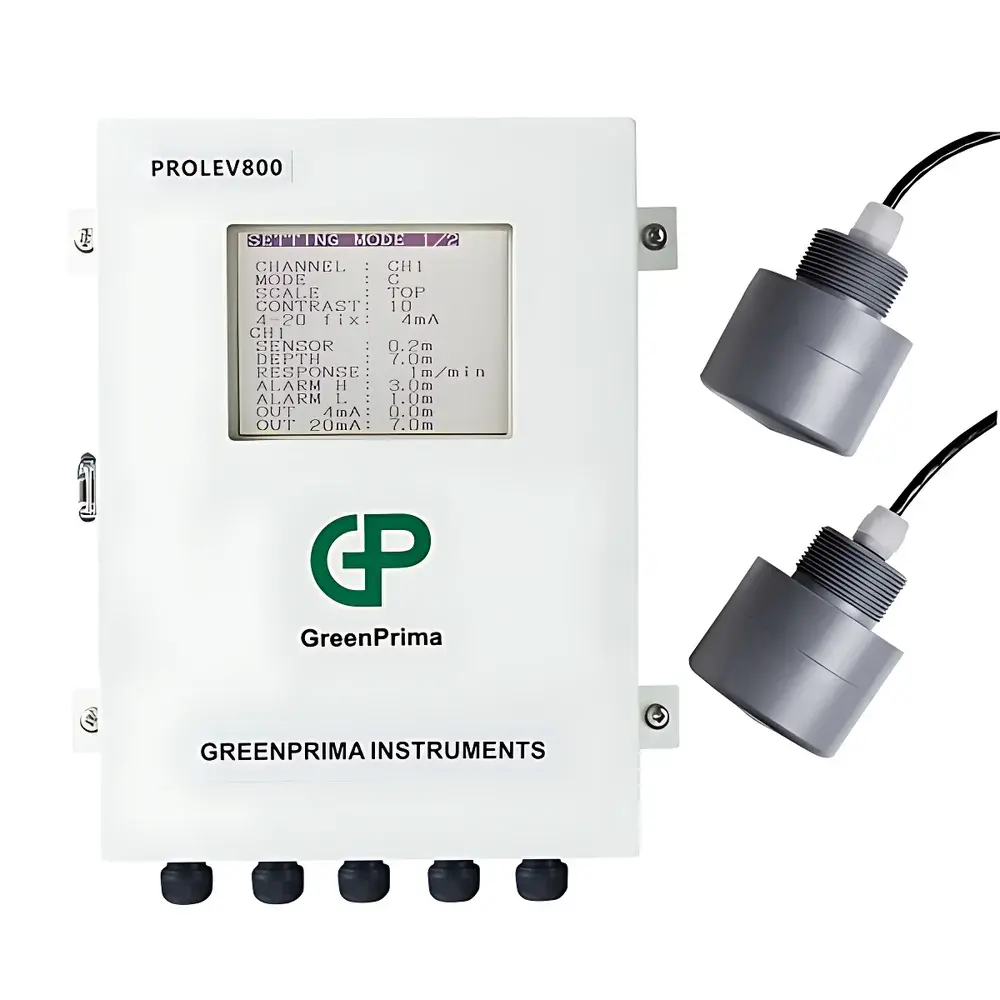
GreenPrima ProL e v800 Ultrasonic Sludge Interface Monitor
| Brand | GreenPrima |
|---|---|
| Origin | United Kingdom |
| Manufacturer Type | Original Equipment Manufacturer (OEM) |
| Product Category | Imported Instrument |
| Model | ProL e v800 |
| Measurement Range | 0.4–10 m |
| Sensor Capacity | Up to 2 independent transducers |
| Accuracy | ±1 cm |
| Response Time | 1 s |
| Operating Temperature | −20 °C to +60 °C |
| Display | Large-backlit LCD with graphical interface (numeric readout, trend plot, echo waveform) |
| Output | 4–20 mA analog signal |
| Alarms | Dual programmable Hi/Low relay outputs |
| Communication | RS232C (cable length ≤10 m) |
| Power Supply | 85–264 VAC, 10 VA |
| Ingress Protection | IP68 |
| Cable Length | 20 m |
| Weight | 3.6 kg (transmitter), 3.0 kg (per transducer) |
Overview
The GreenPrima ProL e v800 Ultrasonic Sludge Interface Monitor is an industrial-grade, non-invasive level measurement system engineered for continuous, real-time monitoring of sludge blanket depth and interface position in wastewater treatment sedimentation basins. It operates on the principle of time-of-flight ultrasonic pulse-echo measurement: a high-frequency acoustic signal (typically 1–5 MHz) is transmitted vertically into the liquid column; the time delay between the emitted pulse and the return echo from the sludge–liquid interface is precisely measured and converted into distance using the known speed of sound in water under process conditions. This method enables stable, drift-free detection of dynamic sludge layers—even in turbid, aerated, or chemically aggressive environments—without mechanical contact or moving parts. Designed specifically for municipal and industrial wastewater infrastructure, the ProL e v800 delivers deterministic interface localization critical for optimizing clarifier hydraulic loading, managing sludge recirculation rates, and preventing underflow carryover or surface scum breakout.
Key Features
- High-resolution ultrasonic transduction with automatic gain control and adaptive echo filtering to suppress noise from suspended solids, foam, or surface turbulence.
- Large backlit LCD display supporting simultaneous numeric height readout, real-time echo waveform visualization, and multi-scale trend plotting (5-minute to 48-hour history).
- Embedded microprocessor architecture enabling on-board signal averaging, statistical validation, and self-diagnostic routines compliant with IEC 61508 SIL 2 functional safety principles.
- Dual-transducer capability: a single transmitter unit interfaces with two independently mounted probes—ideal for cross-sectional profiling or redundancy-critical applications such as final clarifiers or thickener feed wells.
- No-maintenance design: fully solid-state construction with no rotating components, sealed piezoelectric elements, and IP68-rated housing for submersion up to 10 m depth.
- User-configurable parameters via intuitive menu navigation—including adjustable brightness, echo threshold, damping factor, and alarm hysteresis—all accessible without external software.
Sample Compatibility & Compliance
The ProL e v800 is validated for use across heterogeneous aqueous suspensions typical of activated sludge systems, primary settling tanks, gravity thickeners, and coal-washing tailings ponds. It accommodates variable sludge rheology—from low-density flocculent blankets (40 g/L TSS)—and remains operational during intermittent aeration or influent surges. The instrument meets EN 61326-1 (EMC for industrial environments), EN 61000-6-2/6-4 (immunity and emission standards), and carries CE marking under the EU Machinery Directive. Its 4–20 mA output and relay alarms are compatible with SCADA, DCS, and PLC systems conforming to ISA-50.00.01 analog signal standards. While not intrinsically safe, optional ATEX-compliant probe variants (II 2G Ex db IIB T4 Gb) are available for classified zones per IEC 60079-0.
Software & Data Management
Data logging and configuration are performed locally via the integrated LCD interface; no proprietary PC software is required for routine operation. However, optional RS232 connectivity supports ASCII command protocol for integration into centralized data historians or asset management platforms. Logged trends (height vs. time) can be exported in CSV format for post-processing in MATLAB, Python Pandas, or LIMS environments. Audit-trail functionality records parameter changes, alarm events, and calibration timestamps—supporting GLP-aligned documentation requirements. Though not FDA 21 CFR Part 11 certified out-of-the-box, the device’s deterministic firmware architecture allows validation protocols to be developed for regulated wastewater utilities operating under ISO 9001 or ISO/IEC 17025 quality frameworks.
Applications
- Real-time control of return activated sludge (RAS) and waste activated sludge (WAS) pumping based on dynamic interface elevation.
- Performance assessment of secondary clarifiers during diurnal flow variations or shock loads.
- Monitoring of pre-thickener separation efficiency in anaerobic digestion feed preparation.
- Interface tracking in coal preparation plant sedimentation lagoons and fly ash settling basins.
- Commissioning support for new clarifier installations—providing empirical settling velocity profiles for hydraulic model calibration.
FAQ
Does the ProL e v800 require periodic recalibration?
No—ultrasonic time-of-flight measurement is inherently self-referencing and does not drift over time. Routine verification against a known reference point (e.g., calibrated tape measure at tank access port) is recommended annually per ISO 5725-2 accuracy verification guidelines.
Can it operate reliably in aerated basins?
Yes—the instrument employs adaptive echo discrimination algorithms to distinguish the true sludge interface reflection from spurious returns caused by air bubbles or surface agitation.
Is remote configuration supported via Modbus or Ethernet?
Standard RS232 communication is provided; optional Modbus RTU over RS485 or Ethernet/IP modules are available as factory-installed upgrades upon request.
What is the maximum allowable suspended solids concentration for accurate interface detection?
The system maintains reliable detection up to 60 g/L TSS under steady-state conditions; performance beyond this range depends on particle size distribution and acoustic attenuation characteristics of the sludge matrix.
How is probe mounting orientation specified for optimal signal coupling?
Transducers must be mounted vertically (±2° tolerance) with direct line-of-sight to the expected interface plane; angled or side-mounted configurations are not supported due to beam divergence constraints inherent in pulse-echo geometry.







