
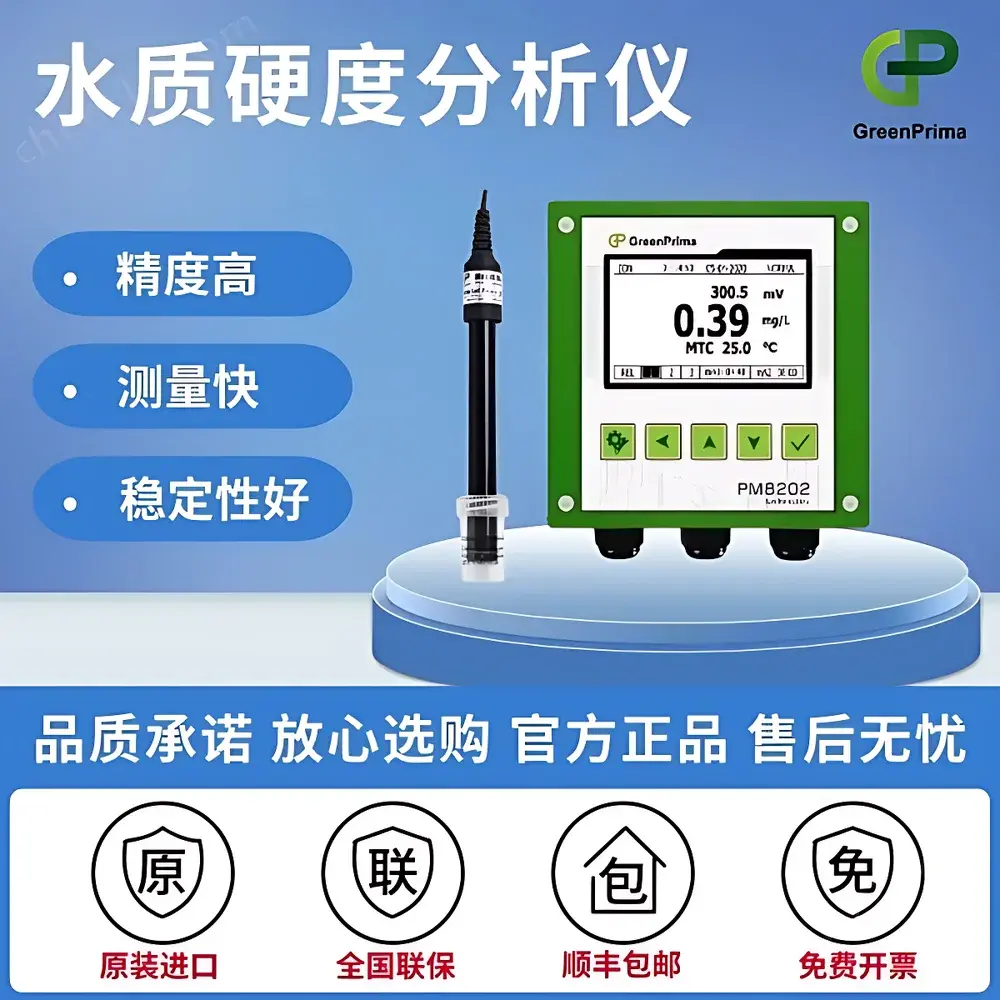
GreenPrima PM8202I Calcium Hardness Analyzer
| Brand | GreenPrima |
|---|---|
| Origin | United Kingdom |
| Manufacturer Type | Original Equipment Manufacturer (OEM) |
| Product Category | Imported Instrument |
| Model | PM8202I |
| Pricing | Available Upon Request |
Overview
The GreenPrima PM8202I Calcium Hardness Analyzer is a dedicated online and laboratory-grade instrument engineered for continuous, real-time quantification of calcium ion concentration — the primary contributor to total water hardness — in aqueous process streams. It operates on the principle of potentiometric measurement using a solid-state, calcium-selective electrode (Ca-ISE), specifically the Bsens740 composite ion-selective electrode. This electrochemical method delivers direct, reagent-free determination of free Ca²⁺ activity, which correlates closely with calcium hardness (expressed as ppm CaCO₃ equivalent) under controlled ionic strength and pH conditions (typically pH ≥ 5.5). Unlike colorimetric or titrimetric methods, the PM8202I eliminates consumables, liquid handling systems, and associated maintenance overheads. Its design targets long-term stability in demanding industrial environments, supporting unattended operation in boiler feedwater control, pharmaceutical purified water (PW) and water-for-injection (WFI) monitoring, semiconductor rinse water management, and electroplating bath surveillance.
Key Features
- Calcium-selective potentiometric detection via integrated Bsens740 ISE — no reagents, no tubing, no waste generation
- IP66-rated hermetically sealed housing with corrosion-resistant materials for reliable deployment in humid, splash-prone, or chemically aggressive locations
- Backlit high-resolution dot-matrix LCD display showing real-time Ca²⁺ concentration (ppm), temperature (°C), timestamp, relay status, and system diagnostics
- Multi-range resolution switching: 0.01 ppm (0–99.99 ppm), 0.1 ppm (100–999.9 ppm), and 1 ppm (1,000–20,000 ppm) — automatically selected based on measured value
- Integrated temperature compensation using either NTC30k or PT1000 sensor input; supports both manual and automatic modes across –10 °C to +130 °C
- Dual isolated 4–20 mA analog outputs configurable for calcium concentration and/or temperature, compliant with HART-compatible loop-powered systems (max. 500 Ω load, accuracy ±0.1% FS)
- One programmable multifunction relay for alarm signaling (e.g., high/low limit, sensor fault, cleaning cycle initiation) or process control actuation
- Onboard non-volatile memory storing up to 600,000 timestamped measurement records with UTC synchronization capability
- Flexible mounting options: panel, wall, or pipe clamp; compatible with standard DIN rail (35 mm) integration
Sample Compatibility & Compliance
The PM8202I is validated for use with low-to-moderate conductivity aqueous matrices including surface water, groundwater, reverse osmosis permeate, deionized water, steam condensate, and industrial cooling or rinsing waters. It requires minimal sample conditioning — typically only pH adjustment to >5.5 if acidic influents are present — and is insensitive to turbidity or color. The instrument conforms to IEC 61000-6-2 (immunity) and IEC 61000-6-4 (emissions) for industrial environments. Its firmware architecture supports audit-trail-enabled data logging aligned with GLP and GMP documentation requirements. While not certified for Class I Div 1 hazardous areas, it meets CE, UKCA, and RoHS directives for general-purpose instrumentation.
Software & Data Management
Data retrieval is supported via local USB port (for CSV export) and optional RS485 Modbus RTU interface (slave mode) for integration into SCADA, DCS, or MES platforms. The embedded firmware includes configurable sampling intervals (1 s to 1 h), moving-average filtering (1–128 points), and user-defined alarm hysteresis. All configuration changes, calibration events, and relay triggers are time-stamped and logged internally. Exported datasets include ISO 8601-formatted timestamps, raw mV readings, compensated concentration values, temperature, and system status flags — facilitating traceability per FDA 21 CFR Part 11 when paired with validated third-party data acquisition software.
Applications
- Real-time calcium hardness control in high-pressure boiler feedwater circuits to prevent scale formation on heat transfer surfaces
- In-line monitoring of purified water distribution loops in pharmaceutical manufacturing (aligned with USP and EU Annex 1 expectations)
- Process water quality assurance in printed circuit board (PCB) fabrication and semiconductor wafer cleaning stages
- Electroplating bath management to maintain optimal Ca²⁺ levels for additive performance and deposit uniformity
- Environmental compliance reporting for municipal wastewater discharge permits requiring hardness parameter tracking
- Research and development studies on antiscalant efficacy and membrane fouling mechanisms in desalination pilot plants
FAQ
What calibration standards are required for the Bsens740 electrode?
Standard calcium chloride solutions (e.g., 100 ppm and 1,000 ppm Ca²⁺ in 0.01 M KNO₃ background) are recommended for two-point calibration. A single-point verification may be performed daily using a mid-range check standard.
Can the PM8202I measure total hardness directly?
No — it measures free Ca²⁺ concentration exclusively. Total hardness estimation requires concurrent magnesium measurement or empirical correlation based on site-specific water composition history.
Is temperature compensation mandatory?
Yes. The Nernstian response of the Ca-ISE is inherently temperature-dependent; accurate results require either automatic compensation (via integrated sensor) or consistent manual entry of ambient temperature.
How often does the Bsens740 electrode require replacement?
Under typical industrial conditions, service life exceeds 12–18 months. Performance degradation is indicated by reduced slope (60 s), or unstable zero potential.
Does the analyzer support remote configuration via Ethernet or Wi-Fi?
Not natively. Remote access requires external protocol converters (e.g., Modbus TCP gateway) or integration through a plant-level historian system.
Related Products




