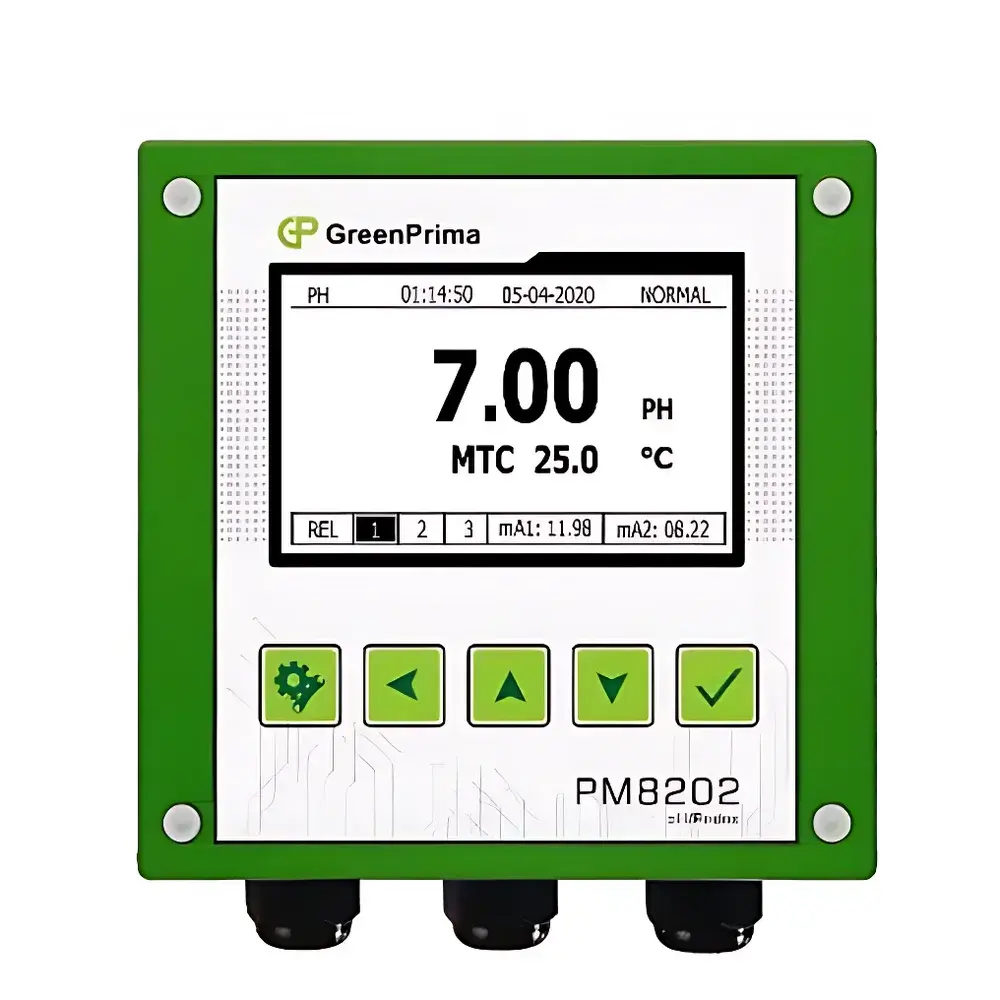
GreenPrima PM 8202P Online pH/ORP Analyzer for Chlor-Alkali Process Control
| Brand | GreenPrima |
|---|---|
| Origin | UK |
| Manufacturer Type | Manufacturer |
| Origin Category | Imported |
| Model | PM 8202P |
| Measurement Range | -2 to 16 pH, -2000 to +2000 mV, 0 to 130 °C |
| Resolution | 0.01 pH, 1 mV, 0.1 °C |
| Accuracy | ±0.01 pH, ±0.1 mV, ±0.1 °C |
| Temperature Compensation Range | -10 to 130 °C (Manual/Automatic |
| Dimensions | 144 × 144 × 108 mm |
| Weight | 0.87 kg |
Overview
The GreenPrima PM 8202P Online pH/ORP Analyzer is an industrial-grade process instrumentation system engineered for continuous, high-stability measurement of hydrogen ion activity (pH) and oxidation-reduction potential (ORP) in demanding chlor-alkali production environments. Designed around a robust two-component architecture—comprising a field-mounted transmitter/controller and interchangeable Bsens-series pH/ORP sensors—the analyzer delivers real-time electrochemical monitoring under aggressive chemical conditions, including concentrated brine, caustic soda (NaOH), chlorine gas interfaces, and hypochlorite solutions. Its measurement principle relies on potentiometric detection using glass electrode (pH) and noble metal (Pt or Ag/AgCl) reference electrode configurations, with integrated temperature compensation to correct for thermodynamic drift in Nernstian response. The device operates within the full operational envelope of modern membrane cell and diaphragm cell electrolysis units, supporting critical control loops for brine purification, electrolyte concentration balance, and caustic strength verification.
Key Features
- IP65-rated, fully sealed housing with corrosion-resistant polycarbonate enclosure—engineered for splash, dust, and chemical vapor resistance in Class I, Division 2 hazardous areas;
- Large backlit dot-matrix LCD display showing simultaneous pH, ORP (mV), temperature, timestamp, relay status, and diagnostic flags;
- Intuitive bilingual (English/Chinese) menu navigation with password-protected configuration access and one-button factory reset;
- Dual isolated 4–20 mA analog outputs (0.1% FS accuracy, max. 500 Ω loop load) configurable for pH, ORP, or temperature signals;
- RS485 Modbus RTU interface for integration into DCS, SCADA, or PLC-based automation systems (slave ID addressable);
- Configurable cleaning cycle output (0.1–1000 h interval; 1–1000 s duration) compatible with pneumatic or solenoid-driven electrode cleaning systems;
- Two independent programmable Hi/Lo alarm relays (5 A @ 250 VAC / 30 VDC) with adjustable hysteresis to prevent chatter during transient process excursions;
- Flexible mounting options: wall-mount bracket, panel-cut installation (138 × 138 mm cutout), or direct pipe-clamp assembly;
- Internal data logging capacity of up to 600,000 timestamped records (pH, mV, °C, alarms) with automatic overwrite policy;
- Wide operating ambient temperature range (-10 to +70 °C) and storage range (-20 to +70 °C), suitable for unheated outdoor enclosures or process skids.
Sample Compatibility & Compliance
The PM 8202P is validated for use with GreenPrima’s Bsens family of process pH electrodes—including models Bsens110T, Bsens210, Bsens120T, Bsens130, Bsens140T, Bsens150T, and Bsens180T—each optimized for specific chlor-alkali applications: high-conductivity brine (≥50 mS/cm), hot caustic streams (>90 °C), low-ionic-strength rinse water, or oxidizing chlorine-rich environments. Electrode compatibility extends to standard DIN 19266 and ISO 7027-compliant fittings and cable glands. The analyzer meets CE marking requirements per EMC Directive 2014/30/EU and Low Voltage Directive 2014/35/EU. While not intrinsically safe certified, its design supports integration into SIL2-capable safety instrumented systems (SIS) when deployed with appropriate barrier modules. Data integrity aligns with GLP and GMP principles via time-stamped logging and audit-trail-ready configuration history.
Software & Data Management
No proprietary PC software is required for basic commissioning; all setup is performed locally via front-panel keypad. For advanced diagnostics and bulk data export, GreenPrima provides optional Windows-compatible configuration utility (PMConfigTool v3.x) supporting firmware updates, calibration history review, and CSV-formatted log extraction via USB-to-serial adapter. Logged data includes measurement values, sensor impedance, temperature, relay activation timestamps, and error codes (e.g., “open circuit”, “low slope”, “temperature out of range”). Calibration validation reports can be generated per ASTM D1293 (Standard Test Method for pH of Water) and ISO 10523 (Water Quality — Determination of pH). All configuration changes are logged with user ID (if enabled) and timestamp, satisfying traceability requirements under FDA 21 CFR Part 11 when used in regulated pharmaceutical or fine chemical manufacturing contexts.
Applications
- Real-time pH monitoring in saturated brine feed tanks prior to membrane cell electrolysis;
- Caustic soda (30–50% NaOH) concentration control in evaporator bleed streams;
- Chlorine gas scrubber solution pH regulation (NaOH absorption towers);
- Wastewater neutralization basins handling spent electrolyte or acid wash effluents;
- Process water quality assurance in cooling tower make-up and boiler feed systems;
- Environmental compliance monitoring at discharge points for regulatory reporting (e.g., EPA NPDES permits).
FAQ
What electrode types are recommended for high-temperature caustic service (>90 °C)?
Bsens180T and Bsens150T sensors feature double-junction, ceramic junction, and temperature-resistant PVDF bodies—validated for continuous operation up to 130 °C in 45% NaOH.
Can the PM 8202P perform automatic temperature compensation without external probes?
No—ATC requires connection of either NTC10K or PT1000 temperature sensors; built-in thermistor is not provided.
Is Modbus communication configurable as master or slave?
The unit operates exclusively as a Modbus RTU slave device (address 1–247); master functionality is not supported.
How often should calibration be performed in chlor-alkali applications?
Typical intervals range from 24 to 168 hours depending on fouling rate; GreenPrima recommends daily verification with certified buffer standards (pH 4.01, 7.00, 10.01) and weekly full two-point calibration.
Does the analyzer support HART protocol?
No—HART is not implemented; only isolated 4–20 mA analog and RS485 Modbus RTU digital outputs are available.
Related Products