
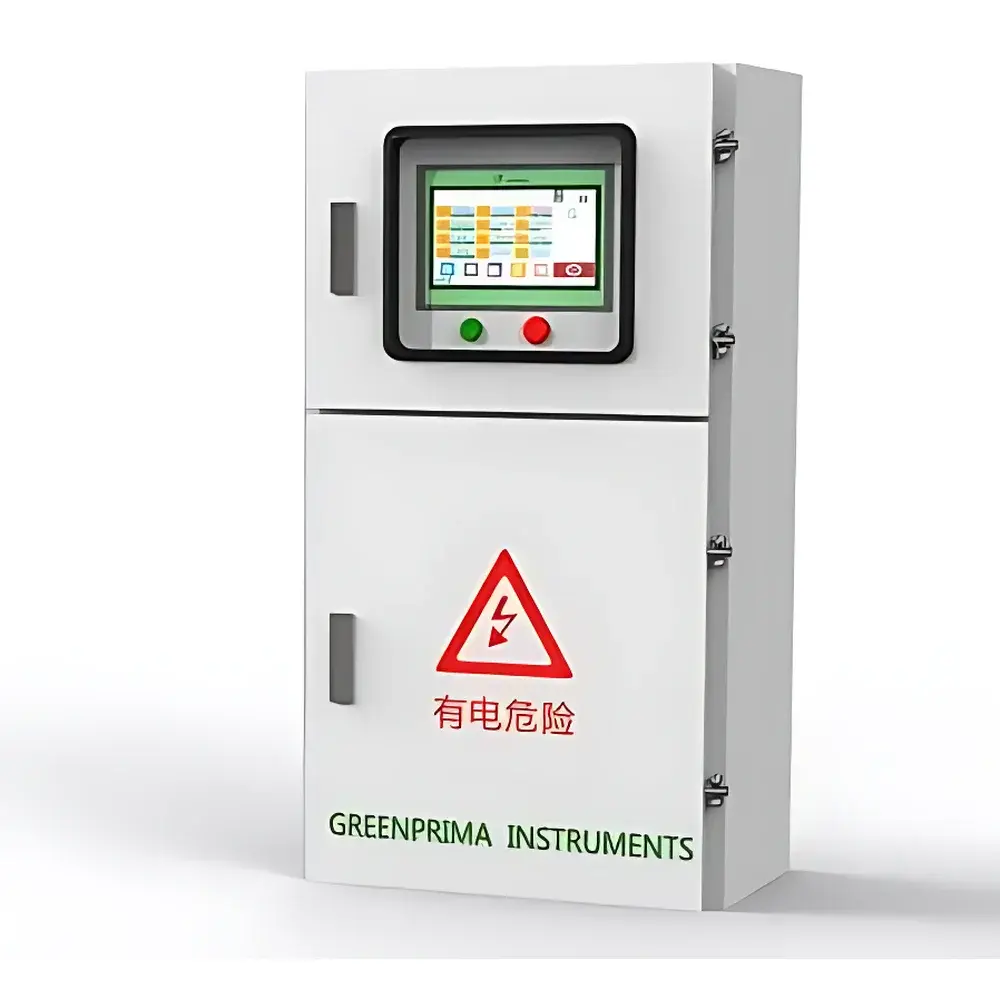
GreenPrima GP8200 MAS Multi-Parameter Water Quality Analyzer
| Brand | GreenPrima |
|---|---|
| Origin | Shanghai, China |
| Manufacturer Type | Manufacturer |
| Product Category | Domestic |
| Model | GP8200 MAS |
| Instrument Type | Online |
| Temperature Range | -5–100 °C |
| pH Range | 0–12 |
| Dissolved Oxygen Range | 0–20 ppm |
| Conductivity Range | 0–200 mS/cm |
| Turbidity Range | 0–1000 NTU |
Overview
The GreenPrima GP8200 MAS Multi-Parameter Water Quality Analyzer is an industrial-grade online monitoring system engineered for continuous, real-time measurement of critical physicochemical parameters in diverse aquatic environments. Built upon a modular sensor architecture and embedded microprocessor control, the analyzer operates on standardized electrochemical (pH, ORP, dissolved oxygen), optical (turbidity, free chlorine), and conductometric (conductivity) measurement principles—each channel independently calibrated and thermally compensated to ensure metrological integrity across dynamic field conditions. Designed for deployment in municipal water infrastructure, environmental regulatory networks, aquaculture facilities, and industrial effluent monitoring points, the GP8200 MAS meets foundational requirements for long-term unattended operation under variable hydraulic pressure (1–200 psi), ambient temperature extremes (0–70 °C operational; -5–100 °C sensor range), and high-humidity outdoor enclosures (IP65-rated stainless-steel cabinet). Its architecture supports compliance with ISO 7027 (turbidity), ISO 5814 (electrochemical DO), ASTM D1293 (pH), and ASTM D5391 (conductivity) test methodologies—serving as a foundational data acquisition node in GLP-aligned environmental monitoring programs.
Key Features
- Modular, channel-isolated sensor design: Each parameter (pH, ORP, dissolved oxygen, free chlorine, turbidity, conductivity, temperature) operates via dedicated analog signal conditioning and digital conversion—eliminating cross-talk and enabling flexible configuration.
- High-resolution embedded control: 10-inch capacitive touch LCD interface with localized multilingual support (English default), intuitive navigation, and real-time graphical trend visualization.
- Multi-protocol digital connectivity: Standard RS485 Modbus RTU; optional GPRS (China Mobile/Unicom/Telecom), NB-IoT, Ethernet, and Wi-Fi modules for secure cloud integration.
- Robust analog I/O: Up to eight configurable 4–20 mA current loops (load <750 Ω) and eight SPST relays (5 A @ 250 VAC / 30 VDC) for local actuation and alarm staging.
- Zero-reagent operation: Optical turbidity (850 nm LED source, 7-year lifetime) and amperometric free chlorine sensors eliminate chemical consumption and secondary contamination risks.
- Comprehensive thermal compensation: Automatic or manual NTC10K/PT1000-based temperature correction across all electrochemical and conductometric channels (-10–130 °C range).
- Extended data retention: Onboard storage capacity for up to 600,000 timestamped records with UTC synchronization and cyclic overwrite management.
Sample Compatibility & Compliance
The GP8200 MAS is validated for continuous immersion or flow-through sampling in freshwater, brackish water, wastewater effluents, recirculating aquaculture systems, potable distribution networks, and surface water bodies (rivers, reservoirs, coastal zones). Sensor materials—including food-grade 316L stainless steel housings, PEEK flow cells, and platinum/iridium ORP electrodes—are chemically inert per ASTM F2129 and resistant to biofouling under typical ambient microbial loads. The system’s firmware and data handling protocols support audit-ready operation in regulated environments: time-stamped event logs, user-access controls, and immutable data export formats align with EPA Method 1600-series documentation expectations and serve as a foundation for 21 CFR Part 11-compliant validation when integrated with qualified cloud platforms. Calibration traceability follows NIST-traceable reference standards (e.g., pH 4.01/7.00/10.01 buffers, KCl conductivity solutions, formazin NTU standards).
Software & Data Management
The GP8200 MAS integrates seamlessly with GreenPrima’s cloud-based AquaView™ Platform—a secure, role-based SaaS environment accessible via web browser or native iOS/Android applications. Platform features include customizable dashboards, multi-site map overlays, automated threshold-triggered SMS/email alerts, scheduled calibration reminders, and exportable CSV/PDF reports compliant with ISO/IEC 17025 reporting templates. All data transmissions employ TLS 1.2 encryption; local edge caching ensures continuity during network outages. Firmware updates are delivered over-the-air (OTA) with version rollback capability and SHA-256 signature verification. Audit trails record all configuration changes, calibration events, and user logins with immutable timestamps—supporting internal QA reviews and external regulatory inspections.
Applications
- Municipal drinking water safety: Real-time surveillance at intake points, treatment plant process stages (coagulation, filtration, disinfection), and distributed network endpoints (secondary supply tanks, fire hydrants).
- Environmental compliance monitoring: Continuous reporting from national surface water quality stations (Class I–V classification per China’s GB 3838-2002), groundwater wells, and regulated discharge outlets.
- Aquaculture optimization: Dissolved oxygen, pH, and temperature trending in shrimp, tilapia, and salmonid recirculating aquaculture systems (RAS) to prevent hypoxia and metabolic stress.
- Industrial water reuse: Monitoring cooling tower conductivity, condensate pH, and pretreatment turbidity to extend membrane life and reduce blowdown frequency.
- Smart city infrastructure: Integration into urban IoT frameworks for flood-resilient water level correlation, stormwater runoff quality assessment, and leak-detection triangulation.
FAQ
What calibration standards are required for field maintenance?
Standard NIST-traceable buffers (pH 4.01, 7.00, 10.01), KCl conductivity standards (1413 µS/cm, 12.88 mS/cm), and formazin-based turbidity standards (20, 100, 400 NTU) are recommended. Free chlorine calibration uses DPD-based standard solutions.
Can the system operate autonomously on solar power?
Yes—the GP8200 MAS supports DC24 V input with optional solar charge controller integration (15 W nominal panel rating); battery backup runtime exceeds 72 hours at full parameter sampling interval.
Is remote firmware update capability available?
Yes—over-the-air (OTA) firmware updates are supported via Ethernet or cellular interfaces, with checksum validation and automatic rollback on failed installation.
How is sensor fouling mitigated in high-sediment environments?
Optional ultrasonic or mechanical wiper modules are available for turbidity and free chlorine sensors; flow velocity optimization (>0.3 m/s) and periodic air-pulse cleaning routines can be scheduled via the onboard scheduler.
Does the system meet cybersecurity requirements for critical infrastructure?
The device implements IEEE 802.1X port-based authentication, TLS 1.2 encrypted telemetry, and disabled default credentials—aligning with NIST SP 800-82 Rev. 2 guidelines for industrial control system hardening.
Related Products







