
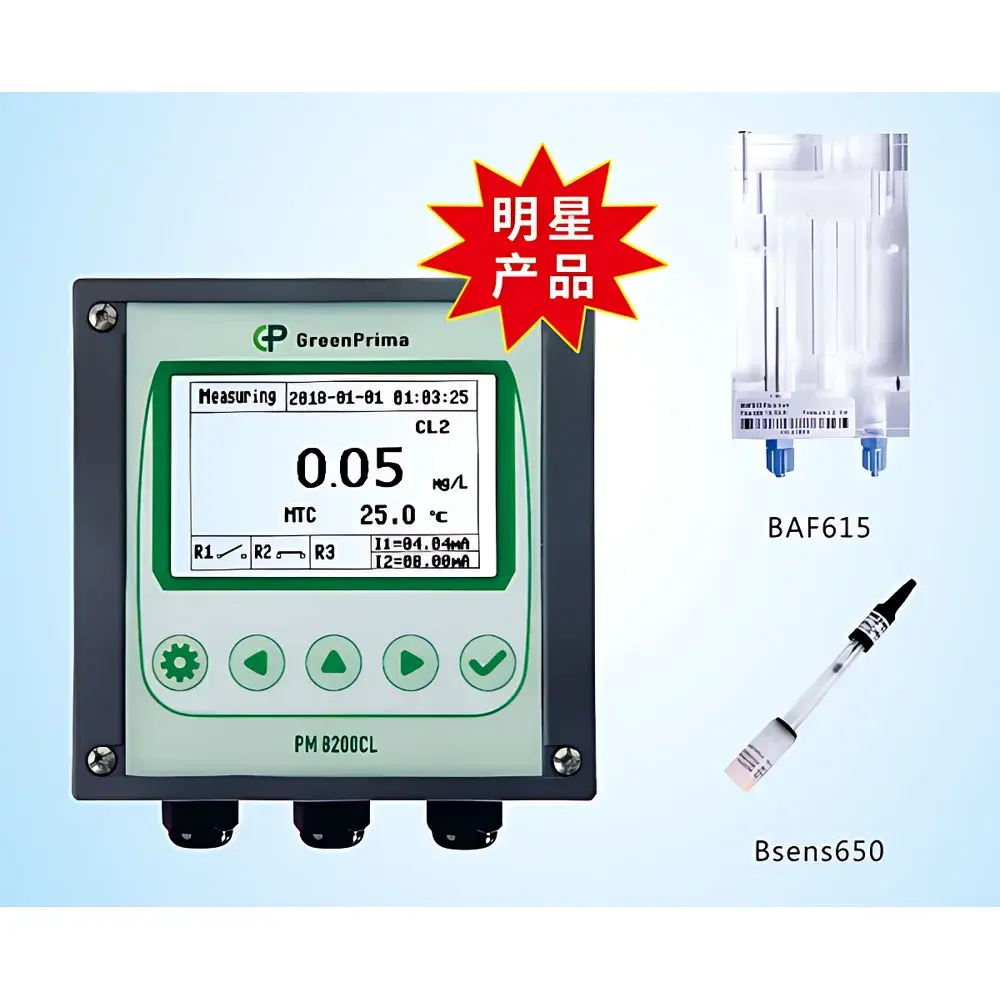
GreenPrima PM8202CL Residual Chlorine, Chlorine Dioxide and Ozone Online Analyzer
| Brand | GreenPrima |
|---|---|
| Origin | Switzerland |
| Manufacturer | GreenPrima AG |
| Instrument Type | Online Analyzer |
| Measurement Principle | Amperometric Electrochemical Sensor (Constant Voltage Mode) |
| Measured Parameters | Free Chlorine, Chlorine Dioxide, Ozone |
| Range | 0–2.000 mg/L and 0–20.00 mg/L (dual-range auto-switching) |
| Accuracy | ±2% of reading |
| Repeatability | ±0.01 mg/L |
| Resolution | 0.001 mg/L |
| Detection Limit | 0.001 mg/L |
| Temperature Compensation | -10 to 130 °C (NTC10K or PT1000 selectable) |
| Output | Dual isolated 4–20 mA (0.1% FS), RS485 Modbus RTU, optional HART |
| Enclosure Rating | IP65 |
| Dimensions (Controller) | 144 × 144 × 108 mm |
| Weight | 0.87 kg |
| Sensor Model | Bsens650 |
| Sensor Operating Temp. | -5 to 100 °C |
| Max. Pressure | 6 bar |
| Electrolyte | Polymer gel |
| Reference System | Ag/AgCl |
| Electrode Diameter | Ø12 mm × 120 mm |
Overview
The GreenPrima PM8202CL is a high-precision, multi-analyte online water quality analyzer engineered for continuous, real-time monitoring of free chlorine, chlorine dioxide, and ozone in aqueous systems. It employs amperometric electrochemical sensing based on the constant voltage (galvanic) principle—where a stable bias potential is applied across a dual-platinum working electrode pair, enabling selective reduction of oxidants without chemical reagents or membrane replacement. This architecture eliminates drift associated with diffusion-limited membranes and avoids the operational overhead of liquid electrolytes or colorimetric reagents. Designed for deployment in municipal drinking water distribution networks, hospital wastewater disinfection loops, secondary water supply systems, and industrial process water lines, the PM8202CL delivers metrologically traceable measurements compliant with ISO 9001-manufactured quality systems and aligned with functional requirements outlined in EPA Method 334.1 and EN ISO 7890-3 for residual disinfectant monitoring.
Key Features
- Triple-parameter capability: Simultaneous or configurable single-analyte measurement of free chlorine, ClO₂, and O₃ using a single sensor platform (Bsens650)
- Reagent-free, membrane-free operation: Eliminates consumables, calibration drift from membrane fouling, and maintenance downtime
- Dual-platinum amperometric electrode with Ag/AgCl reference system ensures high selectivity and resistance to common interferences (e.g., nitrite, bromide, hydrogen peroxide)
- Auto-ranging dual-scale measurement (0–2.000 mg/L and 0–20.00 mg/L) with 0.001 mg/L resolution and ±0.01 mg/L repeatability
- Integrated temperature compensation using NTC10K or PT1000 probes; operating range extends from –10 °C to +130 °C for controller and –5 °C to +100 °C for sensor
- Configurable cleaning output (interval: 0.1–1000 h; duration: 1–1000 s) for automated electrode surface maintenance in high-fouling applications
- Two independent alarm relays (5 A / 250 VAC) with adjustable hysteresis, supporting fail-safe shutdown or pump control logic
- Full bilingual interface (English/Chinese) with password-protected access levels for calibration (code: 1010), configuration (2020), and service modes
Sample Compatibility & Compliance
The PM8202CL is validated for use in potable water, low-conductivity process streams (≥50 µS/cm), and mildly aggressive effluents with pH 4–9 and turbidity <10 NTU. It meets CE marking requirements under the EU Electromagnetic Compatibility Directive 2014/30/EU and Low Voltage Directive 2014/35/EU. Its sensor design conforms to IEC 61290-1 for electrochemical sensor safety and is suitable for installations requiring adherence to GLP and GMP documentation frameworks. While not intrinsically safe, it supports integration into SIL2-rated water treatment control systems when deployed with appropriate barrier isolation. The device supports audit-ready data logging when paired with external SCADA or DCS platforms via Modbus RTU.
Software & Data Management
The PM8202CL operates autonomously without embedded software dependencies. All configuration, calibration, and diagnostics are executed locally via the front-panel LCD interface or remotely via Modbus RTU register mapping (standard function codes 03h/06h/10h). Data transmission includes primary measurement value, temperature, sensor status flags (e.g., “electrode shorted”, “low signal”, “cleaning active”), and diagnostic counters. Optional HART protocol support enables compatibility with legacy asset management systems (AMS Device Manager). For regulatory environments governed by FDA 21 CFR Part 11, the instrument may be deployed as part of a validated system where electronic records and signatures are managed at the supervisory SCADA layer—not within the analyzer itself—ensuring compliance through procedural controls and system-level validation.
Applications
- Municipal drinking water: Continuous verification of disinfectant residual at entry points, storage tanks, and zone boundary valves
- Hospital sterilization circuits: Monitoring ClO₂ concentration in endoscope reprocessing water and ozone in ultraclean utility water loops
- Food & beverage production: Real-time control of chlorine dosing in CIP rinse cycles and ozone in bottled water ozonation stages
- Pharmaceutical purified water (PW) and WFI distribution: Support for USP and EP 2.2.44 disinfectant validation protocols
- Swimming pool and spa management: Automated feedback control of chlorination systems to maintain regulatory-compliant residual levels
- Industrial cooling towers: Corrosion-inhibiting oxidant dosing control to suppress biofilm formation while minimizing excess biocide
FAQ
Does the PM8202CL require daily calibration or reagent addition?
No. It performs zero-point verification using deionized water or air-saturated buffer and gain calibration with certified standard solutions (e.g., NIST-traceable chlorine standards); typical recalibration intervals range from 7 to 30 days depending on application severity.
Can the same sensor measure all three analytes simultaneously?
No—the Bsens650 sensor is configured for one analyte per installation. Switching between free chlorine, ClO₂, and ozone requires hardware-specific electrode variants and corresponding controller firmware selection.
Is the sensor compatible with pressurized flow cells?
Yes. When installed with the BAF615 flow-through cell, the sensor withstands up to 6 bar static pressure and supports laminar flow rates of 100–500 mL/min.
What is the expected service life of the Bsens650 sensor under continuous operation?
Typical field lifetime exceeds 18 months in clean potable water; in high-organic or high-sulfide wastewater, lifespan may reduce to 6–12 months due to electrode passivation—mitigated by scheduled cleaning cycles.
Does GreenPrima provide calibration certificates traceable to national standards?
Yes. Factory calibration reports include uncertainty budgets and traceability to METAS (Swiss Federal Institute of Metrology) for both sensor and transmitter modules upon request.
Related Products







