
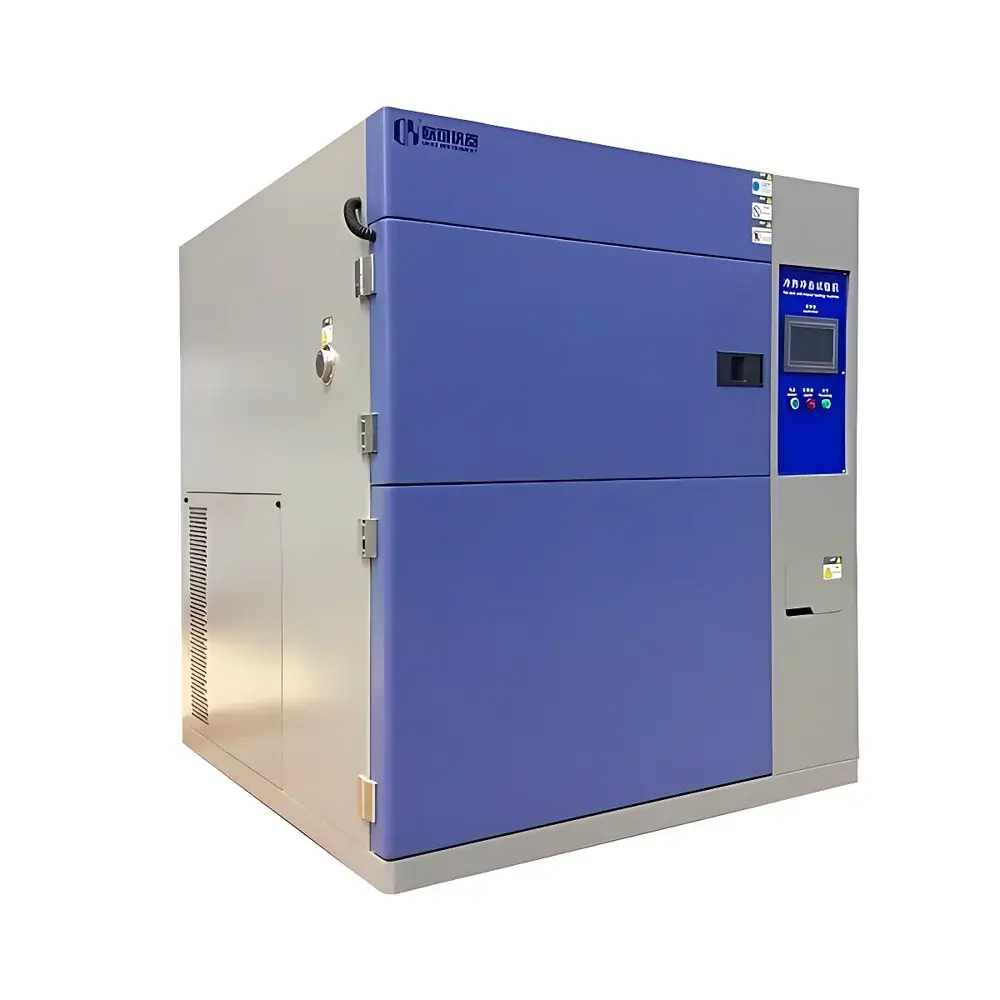
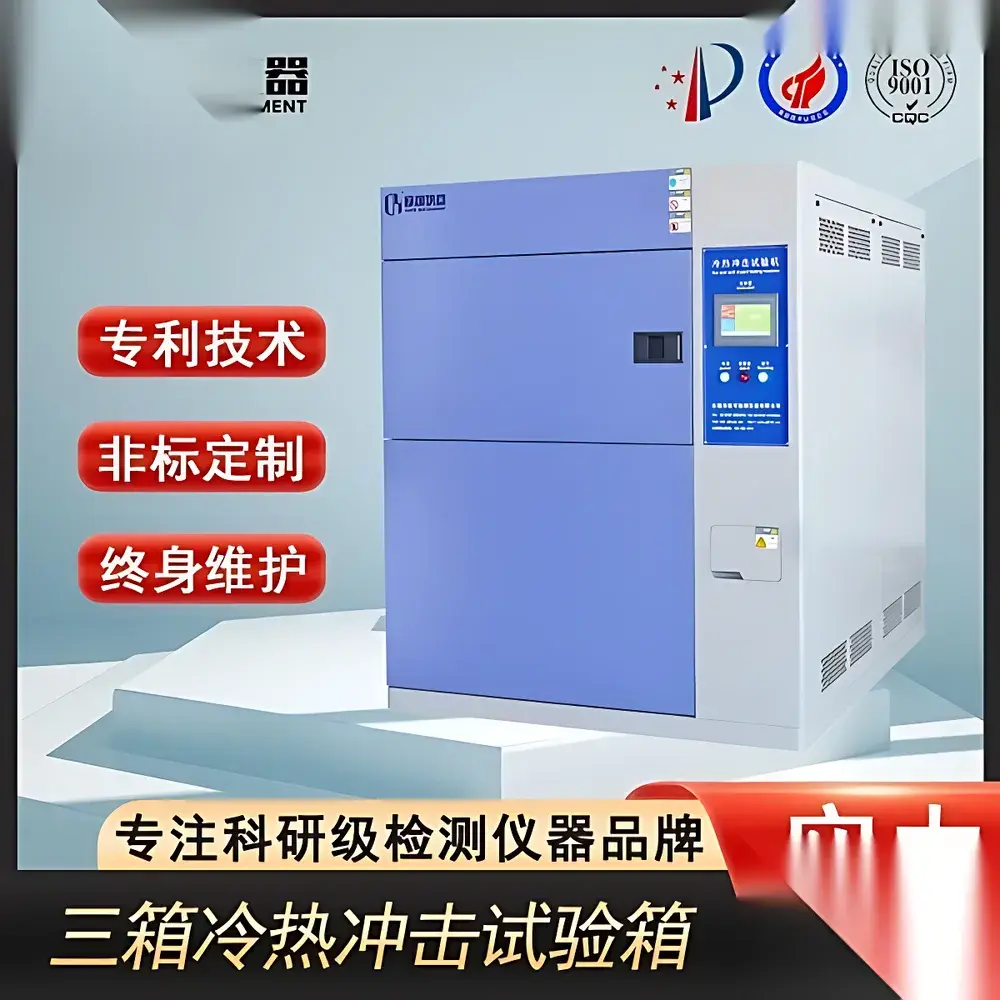
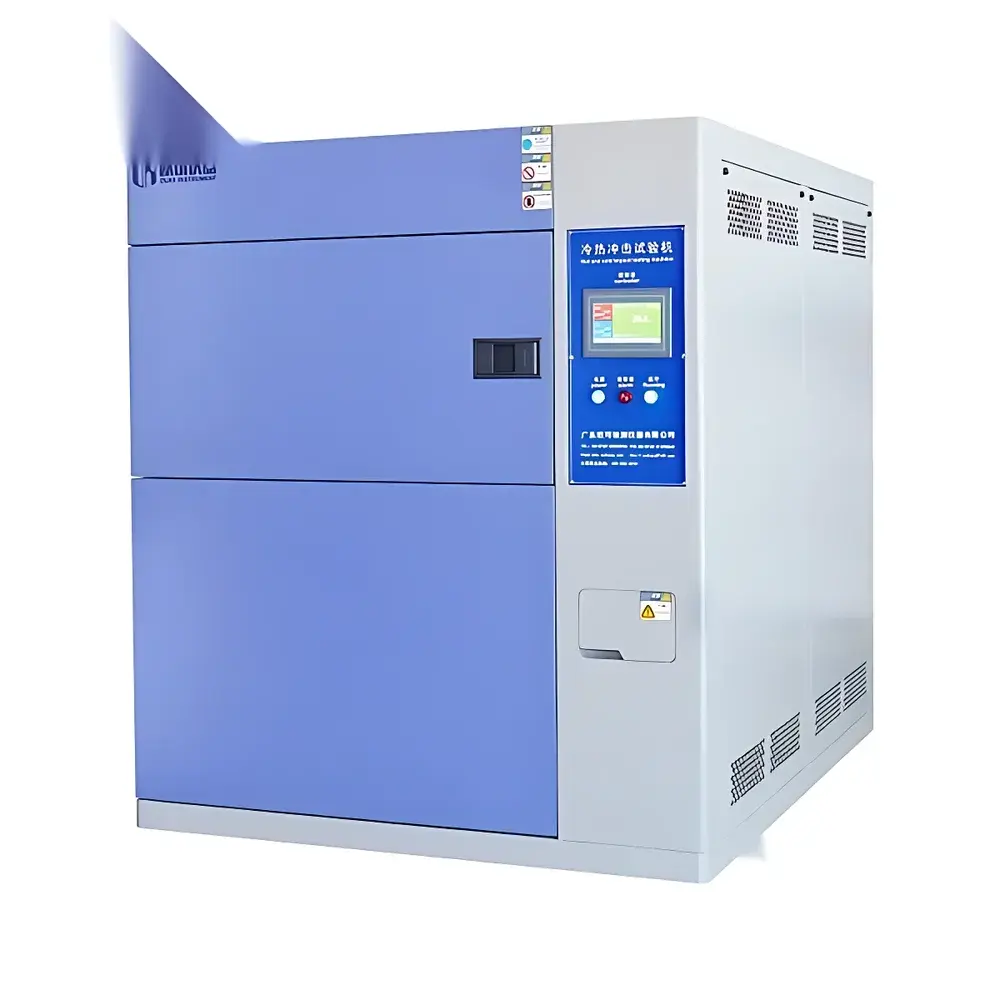
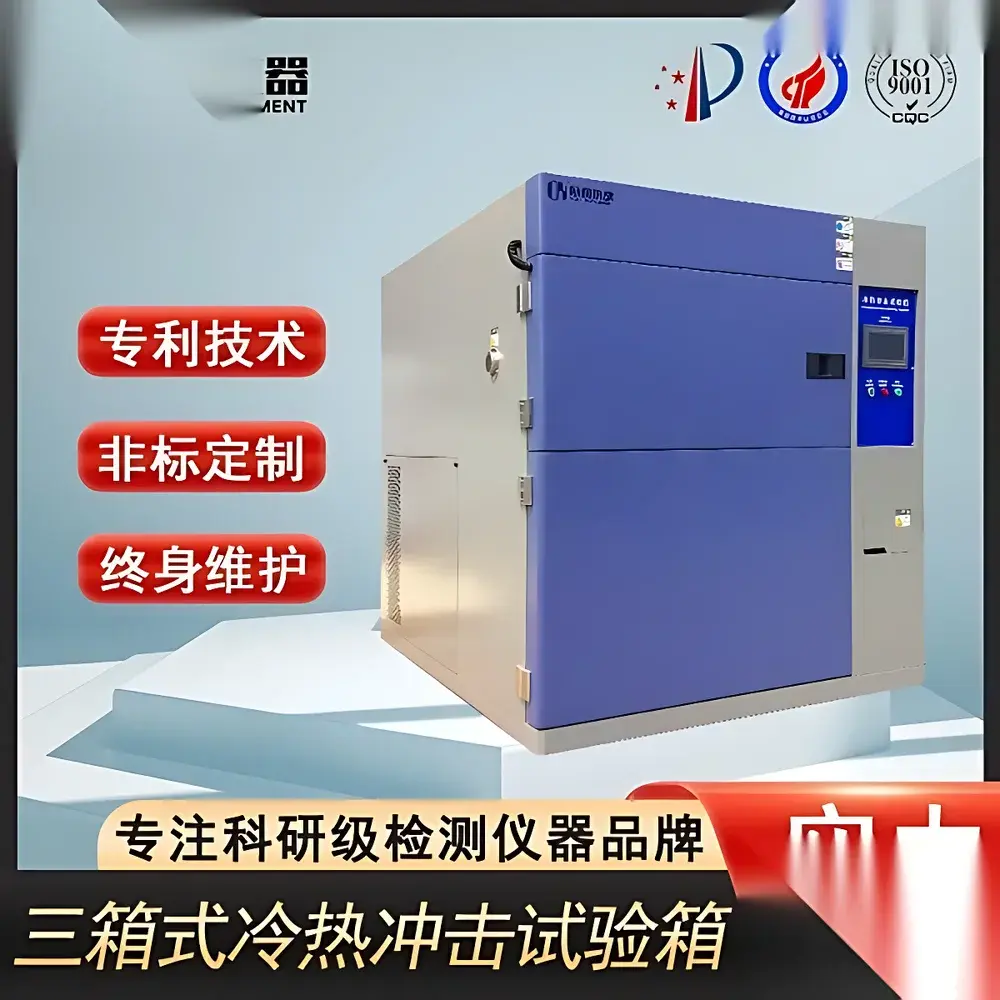
LED Low-Temperature Thermal Shock Test Chamber
| Brand | OEM |
|---|---|
| Origin | Imported |
| Manufacturer Type | Authorized Distributor |
| Price | USD 12,500 (FOB) |
| Internal Dimensions (W×H×D) | 40×35×30 cm to 70×60×60 cm |
| External Dimensions (W×H×D) | 145×180×140 cm to 190×170×270 cm |
| High-Temp Reservoir Range | RT to +200 °C |
| Low-Temp Reservoir Range | RT to −70 °C |
| Test Zone Temperature Range | Hot Shock (+60 °C to +150 °C) |
| Switching Mechanism | Pneumatic Air-Damper–Actuated Static Specimen Method |
| Preheat Time (RT → 150 °C) | ≈30 min |
| Precool Time (RT → −70 °C) | ≈85 min |
| Recovery Time | <5 min |
| Temperature Control Accuracy | ±0.5 °C |
| Temperature Uniformity | ±2.0 °C |
| Refrigeration System | Dual-Stage Cascade with Semi-Hermetic German Compressor (R404A/R23) |
| Inner Chamber Material | Mirror-Finish SUS#304 Stainless Steel |
| Outer Chamber Material | SUS#304 Stainless Steel or Powder-Coated Steel |
| Insulation | High-Density Fire-Retardant PU Foam |
| Power Supply | AC 380 V ±5 %, 50 Hz ±0.5 Hz, 3-Phase 5-Wire |
Overview
The LED Low-Temperature Thermal Shock Test Chamber is a precision-engineered environmental test system designed for accelerated evaluation of material integrity under extreme and rapid temperature transitions. It operates on the principle of thermal shock testing—subjecting specimens to abrupt, repeated shifts between high- and low-temperature reservoirs without physical movement of the test article. This static specimen methodology eliminates mechanical stress from handling or transport, ensuring that observed failures are attributable solely to thermally induced strain, phase transition, interfacial delamination, or microcrack propagation—not extraneous motion artifacts. The chamber implements a three-zone architecture: separate high-temperature (up to +200 °C) and low-temperature (down to −70 °C) storage chambers, plus an isolated test zone where samples remain stationary during thermal cycling. Pneumatically actuated air dampers enable sub-5-second thermal transfer between reservoirs, achieving defined recovery times within ≤5 minutes per cycle—critical for compliance with stringent military, automotive, and electronics reliability standards.
Key Features
- Three-chamber static-specimen configuration ensures zero mechanical disturbance during thermal transitions, preserving test validity for brittle composites and solder-joint assemblies.
- Dual-stage cascade refrigeration system featuring semi-hermetic German compressors, optimized for stable operation at −70 °C with R404A (high-stage) and R23 (low-stage) eco-compliant refrigerants.
- Precision temperature control with ±0.5 °C setpoint accuracy and ±2.0 °C uniformity across the test volume, validated per IEC 60068-3-5 and ASTM E2293.
- Modular internal dimensions (40×35×30 cm to 70×60×60 cm) support custom integration of fixtures, sensor harnesses, and in-situ monitoring ports—including standard 50 mm diameter cable access with silicone gasket seal.
- Fire-retardant, high-density polyurethane insulation (≥120 mm thickness) minimizes thermal leakage and stabilizes chamber dynamics during rapid ramp phases.
- Robust stainless-steel construction: mirror-finish SUS#304 interior for corrosion resistance and cleanroom compatibility; exterior options include full SUS#304 or powder-coated structural steel.
Sample Compatibility & Compliance
This thermal shock chamber accommodates rigid and semi-rigid specimens up to 30 kg, including printed circuit boards (PCBs), semiconductor packages (QFN, BGA), automotive ECUs, polymer housings, aerospace fasteners, and layered composite laminates. Its design conforms to over 15 international and industry-specific standards, including: GB/T 2423.1–2022 (cold), GB/T 2423.2–2022 (dry heat), GB/T 2423.22–2012 (temperature change), GJB 150.5A–2009 (military temperature shock), MIL-STD-810H Method 503.5, IEC 60068-2-14 (Test N: Change of Temperature), EIA-364-32 (connector thermal cycling), and QC/T 17–2019 (automotive component environmental testing). All thermal profiles are traceable to NIST-calibrated platinum resistance thermometers (PRTs) mounted at geometric center and corner locations. Data logging supports GLP/GMP audit readiness with timestamped, tamper-evident records.
Software & Data Management
The integrated controller features a 10.1-inch capacitive touchscreen HMI running embedded Linux with real-time OS determinism. It supports programmable multi-segment thermal profiles (up to 999 cycles), automatic dwell time calculation, and deviation alarms with configurable thresholds. Export formats include CSV and PDF reports compliant with FDA 21 CFR Part 11 requirements—enabling electronic signatures, user-level access control (admin/operator/observer roles), and full audit trail of parameter changes, start/stop events, and calibration logs. Optional Ethernet/IP and Modbus TCP interfaces allow integration into centralized MES or LIMS platforms for automated test sequencing and SPC charting.
Applications
- Failure mode analysis of solder joints in high-reliability electronics under JEDEC JESD22-A104 thermal cycling conditions.
- Evaluation of coefficient of thermal expansion (CTE) mismatch in multilayer ceramic capacitors (MLCCs) and advanced packaging substrates.
- Validation of adhesive bond strength and interfacial stability in fiber-reinforced polymer (FRP) composites used in aviation structures.
- Qualification testing of automotive sensors and battery management systems per ISO 16750-4 and LV-124 specifications.
- Accelerated aging of optical lens coatings and OLED encapsulation barriers exposed to −40 °C/+85 °C extremes.
FAQ
What distinguishes this three-chamber design from two-chamber thermal shock systems?
Unlike basket-transfer two-chamber units—which introduce inertial loading and positional variability—the static-specimen three-chamber architecture isolates mechanical variables, enabling higher repeatability for metrology-grade qualification per ISO/IEC 17025.
Is external cooling water infrastructure mandatory?
Yes. The dual-stage cascade system requires a dedicated closed-loop cooling tower delivering 10 m³/h at 32 °C inlet temperature. This ensures sustained condensing capacity during prolonged −70 °C operation and meets ASHRAE 15 safety compliance.
Can the chamber be validated for IQ/OQ/PQ protocols?
Absolutely. Factory-installed Class A PT100 sensors, NIST-traceable calibration certificates, and preconfigured validation templates (per Annex 15 and EU GMP Annex 15) are provided as optional deliverables.
Does it support custom test profiles beyond published standards?
Yes. The controller accepts user-defined ramp rates (0.5–20 °C/min), non-linear dwell sequences, and conditional branching logic (e.g., “if T ≥ +145 °C for >2 min, initiate cold transfer”).
What maintenance intervals are recommended for long-term reliability?
Compressor oil analysis every 2,000 operating hours; refrigerant leak check quarterly; damper actuator calibration annually; full chamber thermal mapping biannually per ISO/IEC 17025 Clause 6.4.3.



