
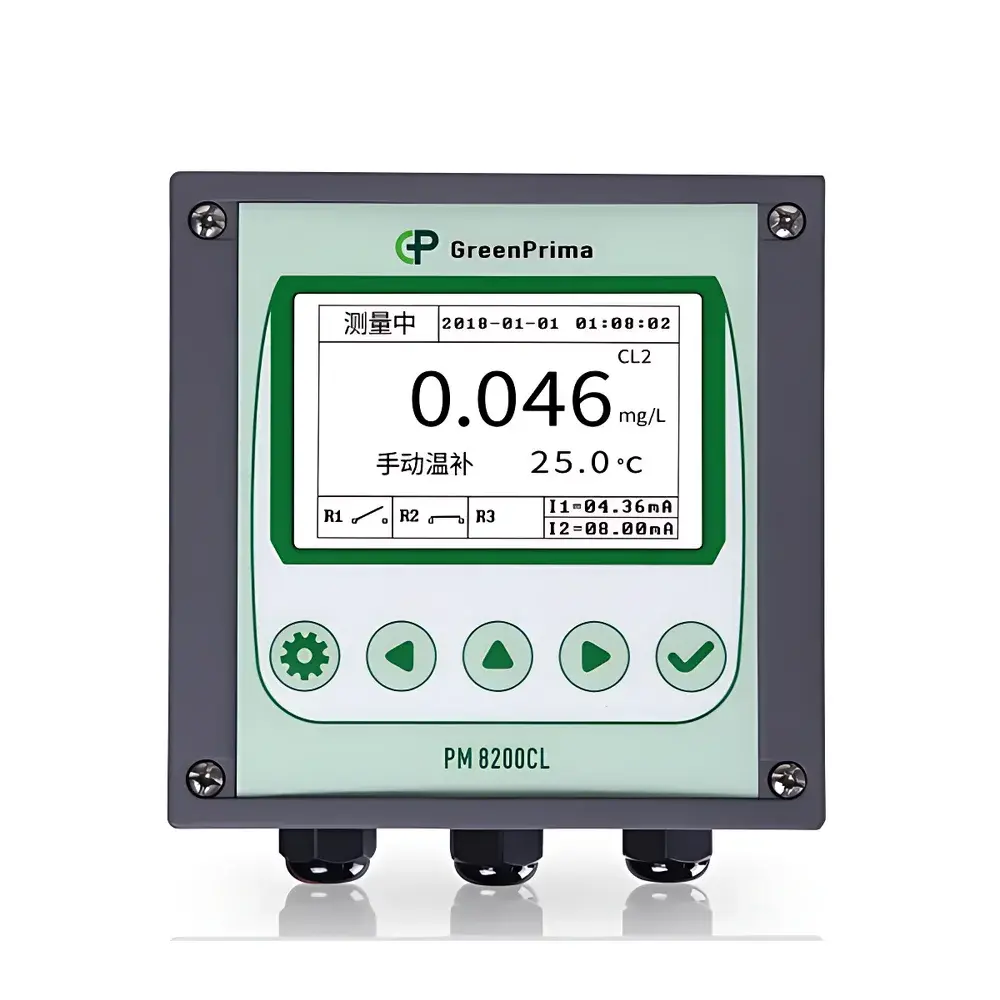
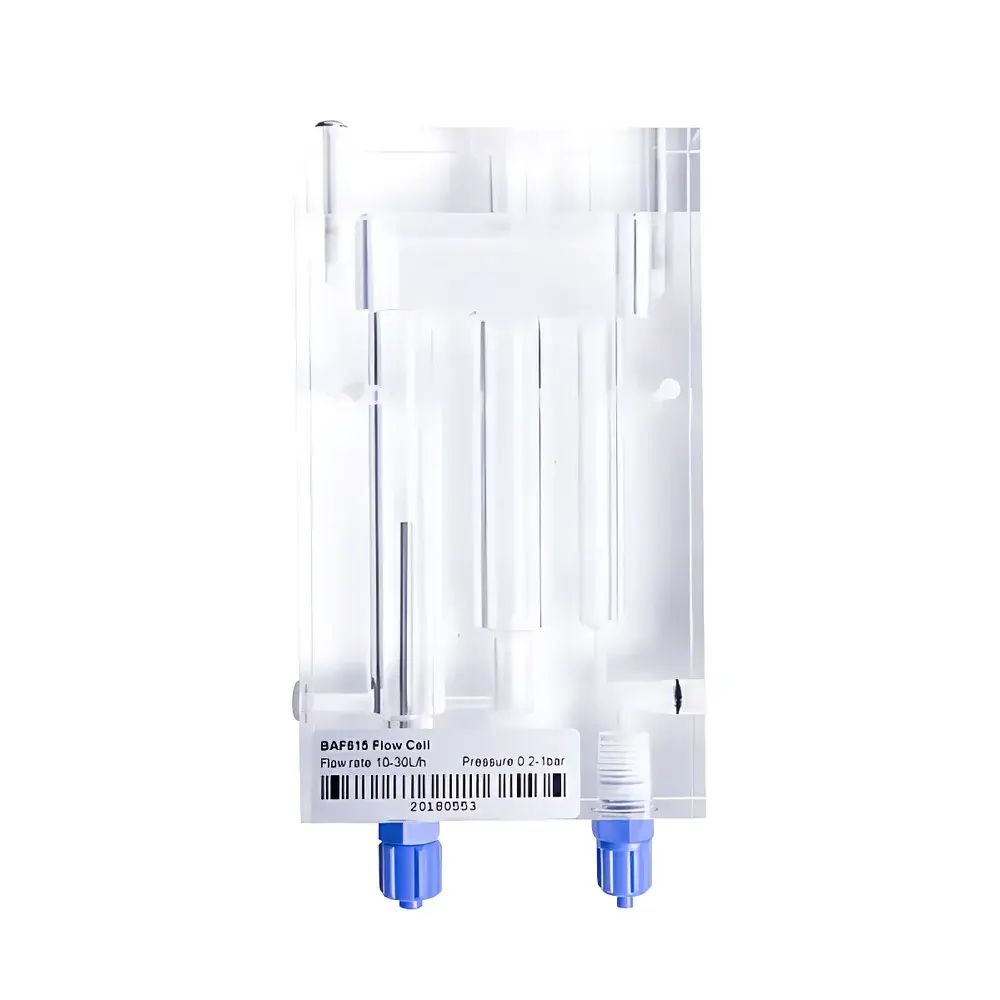
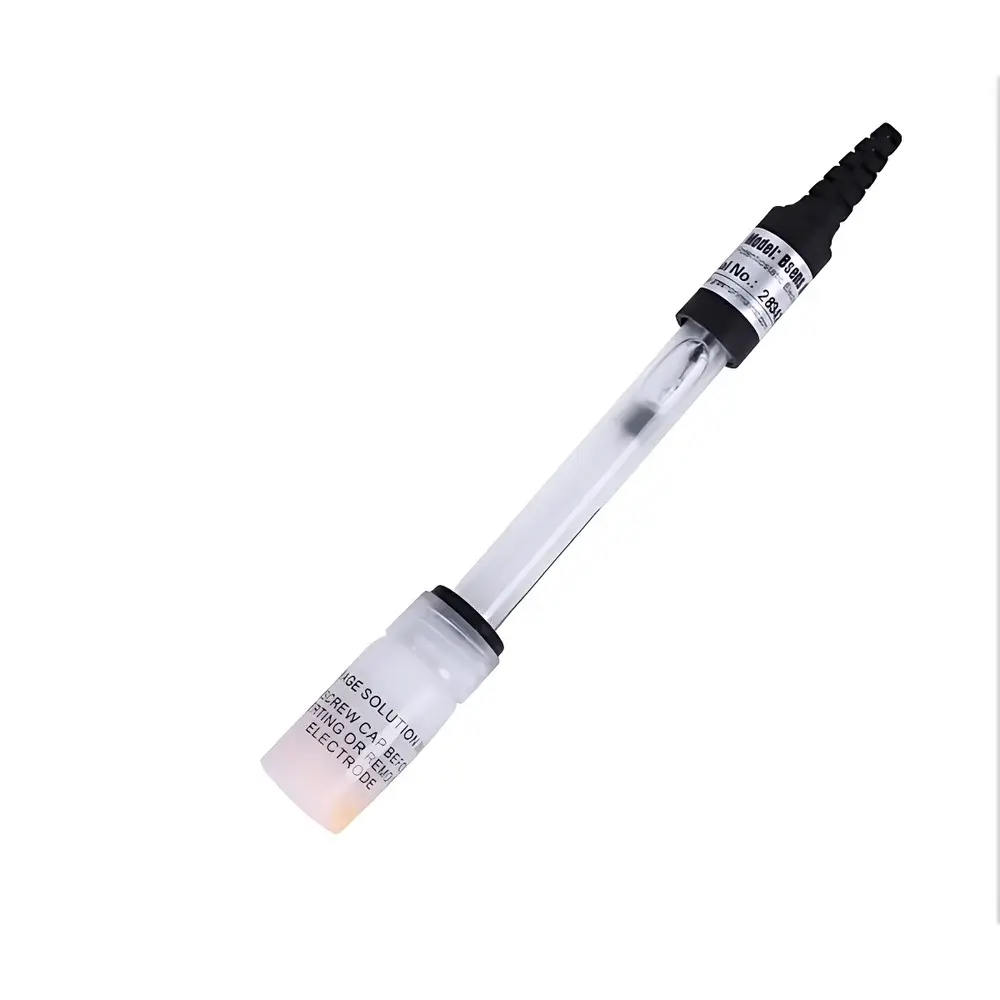
GreenPrima PM8200CL Residual Chlorine, Chlorine Dioxide & Ozone Online Analyzer
| Brand | GreenPrima |
|---|---|
| Origin | United Kingdom |
| Manufacturer Type | Original Equipment Manufacturer (OEM) |
| Product Category | Imported Instrument |
| Model | PM8200 CL |
| Instrument Type | Online Analyzer |
| Measurement Principle | Amperometric Electrochemical Sensor (Constant Potential Method) |
| Measured Parameters | Free Chlorine, Total Chlorine, Chlorine Dioxide, Ozone |
| Range | 0–2.000 ppm / 0–20.00 ppm (dual-range auto-switching) |
| Accuracy | ±0.001 ppm / ±0.01 ppm |
| Repeatability | ±0.001 ppm / ±0.01 ppm |
| Resolution | 0.001 ppm / 0.01 ppm |
| Detection Limit | 0.001 ppm / 0.01 ppm |
| Temperature Compensation | –10 to 130 °C (NTC10K or PT1000, manual/automatic) |
| Operating Temperature | 0–70.0 °C |
| Storage Temperature | –20 to 70.0 °C |
| Display | Backlit Graphic LCD |
| Data Storage | 600,000 records |
| Power Supply | 90–260 VAC, 50/60 Hz or 24 VDC optional |
| Enclosure Rating | IP65 |
| Communication | RS485, MODBUS-RTU compliant |
| Analog Outputs | Two isolated 4–20 mA outputs (max. loop resistance 500 Ω, accuracy ±0.1% FS) |
| Cleaning Control Output | Adjustable interval (0.1–1000 h) and duration (1–1000 s) |
| Mounting Options | Wall-mounted, pole-mounted, panel-mounted |
| Dimensions | 144 × 144 × 106 mm |
| Panel Cutout | 138 × 138 mm |
| Weight | 0.86 kg |
| Sensor Model | Bsens650 |
| Sensor Range | 0–2.000 / 0–20.00 ppm |
| Sensor Accuracy | ±2% FS |
| Sensor Electrode Material | Glass body with dual-platinum ring working electrode |
| Max. Pressure Rating | 5 bar |
| Cable Length | 3 m |
| Connection | PG13.5 threaded gland |
Overview
The GreenPrima PM8200CL is a fully integrated online analyzer engineered for continuous, real-time measurement of residual chlorine (free and total), chlorine dioxide, and ozone in water distribution systems, potable water treatment plants, pharmaceutical process water loops, swimming pools, and wastewater disinfection applications. It operates on the amperometric electrochemical principle—specifically, the constant-potential (galvanic) method—where a stable polarizing voltage is applied between a dual-platinum ring working electrode and a reference electrode. Under this fixed potential, oxidizing species such as hypochlorous acid (HOCl), chlorine dioxide (ClO₂), and ozone (O₃) undergo selective reduction at the electrode surface, generating a diffusion-controlled current proportional to their concentration. This approach eliminates dependence on reagents, optical path length, or membrane permeability—offering inherent stability, minimal drift, and long-term calibration integrity without consumables.
Key Features
- True reagent-free operation: No colorimetric reagents, membranes, or electrolyte refills required—reducing operational cost and maintenance frequency.
- Dual-range auto-switching capability: Seamlessly transitions between low-range (0–2.000 ppm) and high-range (0–20.00 ppm) modes based on measured concentration, ensuring optimal resolution across diverse application profiles.
- Integrated temperature compensation: Supports both NTC10K and PT1000 sensors with automatic or manual compensation across –10 to 130 °C—critical for accurate readings in variable-temperature environments such as hot water loops or outdoor distribution networks.
- Robust industrial interface: Dual isolated 4–20 mA analog outputs (±0.1% FS accuracy), RS485 serial communication compliant with MODBUS-RTU protocol, and programmable cleaning control output for automated sensor maintenance cycles.
- High-integrity sensor design: Bsens650 amperometric sensor features a chemically inert glass body and dual-platinum ring electrode architecture, rated for continuous operation up to 5 bar pressure and compatible with chlorinated, ozonated, and ClO₂-treated waters.
- Flexible installation: Compatible with wall-mount, pole-mount, and panel-mount configurations; compact 144 × 144 mm front panel fits standard DIN cutouts (138 × 138 mm).
- Data continuity assurance: Onboard non-volatile memory stores up to 600,000 timestamped measurement records—including concentration, temperature, sensor status, and diagnostic flags—for traceability and audit readiness.
Sample Compatibility & Compliance
The PM8200CL is validated for use in drinking water (per WHO Guidelines for Drinking-water Quality and EU Directive 98/83/EC), pharmaceutical purified water (USP , EP 2.2.43), and municipal wastewater effluent. Its sensor design minimizes interference from common water matrix constituents including nitrate, chloride, and dissolved organic carbon—provided turbidity remains below 5 NTU and suspended solids are filtered prior to analysis. The system supports GLP/GMP-aligned data management through time-stamped logging and configurable alarm thresholds. While not intrinsically certified for hazardous areas, its IP65-rated enclosure meets IEC 60529 requirements for dust-tight and water-jet resistant operation in typical utility rooms, pump stations, and outdoor kiosks.
Software & Data Management
The embedded firmware enables full local configuration via intuitive bilingual (English/Chinese) menu navigation on the backlit graphic LCD. All parameters—including range selection, temperature compensation mode, analog output scaling, MODBUS slave ID, and cleaning schedule—are configurable without external software. Data export is supported via MODBUS polling by SCADA, DCS, or LIMS platforms. For regulatory compliance, the system maintains immutable event logs for power cycles, calibration events, sensor faults, and cleaning activations—serving as foundational evidence during FDA 21 CFR Part 11 or ISO/IEC 17025 audits when deployed with appropriate procedural controls.
Applications
- Real-time monitoring of free chlorine residuals at finished water discharge points and distribution network endpoints (e.g., Chifeng Municipal Water Plant, Inner Mongolia).
- Process control of chlorine dioxide dosing in secondary disinfection stages of municipal treatment facilities.
- Ozone residual tracking in advanced oxidation processes (AOPs) and bottled water production lines.
- Pharmaceutical clean-in-place (CIP) validation and purified water system sanitization verification per Annex 1 and EU GMP guidelines.
- Automated feedback control for chlorine generators and ozone injection systems via 4–20 mA setpoint integration.
- Swimming pool and spa water quality management per CDC Model Aquatic Health Code (MAHC) recommendations.
FAQ
Does the PM8200CL require daily calibration or frequent zero-point adjustment?
No. Due to its constant-potential amperometric design and stable dual-platinum electrode, the sensor exhibits exceptional zero-point stability. Field calibration is recommended every 30–90 days depending on water matrix complexity, using NIST-traceable standard solutions.
Can the same sensor measure chlorine, chlorine dioxide, and ozone interchangeably?
Yes—the Bsens650 sensor responds selectively to all three oxidants under the same applied potential. However, cross-sensitivity must be evaluated for each application; instrument firmware allows user-defined correction factors where coexisting oxidants are present.
Is the system compatible with existing PLC-based control infrastructure?
Yes. The RS485 interface with MODBUS-RTU protocol ensures seamless integration with Allen-Bradley, Siemens, Schneider Electric, and Mitsubishi PLCs. Both analog outputs are galvanically isolated and field-configurable for direct connection to PID controllers or alarm relays.
What maintenance is required beyond scheduled cleaning cycles?
Beyond periodic mechanical cleaning (typically every 24–168 hours depending on fouling risk), no routine consumables replacement is needed. Sensor lifetime exceeds 24 months under continuous operation in typical municipal water matrices.
How does the system handle temperature fluctuations in unheated outdoor installations?
The integrated temperature sensor (NTC10K or PT1000) provides real-time compensation across –10 to 130 °C. For ambient installations below 0 °C, optional heated sample line kits and insulated enclosures are available to maintain sample temperature above 5 °C prior to analysis.







