
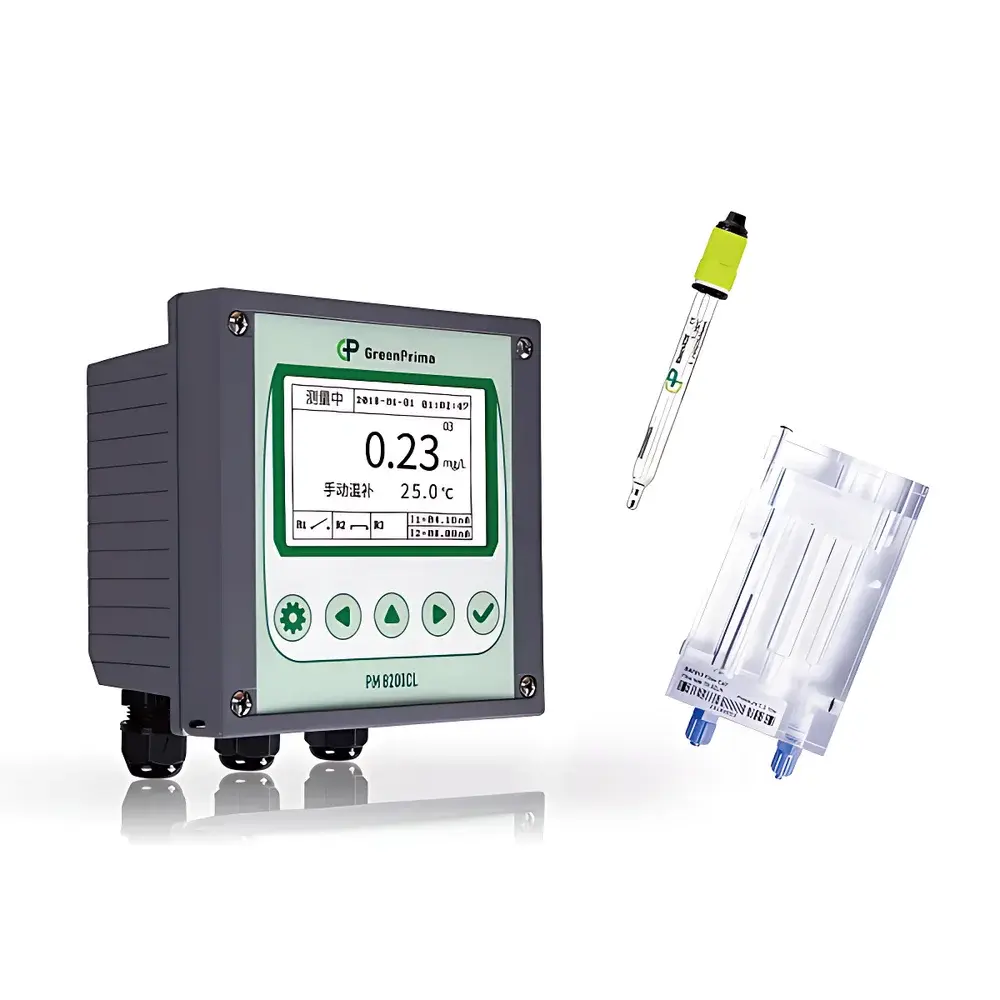
GreenPrima PM8200CL Residual Chlorine Analyzer
| Brand | GreenPrima |
|---|---|
| Origin | Switzerland |
| Manufacturer Type | Manufacturer |
| Origin Category | Imported |
| Model | PM8200CL |
| Instrument Type | Online Analyzer |
| Measurement Principle | Electrochemical Amperometric Sensor (Constant Voltage) |
| Measured Parameter | Free Residual Chlorine |
| Measurement Ranges | 0–2 ppm and 0–20 ppm |
| Accuracy | ≤2% of Full Scale |
| Repeatability | 0.001 ppm |
| Resolution | 0.001 ppm (low range), 0.01 ppm (high range) |
| Detection Limit | 0.001 ppm |
Overview
The GreenPrima PM8200CL Residual Chlorine Analyzer is an online, microprocessor-controlled electrochemical instrument engineered for continuous, real-time monitoring of free residual chlorine in potable water, process water, and disinfection systems. It operates on the amperometric principle with a dual-platinum constant-voltage sensor (Bsens650), delivering stable zero-point performance and high interference rejection—particularly against oxidants such as ozone and chlorine dioxide. Unlike colorimetric methods, the PM8200CL requires no reagents, eliminates sample pretreatment, avoids tubing clogging, and reduces operational overhead while maintaining regulatory-grade measurement integrity. Its modular architecture integrates a dedicated controller, a flow-stabilized sensor module, and an integrated flow cell (constant-flow chamber), ensuring consistent hydrodynamic conditions across varying inlet pressures—a critical factor for reproducible electrochemical response.
Key Features
- Dual-platinum amperometric sensor operating at fixed bias voltage, optimized for selectivity toward hypochlorous acid (HOCl) and hypochlorite ion (OCl⁻)
- Integrated constant-flow chamber (flow cell) to maintain laminar, repeatable sample delivery—eliminating flow-rate dependency in current output
- Triple-analyte capability: configurable for free chlorine, ozone, or chlorine dioxide via sensor calibration and software selection
- Automatic pH compensation (–10 to 130 °C range) using NTC10K or PT1000 temperature probes; supports manual or auto-compensation modes
- Backlit high-contrast dot-matrix LCD display showing real-time residual chlorine concentration, temperature, system status, relay states, and timestamp
- Two independent programmable alarm outputs (Hi/Lo), each with adjustable hysteresis and relay ratings up to 5 A / 250 VAC / 30 VDC
- Programmable cleaning cycle: interval adjustable from 0.1 to 1000 hours; cleaning duration from 1 to 1000 seconds
- Flexible mounting options: wall-mount, panel-mount (138 × 138 mm cutout), or inline pipe-mount configurations
- IP65-rated enclosure (144 × 144 × 106 mm, 0.86 kg) suitable for industrial control rooms and wet utility environments
Sample Compatibility & Compliance
The PM8200CL is validated for use in low-conductivity (<500 µS/cm) and moderate-turbidity aqueous matrices typical of municipal drinking water, secondary distribution networks, pharmaceutical purified water (PW/UPW), beverage bottling lines, cooling tower circuits, and recreational pool systems. It meets functional requirements aligned with ASTM D1253 (Standard Test Method for Determining Residual Chlorine in Water), ISO 7393-2 (Electrochemical determination of free chlorine), and USP for conductivity and oxidation-reduction potential (ORP)-correlated disinfectant verification. While not inherently 21 CFR Part 11 compliant out-of-the-box, its audit-trail-capable data logging (600,000 records) and time-stamped event logs support GLP/GMP-aligned validation when deployed with secure networked data acquisition systems.
Software & Data Management
The embedded firmware supports dual isolated 4–20 mA analog outputs: Output 1 transmits user-selected analyte values (free Cl₂, O₃, or ClO₂); Output 2 delivers temperature data. Both outputs feature galvanic isolation and ≤500 Ω load capability. Digital communication is implemented via RS485 Modbus RTU protocol (standard); HART interface available as optional hardware variant. All configuration parameters—including range selection, alarm thresholds, cleaning schedules, pH compensation coefficients, and language (English, Simplified Chinese, Traditional Chinese)—are accessible via front-panel navigation or remote configuration tools. Data storage retains timestamped measurements, alarms, cleaning events, and calibration history for ≥12 months under typical sampling intervals.
Applications
- Real-time monitoring of free chlorine residual at drinking water treatment plant effluent points and booster station outlets
- Continuous verification of disinfectant levels in pharmaceutical clean steam condensate loops and WFI distribution systems
- Process control of chlorine dosing in bottled water and soft drink production lines
- Automated feedback control for chlorine generators in swimming pool and spa circulation systems
- Trend analysis and compliance reporting for EPA Safe Drinking Water Act (SDWA) and EU Directive 98/83/EC parameter tracking
- Integration into SCADA and DCS platforms for centralized water quality dashboards and predictive maintenance alerts
FAQ
What measurement principle does the PM8200CL employ, and how does it differ from colorimetric methods?
It uses constant-voltage amperometry with a dual-platinum electrode pair, directly measuring the reduction current of hypochlorous acid without chemical reagents or optical components.
Can the same sensor measure ozone and chlorine dioxide in addition to free chlorine?
Yes—the Bsens650 sensor is chemically cross-sensitive but calibrated separately for each oxidant; switching between analytes requires corresponding calibration and firmware configuration.
Is temperature compensation automatic, and what probe types are supported?
Yes—automatic or manual temperature compensation is supported across –10 °C to 130 °C using either NTC10K thermistors or PT1000 RTDs.
Does the device comply with FDA 21 CFR Part 11 for electronic records?
The standalone unit provides time-stamped, non-erasable data logging but requires integration with validated third-party data servers to meet full Part 11 audit-trail and electronic signature requirements.
What is the minimum detectable residual chlorine concentration?
The lower detection limit is 0.001 ppm, verified under controlled flow and temperature conditions per ISO 7393-2 Annex B.







