
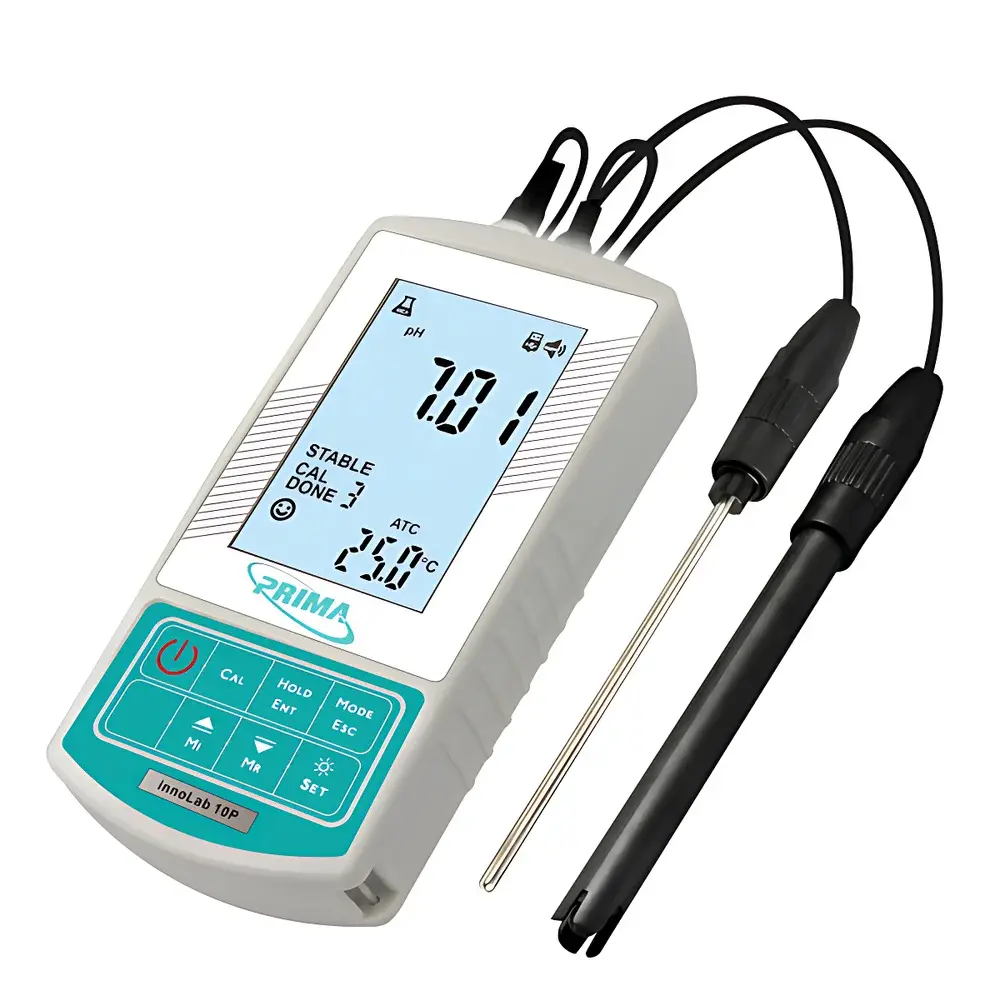
PRIMA innoLab 10P Portable pH/ORP Meter
| Brand | PRIMA (UK) |
|---|---|
| Origin | Taiwan |
| Model | innoLab 10P |
| Instrument Type | Portable |
| Parameter Type | Single-Parameter |
| pH Range | -2.00 to 16.00 |
| ORP Range | -2000 to +2000 mV |
| Temperature Range | -5.0 to 120.0 °C |
| Resolution | 0.01 pH / 0.1 mV (±600.0 mV) / 0.1 °C |
| Accuracy | ±0.01 pH / ±0.2 mV (≤ ±600 mV), ±1 mV (> ±600 mV) / ±0.3 °C |
| Calibration | Up to 5-point auto-calibration with NIST-traceable buffers |
| Temperature Compensation | Automatic or manual |
| Display | 43 × 70 mm LCD |
| Power | 2 × AA batteries |
| IP Rating | IP65 (pH mode), IP67 (conductivity/DO-capable variants) |
| Dimensions | 73 × 152 × 42 mm |
| Weight | 250 g |
Overview
The PRIMA innoLab 10P Portable pH/ORP Meter is an engineered electrochemical measurement instrument designed for field-deployable, laboratory-grade accuracy in demanding environmental, industrial process, and quality control applications. Utilizing high-stability glass electrode sensing principles compliant with ISO 3696 and ASTM D1293 standards, the device measures hydrogen ion activity (pH) and redox potential (ORP) via potentiometric detection against a stable reference electrode. Its dual-mode capability supports both aqueous and semi-aqueous samples across extreme pH ranges (–2.00 to 16.00), enabling reliable characterization of aggressive alkaline caustics, acidic leachates, and sterilization solutions. The meter operates on a low-power architecture optimized for extended battery life—critical for unattended monitoring in remote sampling locations or mobile QC workflows.
Key Features
- Robust dual-protection housing rated IP65 for pH operation and IP67 for conductivity/DO-compatible configurations—ensuring dust-tight integrity and resistance to water jets or temporary submersion.
- Ergonomic handheld design with textured anti-slip grip and integrated lanyard hole for secure field handling and drop mitigation.
- Modular BNC/DIN electrode interface with rear-mounted probe slot—facilitating organized storage and minimizing cable strain during transport.
- Large 43 × 70 mm monochrome LCD with high-contrast backlighting for legible readings under variable ambient lighting conditions, including outdoor daylight and low-light lab environments.
- Five-point automatic calibration routine supporting NIST-traceable buffer sets (e.g., pH 1.68, 4.01, 7.00, 10.01, 12.45), with real-time slope and offset diagnostics to verify electrode health and calibration validity.
- Automatic temperature compensation (ATC) using integrated Pt1000 thermistor or external temperature probe input—correcting for thermal drift per IUPAC-recommended Nernst equation coefficients.
- HOLD function for freezing transient measurements; data logging capability for up to 100 sequential readings with timestamp (when paired with optional PC interface software).
Sample Compatibility & Compliance
The innoLab 10P is validated for use with standard combination pH electrodes (glass body, Ag/AgCl reference system) and ORP-specific noble metal electrodes (e.g., platinum or gold). It accommodates both aqueous solutions and non-aqueous matrices with moderate ionic strength (≥100 µS/cm), including wastewater effluents, cooling tower fluids, pharmaceutical rinse waters, and food processing brines. All calibrations adhere to NIST Standard Reference Materials (SRMs) protocols, ensuring metrological traceability required under ISO/IEC 17025-accredited laboratories. The device meets CE marking requirements for electromagnetic compatibility (EN 61326-1) and safety (EN 61010-1), and its operational firmware supports audit-ready calibration records compatible with GLP/GMP documentation frameworks.
Software & Data Management
While the innoLab 10P operates as a standalone field instrument, it supports optional USB-to-serial connectivity for data export to Windows-based configuration and reporting software. This interface enables generation of calibration certificates with full metadata—including date/time stamps, buffer IDs, measured slopes, asymmetry potentials, and user-defined sample identifiers. Exported datasets conform to CSV and Excel-compatible formats, facilitating integration into LIMS environments or statistical process control (SPC) platforms. Firmware updates are delivered via secure encrypted package files, maintaining compliance with FDA 21 CFR Part 11 requirements for electronic records when used in regulated industries.
Applications
- Environmental monitoring: Surface water, groundwater, and stormwater pH/ORP profiling per EPA Method 150.1 and ISO 10523.
- Pharmaceutical manufacturing: Final rinse verification, clean-in-place (CIP) cycle endpoint detection, and buffer solution QC per USP and EP 2.2.3.
- Food & beverage production: Fermentation tank monitoring, acidulant titration control, and sanitation efficacy validation.
- Academic research: Electrochemical kinetics studies, corrosion potential mapping, and sensor development benchmarking.
- Industrial water treatment: Coagulation/flocculation optimization, chlorine residual correlation, and membrane fouling assessment.
FAQ
What calibration standards are supported?
The innoLab 10P accepts NIST-traceable pH buffers across five points (1.68, 4.01, 7.00, 10.01, 12.45) and supports custom calibration curves for specialized applications.
Is temperature compensation mandatory?
No—both automatic (via integrated or external probe) and manual temperature entry modes are available to accommodate fixed-temperature assays or legacy calibration protocols.
Can the device store calibration history?
Yes—each calibration event is logged internally with slope, offset, and date/time; logs are retrievable via serial interface for audit review.
What battery type and life expectancy does it use?
Two standard AA alkaline cells provide ≥200 hours of continuous operation; battery replacement requires no tools and maintains full IP65 sealing integrity.
Does it support GLP-compliant reporting?
When used with optional software and configured with user authentication, the system generates electronic records meeting ALCOA+ principles and 21 CFR Part 11 signature requirements.






