
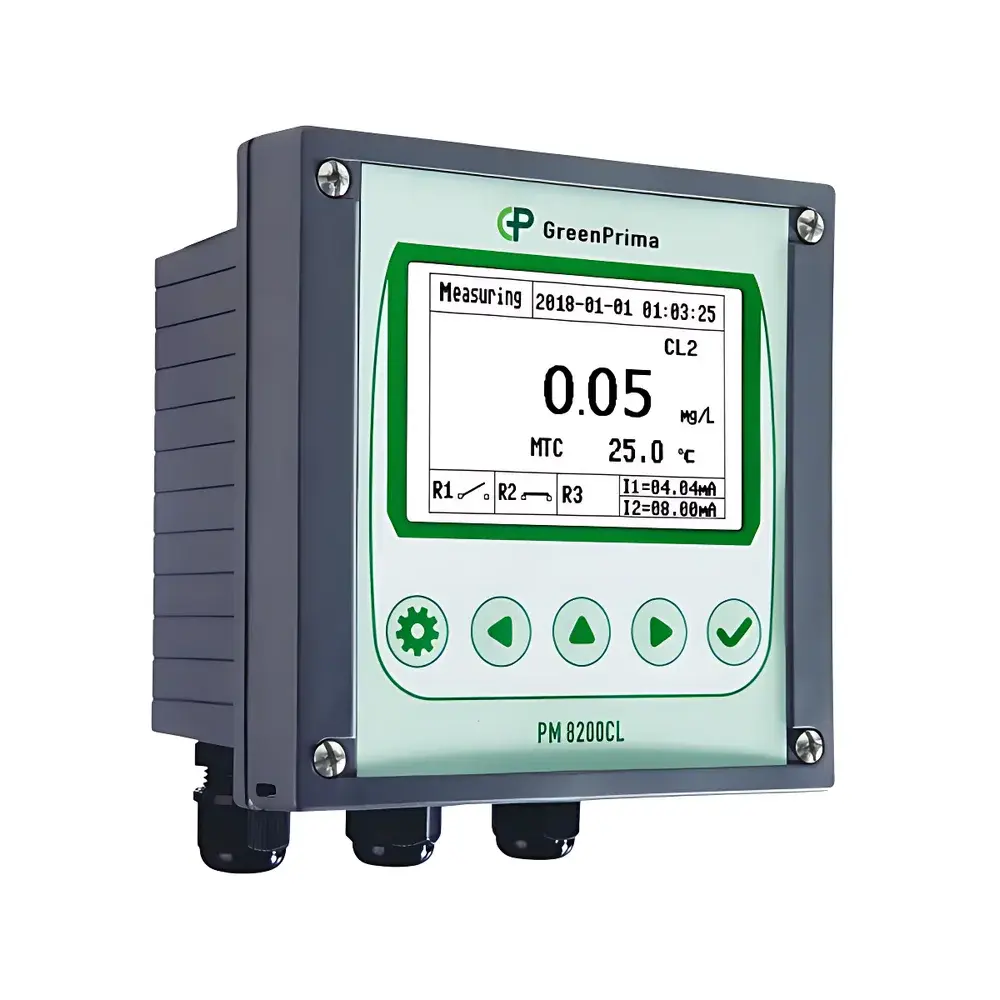
GreenPrima PM8200CL Residual Chlorine, Chlorine Dioxide & Ozone Online Analyzer
| Brand | GreenPrima |
|---|---|
| Origin | United Kingdom |
| Manufacturer Type | Original Equipment Manufacturer (OEM) |
| Product Category | Imported Instrument |
| Model | PM8200CL |
| Instrument Type | Online Analyzer |
| Measurement Principle | Amperometric Electrochemical Sensor (Constant Voltage Technique) |
| Measured Parameters | Free Chlorine, Chlorine Dioxide, Ozone |
| Range | 0–2.000 ppm and 0–20.00 ppm (dual-range auto-scaling) |
| Accuracy | ±0.001 ppm / ±0.01 ppm (depending on range) |
| Repeatability | ±0.001 ppm / ±0.01 ppm |
| Resolution | 0.001 ppm / 0.01 ppm |
| Detection Limit | 0.001 ppm / 0.01 ppm |
| Temperature Compensation | -10 to 130 °C (NTC10K or PT1000 selectable, manual/automatic) |
| Operating Temperature | 0–70.0 °C |
| Storage Temperature | -20 to 70.0 °C |
| Display | Backlit Graphic LCD |
| Language | English & Chinese Menu |
| Data Storage | 600,000 records |
| Power Supply | 90–260 VAC, 50/60 Hz or 24 VDC optional |
| Enclosure Rating | IP65 |
| Communication | RS485, MODBUS-RTU compliant |
| Analog Outputs | Two isolated 4–20 mA outputs (max. loop resistance 500 Ω, accuracy ±0.1% FS) |
| Cleaning Output | Adjustable interval (0.1–1000 h) and duration (1–1000 s) |
| Mounting Options | Wall-mount, pole-mount, panel-mount |
| Dimensions | 144 × 144 × 106 mm |
| Panel Cutout | 138 × 138 mm |
| Weight | 0.86 kg |
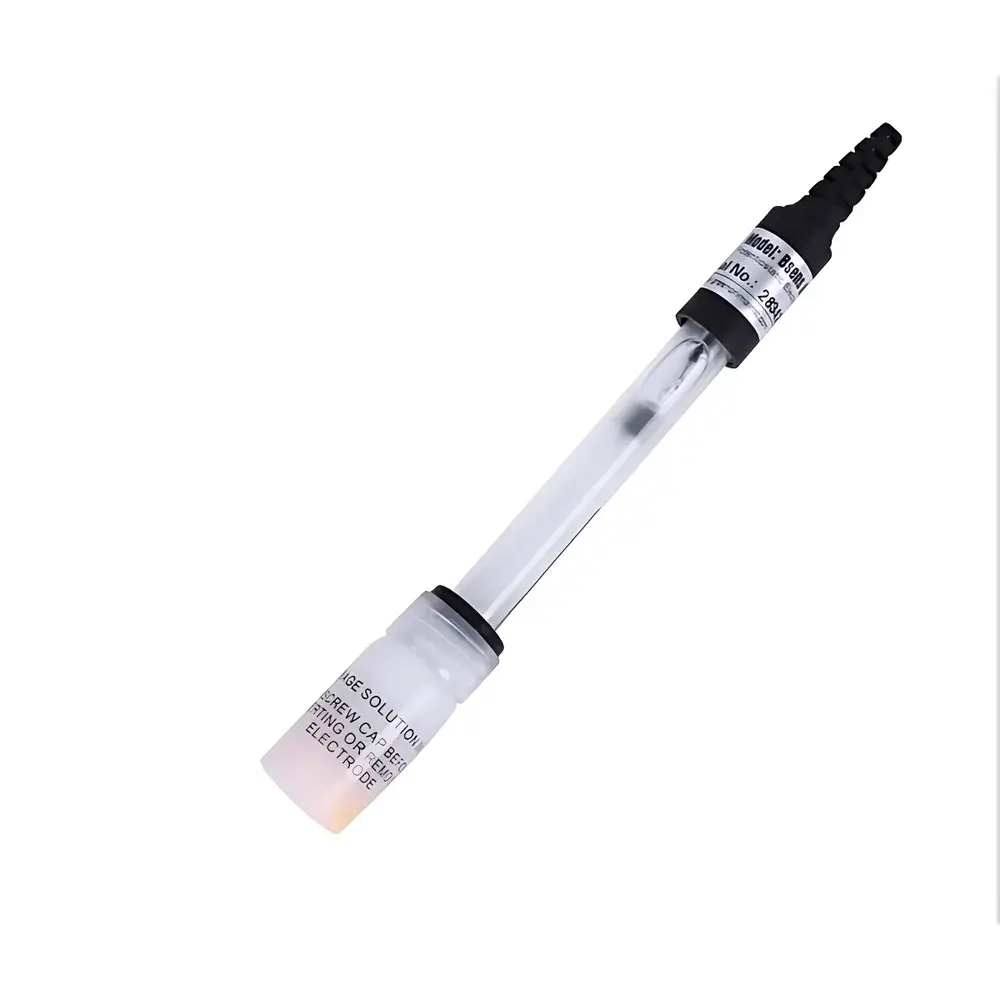
| Sensor Model | Bsens650 |
| Sensor Range | 0–2.000 / 0–20.00 ppm |
| Sensor Accuracy | ±2% FS |
| Sensor Electrode Material | Glass body with dual-platinum ring working electrode |
| Max. Pressure Rating | 5 bar |
| Cable Length | 3 m |
| Connection | PG13.5 threaded fitting |
Overview
The GreenPrima PM8200CL is a three-component online analyzer engineered for continuous, real-time measurement of free chlorine, chlorine dioxide, and ozone in aqueous systems. It operates on the amperometric electrochemical principle—specifically, the constant voltage (potentiostatic) technique—where a stable polarizing potential is applied between a dual-platinum ring working electrode and a reference electrode. Under this fixed potential, target oxidants undergo selective reduction at the electrode surface, generating a diffusion-controlled current proportional to their concentration. This method eliminates reliance on colorimetric reagents or membrane-based electrolyte replenishment, enabling long-term stability and minimal maintenance. Designed for integration into municipal water distribution networks, drinking water treatment plants, hospital wastewater disinfection lines, swimming pool circulation systems, pharmaceutical purified water loops, and industrial cooling towers, the PM8200CL delivers high reproducibility in dynamic flow environments without drift-induced calibration drift.
Key Features
- True amperometric sensing using a constant-voltage circuit architecture—no membrane replacement or electrolyte refilling required throughout service life
- Dual-range auto-scaling capability (0–2.000 ppm and 0–20.00 ppm) ensures optimal resolution across low-dose disinfection control and high-concentration process monitoring
- Integrated temperature compensation via NTC10K or PT1000 sensors supports accurate measurements from sub-zero to near-boiling conditions (-10 to 130 °C)
- Two fully isolated 4–20 mA analog outputs with ±0.1% full-scale accuracy enable direct connection to PLCs, SCADA systems, or DCS controllers
- RS485 interface compliant with MODBUS-RTU protocol facilitates seamless integration into existing industrial communication infrastructures
- Programmable cleaning cycle (interval: 0.1–1000 hours; duration: 1–1000 seconds) mitigates fouling in turbid or organic-rich streams
- IP65-rated enclosure with multiple mounting options (panel, wall, or pole) ensures robust deployment in wet, outdoor, or confined utility spaces
- Backlit graphic LCD display with bilingual (English/Chinese) menu navigation simplifies local operation and diagnostics
Sample Compatibility & Compliance
The PM8200CL is validated for use in potable water, secondary-treated effluent, recirculated pool water, pharmaceutical-grade purified water (PW/WFI), and industrial cooling water. Its sensor design meets requirements for low-conductivity applications (down to 20 µS/cm) and resists interference from common ions including nitrate, chloride, and sulfate within typical municipal and industrial ranges. While not certified to ISO 9001 or ISO/IEC 17025 by default, the instrument’s traceable calibration methodology—including factory-certified zero and span verification—supports GLP and GMP-aligned quality systems. When configured with audit-trail-enabled data logging (via external MODBUS master), it contributes to compliance with FDA 21 CFR Part 11 expectations for electronic records in regulated water systems.
Software & Data Management
Data acquisition occurs at user-defined intervals (default: 10-second sampling) and is stored locally in non-volatile memory—up to 600,000 timestamped records retained onboard. All entries include measured parameter value, temperature reading, sensor status flags (e.g., low signal, high impedance), and system diagnostic codes. Export is supported via MODBUS register polling; no proprietary software or drivers are required. The controller supports Modbus function codes 03 (Read Holding Registers) and 06 (Write Single Register), allowing full remote configuration—including range selection, alarm thresholds, cleaning schedules, and language preference—without physical access. For regulatory environments, integration with third-party historian platforms (e.g., Ignition, Siemens Desigo CC, or AVEVA System Platform) enables automated report generation aligned with ISO 24533 or ASTM D6503 water quality documentation standards.
Applications
- Municipal drinking water treatment: real-time monitoring at chlorination contact basins, clearwells, and distribution network endpoints
- Hospital wastewater disinfection: verification of residual oxidant levels post-UV/ozone treatment prior to environmental discharge
- Pharmaceutical water systems: continuous surveillance of chlorine residuals in purified water storage and distribution loops per USP
- Swimming pool & spa management: closed-loop control of chlorine dioxide dosing to maintain WHO-recommended disinfectant thresholds
- Industrial cooling tower operations: prevention of microbiologically influenced corrosion (MIC) through precise biocide residual tracking
- Food & beverage processing: validation of sanitizing rinse water efficacy in CIP cycles per NSF/ANSI Standard 151
- Wastewater reuse facilities: compliance monitoring for reclaimed water irrigation or indirect potable reuse schemes
FAQ
Does the PM8200CL require daily calibration?
No. The sensor exhibits inherent zero stability and requires only periodic verification (recommended weekly or per operational risk assessment) using certified standard solutions. Factory calibration remains valid for ≥6 months under normal operating conditions.
Can the same sensor measure chlorine, chlorine dioxide, and ozone interchangeably?
Yes. The Bsens650 sensor responds selectively to each oxidant at its optimized polarizing potential. Switching between analytes is performed entirely in firmware—no hardware modification or sensor replacement is needed.
Is the instrument suitable for low-conductivity ultrapure water applications?
Yes. With optional conductivity compensation enabled and proper grounding practices, the PM8200CL maintains reliable performance in PW systems with conductivity as low as 0.055 µS/cm (at 25 °C).
What maintenance is required beyond scheduled cleaning cycles?
None. There are no consumables—no membranes, gels, or reagents—to replace. Annual visual inspection of the flow cell (BAF615) and electrode surface is recommended to confirm absence of scaling or biofilm accumulation.
How does the system handle air bubbles or flow interruptions?
The BAF615 flow cell incorporates a bubble trap and laminar flow geometry. Integrated flow detection (via pressure differential or optional flow switch input) triggers hold-last-value logic and alarms during transient flow loss, preventing erroneous reporting.







