
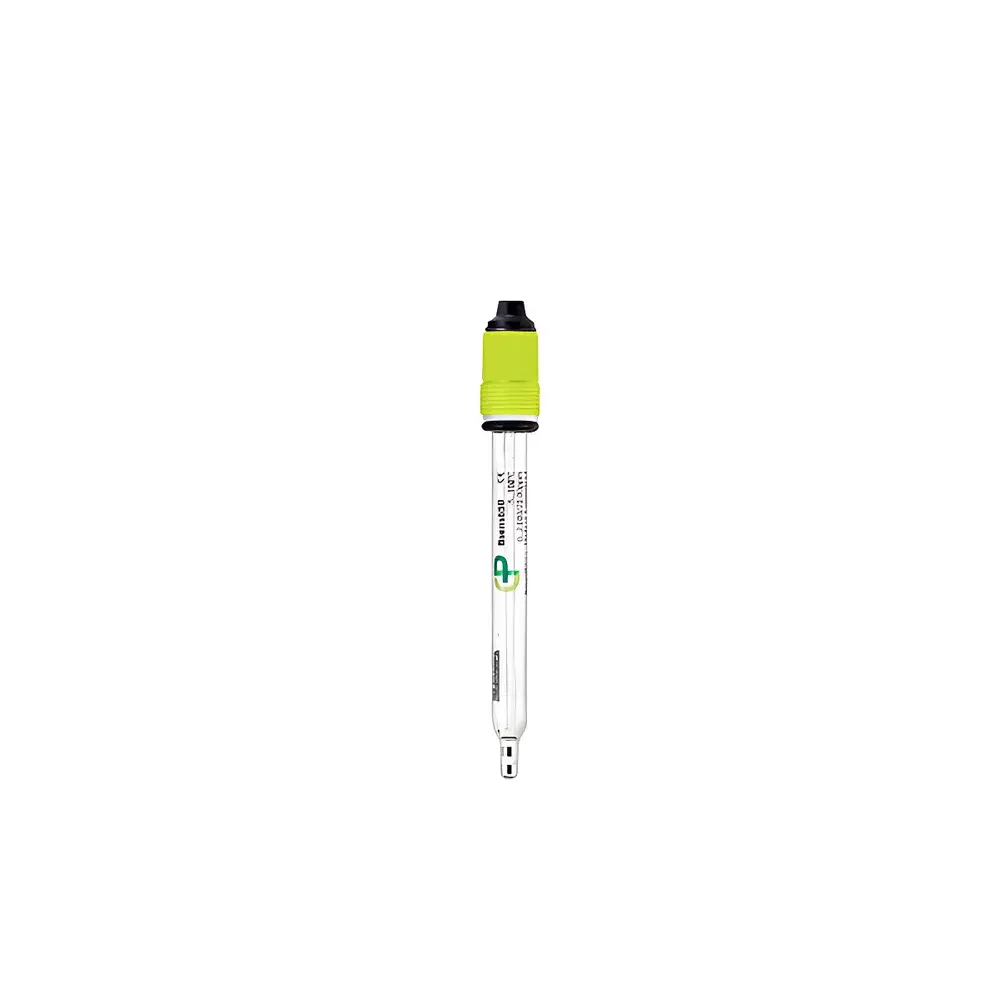
GreenPrima Bsens650 Residual Chlorine Electrode
| Brand | GreenPrima |
|---|---|
| Origin | United Kingdom |
| Manufacturer Type | Original Equipment Manufacturer (OEM) |
| Product Category | Imported Instrument |
| Model | Bsens 650 |
| Instrument Type | Online Analyzer |
| Measurement Principle | Amperometric Electrochemical Sensor (Constant Voltage Mode) |
| Measured Parameters | Free Chlorine, Ozone, Chlorine Dioxide |
| Range | 0–2.000 mg/L and 0–20.00 mg/L (dual-range auto-scaling) |
| Accuracy | ≤1% of reading |
| Repeatability | ±0.01 mg/L (low range), ±0.1 mg/L (high range) |
| Resolution | 0.01 mg/L / 0.1 mg/L |
| Limit of Detection | 0.01 mg/L |
| Electrode Body Material | Borosilicate Glass |
| Cable Length | 3 m |
| Output Signal | 4–20 mA (isolated, HART-compatible) |
| pH Compensation | Integrated automatic pH compensation (pH 4–9) |
Overview
The GreenPrima Bsens 650 is a high-stability amperometric residual chlorine electrode engineered for continuous, real-time monitoring of free chlorine in potable water, swimming pools, cooling towers, distribution networks, and disinfection process streams. Operating on the constant-voltage amperometric principle, the sensor detects electrochemical current generated by the reduction of hypochlorous acid (HOCl) at a noble metal cathode under a precisely controlled bias voltage. This method eliminates dependence on reagent addition or optical path integrity—unlike colorimetric methods—and ensures robust performance in turbid, colored, or particle-laden water matrices. The electrode’s glass-bodied construction provides chemical inertness and mechanical durability in chlorinated environments, while its integrated pH compensation circuit dynamically corrects for activity coefficient variations across pH 4–9, significantly improving measurement fidelity in variable-alkalinity systems such as municipal water treatment and recirculating pool circuits.
Key Features
- True amperometric detection with constant-voltage polarization—no reagents, no consumables, no optical interference
- Dual-range measurement capability (0–2.000 mg/L and 0–20.00 mg/L) with automatic range switching and digital resolution of 0.01 mg/L (low range) or 0.1 mg/L (high range)
- Built-in temperature-compensated pH correction using an embedded reference electrode pair, compliant with ISO 7393-2 guidance for electrochemical chlorine measurement
- 3-meter shielded coaxial cable with IP68-rated connector, rated for continuous submersion in pressurized flow cells or immersion housings
- Zero-point stability verified to <±0.005 mg/L over 72-hour unattended operation under static calibration conditions
- Low maintenance architecture: no membrane replacement, no electrolyte refilling, no periodic polishing required
- Compatible with GreenPrima PM8200CL controller (CE-marked, EMC-compliant) supporting 4–20 mA analog output with HART 7 protocol for integration into SCADA, DCS, or PLC-based water management systems
Sample Compatibility & Compliance
The Bsens 650 is validated for use in clarified and filtered drinking water, chlorinated recreational water (ASTM D511–22), secondary effluent, and low-turbidity industrial process water (NTU <5). It demonstrates minimal cross-sensitivity to common oxidants including monochloramine (<3% response), bromine (<5%), and hydrogen peroxide (<2%) when operated within specified pH and temperature windows. The electrode meets EN ISO/IEC 17025 traceability requirements for field-deployable sensors and supports GLP-compliant data logging when paired with PM8200CL units configured with audit-trail-enabled firmware (21 CFR Part 11 ready). Calibration verification follows ASTM D1253–21 procedures using NIST-traceable potassium iodide/starch titration standards.
Software & Data Management
When connected to the GreenPrima PM8200CL controller, the Bsens 650 enables time-synchronized data acquisition at user-selectable intervals (1 s to 1 h). The controller’s embedded firmware stores up to 32,000 timestamped records with metadata (temperature, pH, raw current, compensated value), exportable via USB or Modbus TCP. Calibration history—including date, standard concentration, slope (%/mg·L⁻¹), and offset (nA)—is retained with tamper-proof timestamps. Optional cloud gateway modules support MQTT-based transmission to secure enterprise platforms (e.g., AWS IoT Core or Azure IoT Hub), enabling remote diagnostics, predictive drift alerts, and automated report generation aligned with utility asset management frameworks.
Applications
- Real-time dosing control in chlorine contact tanks and clearwells per AWWA B300 guidelines
- Swimming pool and spa water quality assurance per CDC Model Aquatic Health Code (MAHC) Section 4.3.2.1
- Monitoring residual biocide levels downstream of electrolytic or chemical chlorine dioxide generators
- Validation of disinfection efficacy in pharmaceutical water-for-injection (WFI) loops under EU GMP Annex 1
- Regulatory compliance reporting for EPA Safe Drinking Water Act (SDWA) Tier 2 monitoring requirements
- Performance verification of UV/chlorine advanced oxidation processes (AOPs) in wastewater reuse applications
FAQ
Does the Bsens 650 require daily calibration?
No—field calibration is recommended every 7–14 days depending on water matrix stability; zero-point verification can be performed in deionized water, and span calibration uses certified HOCl standard solutions.
Can it measure combined chlorine (chloramines)?
No—the sensor responds selectively to free available chlorine (HOCl/OCl⁻); combined chlorine requires separate analysis via DPD colorimetry or ion chromatography.
Is the electrode compatible with ozone and chlorine dioxide without hardware modification?
Yes—identical electrochemical interface and polarization logic enable seamless parameter switching via PM8200CL firmware configuration; no physical recalibration or sensor swap is needed.
What is the expected service life under continuous operation?
Typical operational lifetime exceeds 24 months in municipal drinking water applications with average free chlorine <1.5 mg/L; accelerated aging tests per IEC 60751 show <5% sensitivity drift after 18,000 hours at 25°C.
How is temperature compensation implemented?
A built-in Pt1000 RTD measures sample temperature at the electrode tip; compensation coefficients are applied per the Nernst–Planck-derived kinetic model embedded in PM8200CL firmware, not simple linear offsetting.
Related Products







