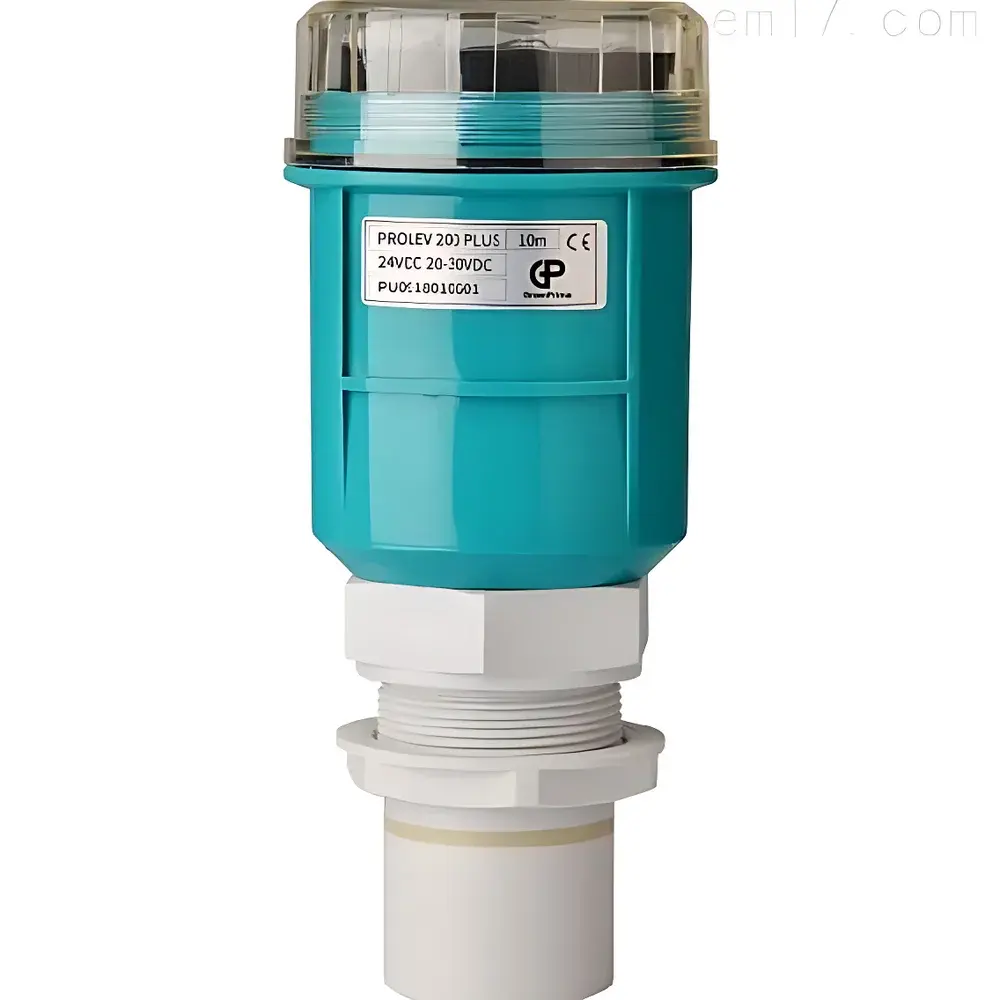
GreenPrima PROL EV200/300 Integrated Ultrasonic Level Transmitter
| Brand | GreenPrima |
|---|---|
| Origin | United Kingdom |
| Manufacturer Type | Original Equipment Manufacturer (OEM) |
| Product Category | Level Meter |
| Model | PROL EV200 / PROL EV300 |
| Measurement Principle | Non-contact ultrasonic time-of-flight (ToF) |
| Range | 6 m / 10 m (selectable per variant) |
| Blind Zone | 0.25 m / 0.5 m |
| Accuracy | ±0.2% FS |
| Resolution | 1 mm |
| Max Process Pressure | 1.5 bar |
| Operating Temperature | −30 to +70 °C |
| Housing Material | PC/PP (EV200), Aluminum/PVDF (EV300) |
| Sensor Diaphragm Material | ETFE or PVDF |
| Output Options | 2-wire 4–20 mA (max 750 Ω), 4-wire 4–20 mA + Modbus RTU + dual relay, or 2-wire HART-enabled variants |
| Power Supply | 24 VDC |
| Ingress Protection | IP67 (EV200), IP68 (EV300) |
| Explosion Protection | ATEX II 1/2G Ex ia II C T6 |
| Process Connection | G2" |
| Media Compatibility | Liquids and bulk solids |
| Display | Backlit LCD |
Overview
The GreenPrima PROL EV200/300 Integrated Ultrasonic Level Transmitter is a microprocessor-based, non-contact level measurement instrument engineered for high reliability in demanding industrial environments. Utilizing time-of-flight (ToF) ultrasonic pulse-echo technology, the device emits high-frequency acoustic waves (typically 50–70 kHz) toward the surface of the target medium and precisely measures the elapsed time between transmission and echo return. This principle enables robust distance calculation independent of medium density, conductivity, transparency, or dielectric constant—making it suitable for both conductive and non-conductive liquids (e.g., wastewater, acids, solvents, potable water) as well as free-flowing or aerated bulk solids (e.g., grains, pellets, powders). Unlike radar or guided-wave radar (GWR), ultrasonic transmitters require no waveguide and impose no process intrusion; their compact, single-piece mechanical design eliminates field wiring complexity between sensor and electronics, reducing commissioning time and long-term maintenance exposure.
Key Features
- Integrated architecture: Fully sealed, self-contained transmitter with embedded signal processing—no external controller or separate housing required.
- Adaptive signal conditioning: Real-time automatic gain control (AGC), dynamic power adjustment, and built-in temperature compensation ensure stable performance across ambient fluctuations from −30 °C to +70 °C.
- Advanced echo processing: Proprietary waveform analysis algorithms discriminate true surface echoes from false returns caused by tank obstructions, foam, vapor layers, or agitator interference—minimizing spurious readings without manual threshold tuning.
- Corrosion-resistant wetted parts: ETFE or PVDF diaphragms provide broad chemical compatibility, validated against ISO 15142-1 for prolonged exposure to aggressive media including chlorine solutions, caustic soda, and organic solvents.
- Dual enclosure options: EV200 features impact-resistant PC/PP housing (IP67); EV300 employs machined aluminum body with PVDF-coated front housing (IP68), rated for continuous submersion up to 1 m depth.
- Flexible configuration: Field-selectable range (6 m or 10 m), adjustable damping, programmable fail-safe output behavior, and user-defined linearization tables via local keypad or PC software.
Sample Compatibility & Compliance
The PROL EV200/300 is certified for use in hazardous areas under ATEX Directive 2014/34/EU (Category 1/2G, II C, T6), permitting installation in Zones 0, 1, and 2 without additional barriers in gas group IIC atmospheres. It complies with EMC Directive 2014/30/EU (EN 61326-1:2013) and Low Voltage Directive 2014/35/EU. For regulated industries, the device supports audit-ready operation: all parameter changes—including calibration constants, damping settings, and relay logic—are timestamped and logged internally with optional export via Modbus. While not intrinsically part of FDA 21 CFR Part 11, its deterministic firmware architecture, write-protected configuration memory, and traceable setup history align with GLP/GMP documentation requirements for pharmaceutical water systems and food-grade process tanks.
Software & Data Management
Configuration and diagnostics are performed using GreenPrima’s Windows-based LevelConfig Suite, which provides full access to diagnostic logs, echo curve visualization, and real-time signal amplitude monitoring. The software supports batch configuration import/export and generates PDF-formatted commissioning reports compliant with ISO/IEC 17025 documentation standards. For integration into DCS or SCADA platforms, the 4-wire EV300 model delivers simultaneous analog (4–20 mA) and digital (Modbus RTU over RS-485) outputs—enabling redundant data paths and remote firmware updates. Relay outputs support configurable high/low alarms, pump control, or overflow interlocks with adjustable hysteresis and delay timers. HART-enabled variants (EV300-H series) are compatible with standard handheld communicators and AMS Device Manager for asset health monitoring and predictive maintenance scheduling.
Applications
- Municipal and industrial wastewater treatment: Level monitoring in influent channels, equalization basins, sludge thickeners, and effluent discharge weirs—resistant to condensation, H2S corrosion, and biological fouling.
- Drinking water distribution: Reservoir, clearwell, and elevated tank level control meeting DWI and DVGW W200 guidelines for potable water integrity.
- Chemical dosing systems: Accurate inventory management of coagulants, biocides, and pH adjusters in ISO-certified storage vessels.
- Food & beverage processing: Sanitary-level monitoring in CIP tanks, syrup silos, and fermentation vessels—compatible with SIP cycles when installed with appropriate thermal standoff.
- Aggregates and mining: Bulk solid level measurement in open-top hoppers and conveyor feed bins under dusty, vibration-prone conditions.
FAQ
What is the minimum measurable distance (blind zone) for the PROL EV200 and EV300?
The blind zone is 0.25 m for standard 6 m range configurations and 0.5 m for 10 m range variants—defined as the near-field region where acoustic reverberation prevents reliable echo detection.
Can the transmitter operate reliably in vaporous or steam-laden environments?
Yes—integrated temperature compensation and adaptive gain control maintain accuracy in saturated air up to 95% RH; however, direct steam impingement on the transducer face must be avoided via proper mounting orientation or stilling well.
Is third-party calibration certification available?
GreenPrima offers UKAS-accredited calibration (ISO/IEC 17025) upon request, traceable to NPL standards, with full uncertainty budgeting and certificate of conformity.
How does the device handle foam or turbulent surfaces?
The waveform analysis engine identifies the strongest consistent echo envelope beneath foam layers; for heavy, acoustically absorbent foam, optional echo averaging or extended averaging time may be configured to improve stability.
What mounting considerations apply for optimal performance?
Mounting must avoid obstructions within the beam angle (typically ±6° divergence); vertical alignment is critical, and distance from tank walls should exceed 300 mm to prevent side-wall reflections. Use of a G2″ male thread ensures mechanical stability and pressure-tight sealing per EN 1092-1.