
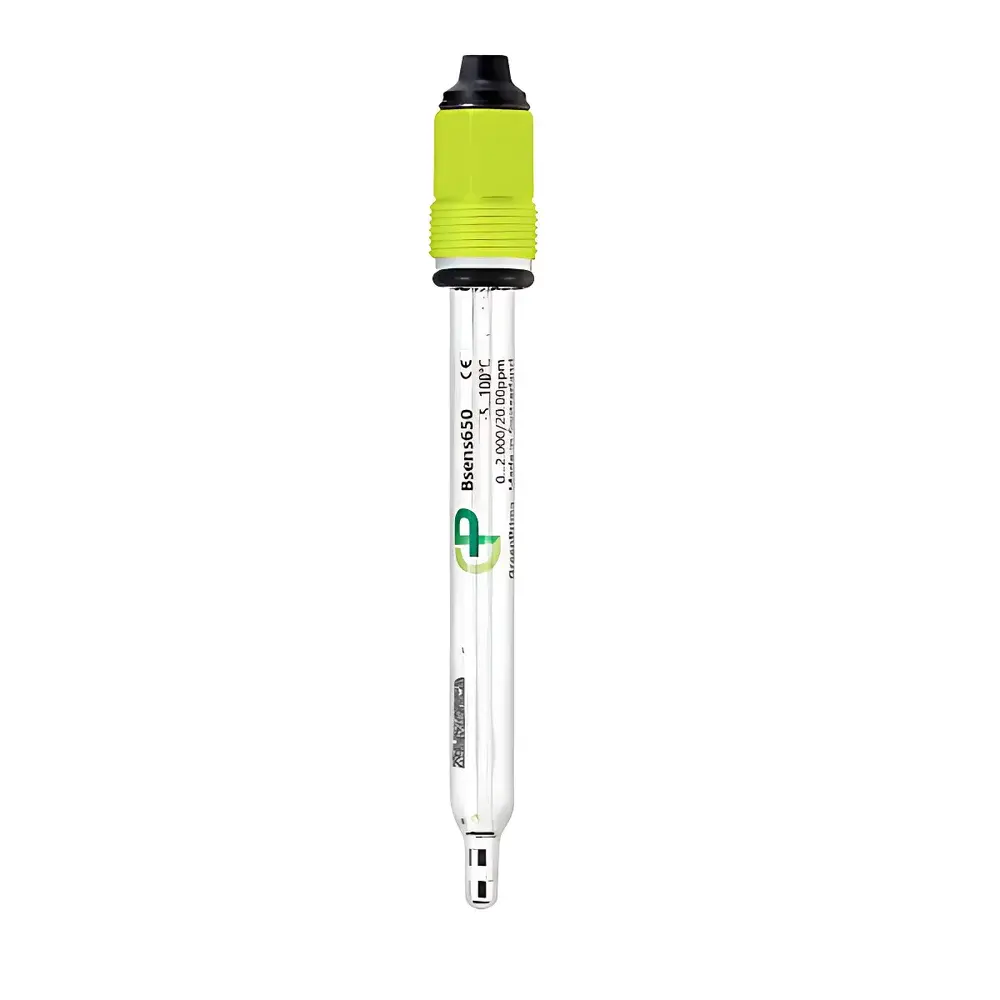
GreenPrima Bsens650 Chlorine Dioxide Electrode
| Brand | GreenPrima |
|---|---|
| Origin | Switzerland |
| Manufacturer Type | Original Equipment Manufacturer (OEM) |
| Product Category | Imported Instrument |
| Model | Bsens650 |
| Instrument Type | Online Analyzer |
| Measurement Principle | Amperometric Electrochemical Sensor (Constant Potential) |
| Measured Parameter | Chlorine Dioxide (ClO₂) |
| Range | 0–2 ppm and 0–20 ppm (switchable or dual-range configuration) |
| Accuracy | ≤ ±2% of reading |
| Repeatability | ±0.01 ppm |
| Resolution | 0.001 ppm |
| Limit of Detection (LOD) | 0.001 ppm |
| Operating Temperature | –5 to 100 °C |
| Max. Working Pressure | 6 bar |
| Electrode Body Material | Borosilicate Glass |
| Membrane | Triple-ceramic junction (3× porous ceramic frits) |
| Diameter | 12 mm |
| Length | 120 mm |
| Connection | PG13.5 threaded fitting |
| Cable Length | 3 m |
| Sensing Element | Dual platinum ring working electrode |
| Electrolyte | Polymer-based gel electrolyte |
| Reference System | Ag/AgCl internal reference |
Overview
The GreenPrima Bsens650 is a high-stability, amperometric chlorine dioxide (ClO₂) selective electrode engineered for continuous, real-time monitoring in demanding aqueous environments. Based on constant-potential (potentiostatic) electrochemical detection, the sensor operates via selective reduction of ClO₂ at a dual-platinum ring working electrode under controlled bias voltage. This principle ensures direct, reagent-free quantification without interference from free chlorine, chloramines, or oxidizing agents commonly present in treated water systems. The sensor’s glass body and triple-ceramic junction design provide mechanical robustness and long-term stability of the liquid junction potential—critical for low-drift operation in variable conductivity matrices such as cooling tower water, potable distribution networks, and hospital sterilization loops. Unlike colorimetric or spectrophotometric methods, the Bsens650 eliminates dependence on chemical reagents, sample filtration, or acidification steps, enabling true “plug-and-measure” deployment in inline or submersible configurations.
Key Features
- Reagent-free, maintenance-optimized amperometric detection with no consumables beyond routine calibration
- Triple-ceramic junction architecture ensuring stable reference potential across wide conductivity ranges (50–2000 µS/cm)
- Gel-filled Ag/AgCl reference system with integrated electrolyte matrix—eliminates leakage, drying, or refilling requirements
- Dual platinum ring electrode geometry enhancing signal-to-noise ratio and improving response time (t₉₀ < 60 s)
- Chemically inert borosilicate glass body rated for continuous exposure to hypochlorite, ozone, and acidic disinfectant residuals
- IP68-rated PG13.5 connector and 3-meter shielded cable with low-noise twisted-pair construction for EMI resilience in industrial control cabinets
- Zero-point stability maintained within ±0.005 ppm over 7-day unattended operation (per ISO 15839 verification protocol)
Sample Compatibility & Compliance
The Bsens650 is validated for use in municipal drinking water (per EN 872 and ISO 10523), industrial cooling circuits (ASTM D4691), swimming pool recirculation systems (CEN/TS 16359), and pharmaceutical process water (USP and EU GMP Annex 1). It exhibits negligible cross-sensitivity to Cl₂ (<0.3% signal contribution at 1 ppm Cl₂), NO₂⁻ (<0.1%), and H₂O₂ (<0.05%) under typical operating pH (5.5–8.5). The sensor complies with IEC 61000-6-2 (immunity) and IEC 61000-6-4 (emissions) for industrial electromagnetic environments. Its construction meets RoHS 2011/65/EU and REACH SVHC screening requirements. When integrated with a compliant transmitter (e.g., PM8200CL), full audit trails, calibration history, and user-access logs satisfy FDA 21 CFR Part 11 data integrity expectations for regulated water quality monitoring.
Software & Data Management
The Bsens650 interfaces seamlessly with GreenPrima’s PM8200CL intelligent controller, supporting Modbus RTU (RS-485) and 4–20 mA analog output with HART 7.0 capability. Firmware includes configurable auto-zero routines, temperature-compensated slope validation, and drift trending algorithms aligned with ISO/IEC 17025 method validation guidelines. All calibration events—including standard addition, multi-point verification, and zero-check intervals—are timestamped and stored locally with SHA-256 hash integrity. Exportable CSV reports include raw current (nA), compensated concentration (ppm), temperature (°C), and diagnostic flags (junction resistance, membrane impedance, reference stability index). Optional cloud integration via MQTT enables centralized dashboarding compatible with SCADA and CMMS platforms.
Applications
- Real-time ClO₂ dosing control in municipal water treatment plants and point-of-use disinfection units
- Process validation and residual monitoring in pharmaceutical clean steam generation and WFI distribution loops
- Corrosion mitigation in closed-loop cooling systems where ClO₂ replaces bromine or chlorine
- Regulatory compliance reporting for healthcare facility hot water systems (HTM 04-01, DIN 1988-200)
- Quality assurance in food & beverage processing lines using ClO₂ for surface sanitation and CIP rinse verification
- Environmental monitoring of effluent discharge points subject to local ClO₂ discharge limits (e.g., Swiss ORA Annex 5)
FAQ
Does the Bsens650 require daily recalibration?
No—under stable process conditions, calibration is recommended every 7–14 days. The gel electrolyte and triple-junction design minimize drift; built-in diagnostics alert users when slope deviation exceeds ±5% of initial calibration.
Can it be installed directly in pressurized pipelines?
Yes, provided upstream pressure does not exceed 6 bar and flow velocity remains below 2 m/s. A stainless-steel flow cell (optional accessory) is recommended for turbulent or particulate-laden streams.
Is temperature compensation automatic?
Yes—the integrated Pt1000 RTD provides real-time thermal correction per the Nernstian relationship for ClO₂ reduction kinetics, referenced to 25 °C.
What maintenance is required beyond calibration?
Annual inspection of the ceramic junction for fouling (e.g., CaSO₄ or Fe(OH)₃ deposits) using 0.1 M HCl soak; no membrane replacement or electrolyte refill is needed during the 24-month service life.
How does it perform in high-TDS wastewater?
Validated up to 15,000 µS/cm conductivity; junction potential stability is preserved via the triple-ceramic design, though periodic cleaning may extend service intervals in brackish influent applications.







