
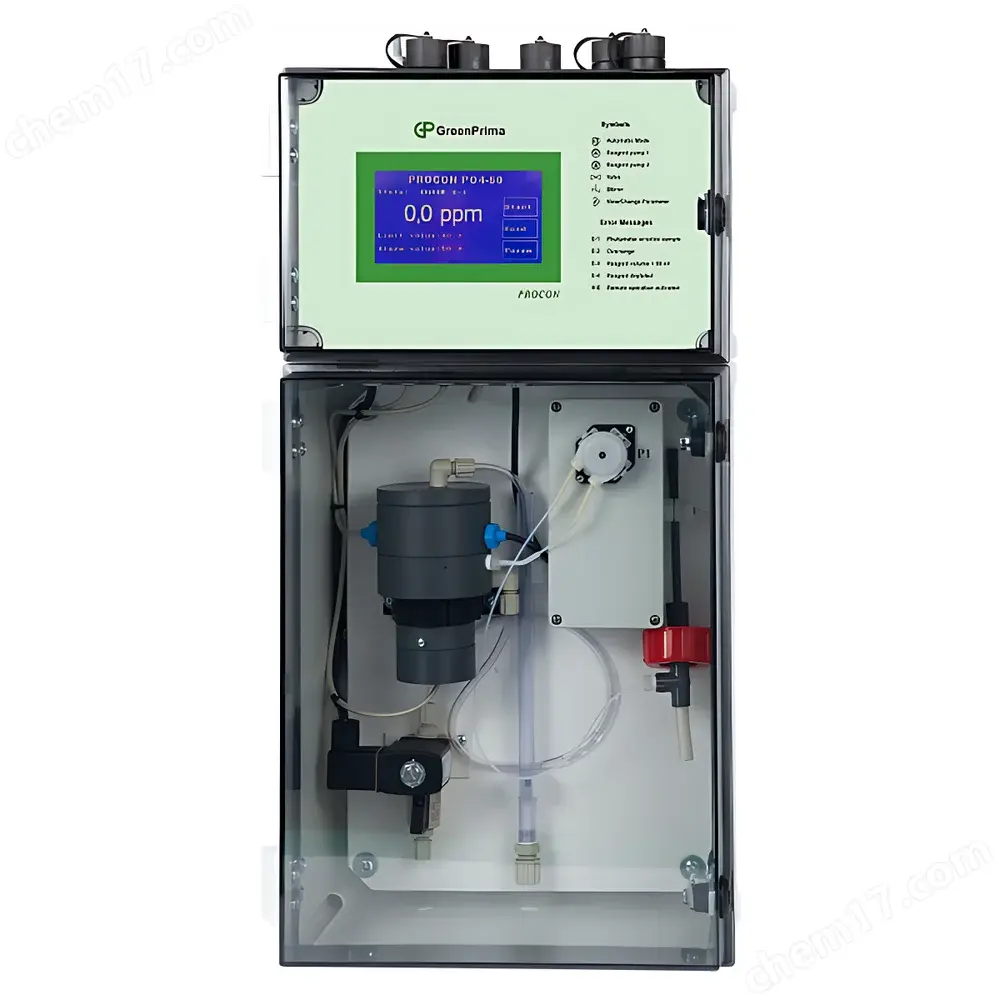
GreenPrima PROC ON 4000 Online Silicate Analyzer for Surface Water
| Brand | GreenPrima |
|---|---|
| Origin | United Kingdom |
| Manufacturer Type | Original Equipment Manufacturer (OEM) |
| Product Category | Imported Instrument |
| Model | PROC ON 4000 |
| Instrument Type | Online Analyzer |
| Measurement Principle | Photometric Detection of Reduced β-Molybdo-Silicic Acid Complex |
| Application Domain | Surface Water, Power Plant Feedwater, Condensate, Boiler Water, and High-Purity Process Water |
Overview
The GreenPrima PROC ON 4000 is a fully automated online silicate analyzer engineered for continuous, trace-level quantification of dissolved reactive silica (SiO₂) in surface water and ultrapure industrial water streams. It operates on the standardized photometric molybdate blue method: soluble silicate reacts with ammonium molybdate under acidic conditions to form heteropoly acids, which are subsequently reduced to the intensely colored β-molybdo-silicic acid complex. Absorbance at 815 nm is measured via a high-stability LED-photodiode optical system, enabling precise determination of SiO₂ concentration down to sub-ppb levels. Designed specifically for demanding environments—including thermal power generation, semiconductor wafer cleaning, pharmaceutical water-for-injection (WFI) systems, and high-purity chemical processing—the PROC ON 4000 integrates robust fluidics, embedded microprocessor control, and ISO/IEC 17025-aligned measurement traceability. Its architecture supports long-term unattended operation with minimal reagent consumption and no manual calibration drift correction required.
Key Features
- Integrated touchscreen HMI (240 × 128 pixel, resistive type) for intuitive local configuration, real-time diagnostics, and event log review
- Automated sequence control: sampling, line flushing, reagent dosing (molybdate + reducing agent), reaction timing, and photometric readout—all governed by deterministic firmware logic
- Three selectable measurement ranges: 1–100 ppb, 4–999 ppb, and 0.02–3 ppm SiO₂—each optimized for optical path length and signal-to-noise ratio
- Zero-point auto-compensation algorithm continuously corrects baseline drift using dual-reference photodiode monitoring and air-blank referencing
- Programmable analysis interval from 13 minutes (standard cycle including flush) up to 99 minutes; external trigger input enables synchronization with plant PLC or DCS
- Configurable 0/4–20 mA analog outputs (max. load 500 Ω) with user-defined scaling, alarm hysteresis, and fault reporting modes
- IP65-rated enclosure (640 × 315 × 190 mm H×W×D) with ring-terminal electrical interface for relay outputs (alarm, limit, analysis status) and remote start/stop control
- Low-power design (~16 VA typical), compatible with universal 110–230 V AC, 50/60 Hz supply; operating ambient temperature range: 5–45 °C
Sample Compatibility & Compliance
The PROC ON 4000 accepts clarified, particle-free liquid samples with conductivity < 5 µS/cm and suspended solids < 1 mg/L. It is validated for use with deionized water, condensate, boiler feedwater, and surface water pretreated by coagulation/filtration. All wetted materials—PFA tubing, ceramic flow cells, and EPDM diaphragms—are compliant with ASTM D859 (Standard Test Method for Silica in Water) and ISO 10523 (Water Quality — Determination of pH). The analyzer meets IEC 61326-1 (EMC for laboratory equipment) and carries CE marking per EU Directive 2014/30/EU. Data integrity functions—including timestamped measurement records, audit-trail-enabled parameter changes, and non-volatile memory storage—support adherence to FDA 21 CFR Part 11 requirements when integrated with compliant LIMS or SCADA platforms.
Software & Data Management
Internal firmware implements deterministic state-machine sequencing with CRC-protected memory for method parameters and calibration history. USB port (optional accessory) enables periodic export of CSV-formatted datasets containing timestamp, raw absorbance, calculated SiO₂ value, status flags (e.g., low reagent, flow fault), and diagnostic codes. No proprietary software installation is required: exported files are natively readable in Excel, LabVIEW, or Python pandas. Remote access is supported via Modbus RTU over RS-485 (optional module), permitting integration into central SCADA systems for trend visualization, alarm forwarding, and predictive maintenance scheduling. Firmware updates are performed via USB stick with SHA-256 signature verification.
Applications
- Real-time monitoring of silica breakthrough in mixed-bed ion exchange units and reverse osmosis permeate in power plant water treatment trains
- Steam purity assurance in drum-type and once-through boilers, where silica carryover causes turbine blade deposition
- Ultrapure water (UPW) quality control in semiconductor front-end fabs, meeting SEMI F63 specifications for < 100 ppt SiO₂
- Pharmaceutical purified water (PW) and WFI systems, supporting USP and EU GMP Annex 1 compliance through documented, repeatable silica trending
- Environmental surveillance of silica discharge from industrial effluents into receiving surface waters, aligned with national water quality standards (e.g., EU WFD, US EPA 305.1)
FAQ
What detection principle does the PROC ON 4000 employ?
It uses the standardized photometric molybdate blue method, measuring absorbance of the reduced β-molybdo-silicic acid complex at 815 nm.
Is manual calibration required during routine operation?
No—zero-point auto-compensation and factory-established photometric gain curves eliminate the need for field recalibration under normal operating conditions.
Can the analyzer be integrated into an existing DCS or PLC network?
Yes, via optional Modbus RTU (RS-485) interface or programmable 4–20 mA outputs with configurable engineering units and alarm thresholds.
What sample pretreatment is necessary?
Samples must be particle-free (<1 mg/L TSS) and low in organic interferents; inline filtration (0.45 µm) and degassing are recommended for high-turbidity surface water sources.
Does the instrument comply with regulatory data integrity requirements?
Its embedded audit trail, time-stamped records, and non-volatile parameter storage support alignment with FDA 21 CFR Part 11 and EU GMP Annex 11 when deployed within a validated IT infrastructure.
Related Products







